.png)
July is done and dusted, August is up and running, so let’s kick back and reflect on another eventful month for the retail technology space. Here's your briefing on the most important stories from July, including Tesco, ICE, Morrisons, Instacart, Auchan Retail, shopreme, Augmodo, Zalando, Sereact, Simbe, Wonder, Butlin's, and Boxbar Tech.
1. Tesco completes initial phase of grocery retailer's ICE store cleaning automation roll-out
ICE recently announced a partnership with Tesco, launching autonomous cleaning robots across 600 Express stores. The pair said that this was the first deployment of this scale in the UK convenience sector. The initial phase of the roll-out has now been completed.
The machines are designed as "co-bots" to work alongside Tesco colleagues. By taking over routine floor cleaning, they free up time for the store teams to focus on serving customers. The technology promises a highly consistent, premium clean every single day, backed by data tracking and reporting.
In a LinkedIn post, Tabitha Gafencu, Project Manager - Stores Transformation and Operations Development at Tesco, said: "600 stores. One vision. Countless people behind the success. We've officially completed the initial phase of our 600-store cleaning automation roll-out - the largest deployment of its kind delivered in the UK to date."
She added: "A project of this scale and complexity is never about one team alone. It has taken the commitment, collaboration, and dedication of many stakeholders across the business, store colleagues, shift leaders, store managers, ICE engineers and suppliers to turn a shared vision into reality."
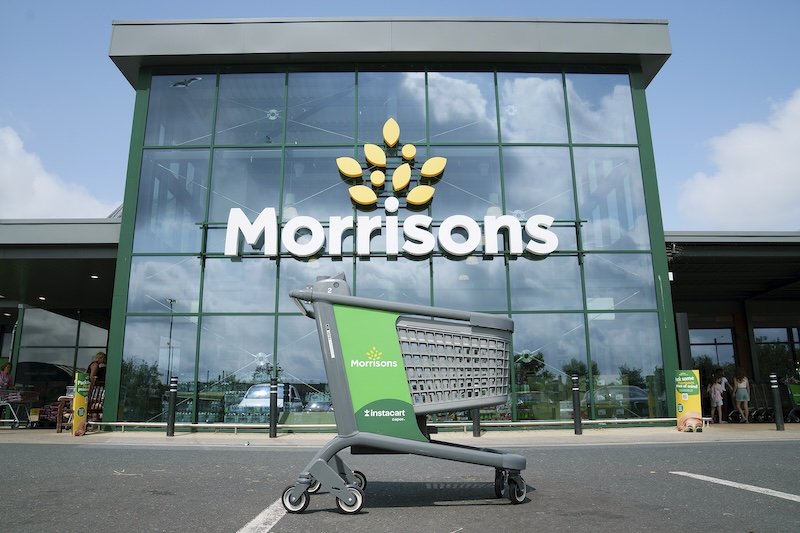
2. Morrisons notches up a first as it deploys Instacart AI powered smart trolleys in Preston store
Morrisons has launched Instacart’s Caper Cart smart trolleys at a Preston supermarket, marking North American firm Instacart’s first retail partnership in the UK for its AI powered solution. These automatically recognise items as they are placed in the trolley, including weighing fresh produce on the spot.
Customers can bag items as they shop, saving time throughout the trip and making checkout quicker and easier. The trolley's touchscreen displays a running basket total to help customers stay on budget, makes relevant product recommendations, and enables them to scan their Morrisons More Card to access loyalty savings and promotions throughout their shop. At the end of their trip, they scan the barcode displayed on the trolley's screen at a dedicated Caper checkout lane to complete payment.
"Caper smart trolleys represent a new era for in-store grocery shopping - one where the physical store is as intelligent and personalised as the best online experience," says David McIntosh, Chief Connected Stores Officer at Instacart. “Customers want technology that helps them stay on budget and discover products they love, and Caper smart trolleys deliver both, directly in the aisle. We're proud to bring this to the UK for the first time through our partnership with Morrisons, who share our belief that technology should make the weekly shop not just easier, but genuinely more enjoyable."
"Our customers are at the heart of everything we do, and we're always looking for ways to make their weekly shop easier, more rewarding, and more enjoyable, to give them more reasons to shop at Morrisons," says Gordon Macpherson, Productivity Director at Morrisons. “Caper smart trolleys do exactly that, giving customers real-time visibility of their spending, instant access to their More Card savings, and a more seamless experience in the aisle. We're proud to be the first UK retailer to bring this technology to our customers, and we look forward to seeing how shoppers in Preston and across Lancashire respond to this innovative new trolley in this in-store trial.”
Caper Carts are now live in more than 100 cities across the US and Australia with the likes of Kroger, Wakefern Food Corp., Schnucks, and Coles.
3. Tesco follows grocery rival Morrisons as it tests out Simbe's Tally in-store stock scanning robot
Tesco is trialling Simbe’s Tally in-store shelf scanning robot. This is taking place at a single store, with plans to extend the pilot to a small number of other locations.
Last year, in a UK first, Morrisons also tested out Tally. Toby Pickard, Retail Futures Senior Partner at IGD, and a member of the judging panel for the 2026 RTIH Innovation Awards, first brought this to RTIH’s attention.
In a LinkedIn post, he said: “I saw a Tally robot from Simbe in a Morrisons. This is the first time Tally has been deployed in the UK. It has only been in store for a few weeks, and there are two other stores trialling the technology. The tech should help with price accuracy and stock availability, along with other benefits. It is great to see technology being tested in UK retail that can help store associates and improve the shopping experience.”
Seamus McHugh, Head of European Market Development at Simbe, commented: “Delighted to have Tally live in the UK and to be working with the innovative team at Morrisons on this project. This is a significant milestone for Simbe as we add another country and a new retailer to our growing list of deployments.”
4. Morrisons hits 100 stores milestone as it rolls out digital shelf edge labels in Vusion partnership
Morrisons reports that it has installed its 100th store with digital shelf edge labels. In a LinkedIn post, Charlotte Rush, Senior Productivity Manager - Projects at Morrisons, said: "Reaching the 100 store milestone is a huge testament to the strength of our strategic partnership with Vusion."
"By digitising the shelf edge, we are using technology to enhance the customer journey while driving operational efficiency across our estate. We’ve eliminated thousands of manual paper updates, freeing up our store colleagues to focus on our customers. We are now utilising innovative Pick to Light functionality. By using flashing lights on the digital labels to guide our online picking teams directly to the correct items."
She concluded: "A big thank you to our in-store teams, our regional support teams, and the core project team who have supported this roll-out every step of the way, enabling us to scale to 100 stores at an incredible pace. Onward to the next 100 stores!"
5. Lidl Plus goes global with US launch as retailer's app hits 120+ million users across 32 countries
Lidl Plus is now live in all countries where the discount retailer has stores. A launch in the US on 15th July marked the final step in the loyalty and rewards app’s international expansion. There are now 120+ million users across 32 countries.
"Launching a platform at global scale across continents and time zones requires more than excellent tech and project management. It takes clear strategic alignment, seamless cross-functional collaboration, and an exceptional team committed to one shared goal," says Linus Himzmann, Global SVP and Board Member at Lidl International
"What excites me most isn’t the scale itself - it’s what it enables: faster learning, better customer experiences, and new value through AI on one shared platform."
6. Marc Lore’s startup Wonder secures $650 million Series D round at $9 billion pre-money valuation
Wonder, a Marc Lore fronted food technology platform, has announced a $650 million Series D round at a pre-money valuation of $9 billion.
The round has participation from existing investors, including Accel, GV (Google Ventures) and New Enterprise Associates (NEA). New backers include certain funds managed by AllianceBernstein, ARK Invest and funds managed by Kayne Anderson Rudnick Investment Management.
The funding will support Wonder's physical expansion, marketplace growth, and investments in technology, robotics and artificial intelligence. The company is set to go public in 2027 or 2028.
“Wonder was founded with the mission to make great food more accessible,” says Lore. “By building the technology, robotics and infrastructure behind a new kind of food platform, we’re making high quality food more affordable, more convenient and available to more people than ever before. This funding allows us to accelerate that mission.”
“It’s been exciting to watch the evolution of what Wonder is building - a fundamentally new way for people to access great food, at a level of quality and speed traditional players can’t match,” says Tony Florence, Co-CEO at NEA. “Our ongoing investment reflects our confidence in that model and in Marc’s ability to continue executing at scale.”
7. Augmodo bags $21 million in funding to take its AI powered offering beyond retail stores
Augmodo, a US-based startup that puts AI powered cameras onto retail workers to track store shelves, has secured $21 million in a funding round led by existing backer TQ Ventures, taking its valuation to $350 million. The company says that it is scaling AI assistants for the physical workforce and accelerating its roadmap into manufacturing, automotive, convenience stores, and more.
“Just as AI is changing knowledge work, Augmodo’s physical AI is changing the future of physical work,” says Ross Finman, Founder and CEO. “The core thesis: picking up a box of Cheerios for an e-commerce order and picking up a wrench on a factory floor require the exact same intelligence. Both require a computer that understands a person, a hand, an object, and the 3D space around them in real-time. We built that by capturing egocentric data, seeing the world seamlessly through the physical worker's eyes, to enhance and enable people.”
He adds: “We weren't raising, but TQ saw our traction and came to us wanting to double down. We were excited to accelerate and follow the market pull beyond our initial go to market to build out our vision of augmenting the physical workforce with physical AI tools. An enterprise's best asset is its people, and our human powered AI is built to dramatically enhance the workforce rather than replace it.”
“Building an AI assistant that works seamlessly in dynamic, messy, real-world environments is incredibly challenging. But that's where the highest value lies. This capital gives us the runway to aggressively expand our global enterprise footprint, invest deeply in our core AI models, and scale our engineering team.”
8. Zalando invests in Berlin-based warehouse robotics provider Sereact as part of Series B round
Berlin-based Sereact, a provider of physical AI for warehouse robotics, has added Zalando as an investor in its ongoing Series B, which now stands at $116 million. It lines up alongside lead investor Headline as well as Bullhound Capital, Daphni, Felix Capital, Air Street Capital, Creandum and Point Nine.
The startup has now raised over $145 million to date.
Over 200 Sereact systems are currently in use across Europe, including at Mercedes Trucks and BOL. The capital will go toward Cortex 2.0, the next-generation of Sereact's robot brain, as well as international expansion, particularly into the US.
Cortex acts as a universal AI operating system that can run across multiple hardware forms - from single arm picking cells and dual-arm returns stations to humanoid robots.
According to a press release, the upcoming Cortex 2.0 model “shifts robotic automation from a "try and see" to a "plan and try" approach by using a learned world model to anticipate physical outcomes, score potential trajectories for risk and efficiency, and plan movements before the robot even acts”.
9. Butlin's notches up a hospitality first as it deploys Boxbar automated self-serve bar technology
Butlin's has completed the roll-out of 119 automated self-serve bar terminals across its three UK resorts, becoming the world’s first holiday resort operator to introduce the Boxbar machines. This is pitched as the largest deployment of its kind anywhere in the world.
The installation spans entertainment venues at Bognor Regis, Minehead and Skegness. The aim is to increase bar service capacity all year round, maximise sales during peak trading periods, reduce queues and improve the guest experience. The 119-unit deployment spans Boxbar's full machine portfolio including Boxbar Mobile (2-Bank & 3-Bank), Container and fixed TapWall installations. By combining permanent and mobile formats, Butlin's says it can service a wide variety of indoor and outdoor venues whilst retaining the flexibility to support special events and changing guest demand.
The units can pour two drinks in as little as six seconds and serve a broad drinks menu, with 20 different products on offer across the Butlin’s portfolio. Across the three resorts, the deployment has the capability to dispense hundreds of drinks every minute. The technology has been integrated into Butlin's existing guest experience, including support for the resort's popular All Inclusive Drinks package.
10. Auchan Retail teams with shopreme for launch of AutoScan self-scanning feature in Club Alcampo app
Working with shopreme, Auchan Retail has launched AutoScan, a new service available in its Club Alcampo app that allows people to scan products with their mobile phone whilst moving around a store and then speeds up the checkout experience.
The service has begun to be implemented in around 40 Alcampo stores in the Community of Madrid, Catalonia and Castilla-La Mancha, and will be extended to the entire Spain network before the end of 2026.
To start, shoppers access AutoScan from the app when they arrive at the store and activate it using the available signage or geolocation. Then, it's time to scan each product before putting it in the basket or cart. At the end, they click on the payment option to generate a QR code and transfer the purchase to the checkouts enabled for this service. Team members are on hand to help if any issues arise.

Comments (0)
No comments yet.