.png)
Retailers have spent years adding new digital tools for payments, e-commerce, customer service and inventory management. AI agents could introduce a different kind of technology: software that does not only provide information, but can also follow workflows and complete defined tasks.
Platforms such as Agensi.io add another layer to this development by offering SKILL.md skills that give compatible AI agents specialised instructions. That raises an interesting question for retailers: could these agents eventually function more like digital employees than conventional software?
In short
AI agents can support retail teams with repeatable digital work such as organising product information, preparing customer responses, researching competitors and reviewing content. Skills make these agents more specialised because they define how a particular task should be approached. The most realistic model is therefore not an autonomous AI employee that runs a department, but several agents that each perform a clearly defined role under human supervision.
AI agents are moving beyond the chatbot
Generative AI first entered many workplaces through chat interfaces. A retailer could ask for a product description, analyse some information or draft a customer email. The AI produced an answer, but the employee remained responsible for providing instructions and moving the work through every subsequent stage.

An agent can take on a broader workflow. It can receive a goal, break that goal into steps and use available tools or information to work towards a result. This distinction matters in retail because many digital activities consist of recurring processes rather than isolated questions.
What turns a general AI agent into a retail specialist?
A general AI model might understand what merchandising or customer service means, but that does not automatically make it suitable for a retailer's specific workflow. It does not inherently know which checks should happen before a product goes live, how a customer complaint should be escalated or which information should be included in a particular analysis.
SKILL.md provides a way to encode such instructions. A skill is essentially a structured instruction file that teaches a compatible agent how to perform a particular task. Unlike a temporary prompt, the skill can remain available for repeated use. This allows the underlying AI to stay general while its working method becomes much more specific.
Skills can become job descriptions for AI agents
The comparison with employees becomes useful here. A new employee might bring general knowledge to a role, but still needs procedures, responsibilities and standards before performing company-specific work. Skills can play a similar role for agents.
A code review skill, for example, can specify what an agent should check and how findings should be reported. The same principle can extend beyond development. Skills can encode workflows for research, documentation, content planning or other repeatable knowledge tasks. Multiple skills can also be combined, giving one agent different procedures depending on the work it receives.
Three retail roles an AI agent could support
Retail offers plenty of opportunities to apply this model because digital commerce produces large amounts of repetitive information work. Three examples show how the same general AI could perform very different roles once its instructions change.
A merchandising agent
A merchandising agent could collect product performance information, organise findings and flag products that deserve attention. A dedicated skill could determine which information needs to be considered and how the results should be structured. The merchandiser can then concentrate on decisions about positioning, promotions and assortment rather than assembling the initial analysis.
A customer service agent
A service agent could classify incoming questions, retrieve relevant information and prepare responses for common situations. Its skill could define the required checks and indicate when a case must be escalated. Employees would still handle sensitive complaints and unusual circumstances, while the agent deals with more predictable preparation work.
A product data agent
Large catalogues create repetitive tasks around categories, descriptions and missing product attributes. A product data agent could inspect this information according to predefined rules and flag inconsistencies before publication. Human approval can remain part of the process while the agent handles much of the initial checking.
Which retail tasks suit AI agents?
The strongest candidates usually have a repeatable process and a result that employees can verify. The distinction becomes clearer when tasks are separated from the decisions surrounding them.
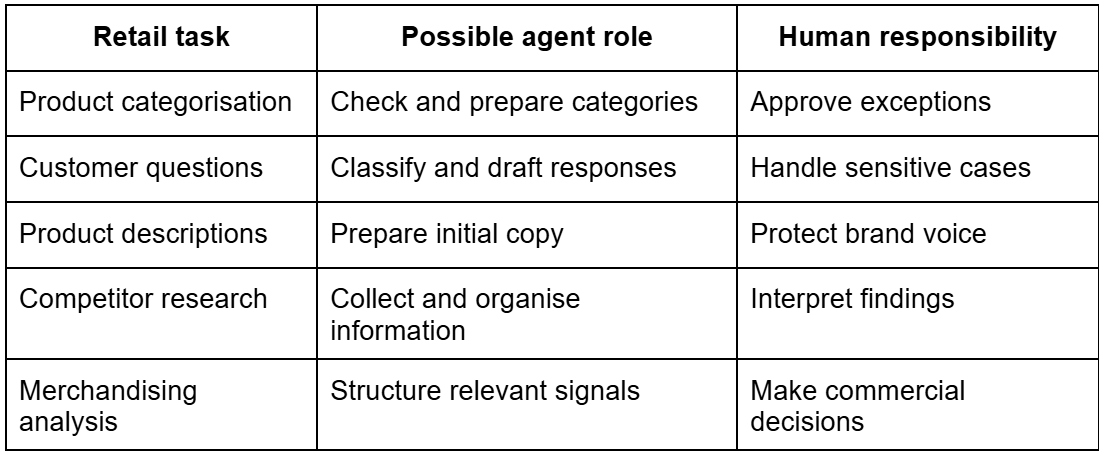
This division prevents the discussion from becoming a simple choice between humans and AI. A retailer can automate part of a workflow without handing over the entire responsibility.
Repeatable skills could matter more than clever prompts
Prompts work well for individual tasks, but they become less practical when employees repeatedly need to explain the same process. A skill can preserve those instructions and make them available when a relevant request appears.
This also creates consistency between users. A team could share the same skill instead of every employee developing a different collection of prompts. Agensi's material describes project-level skills as a way to encode shared standards and workflows so that agents can apply them across a team. That principle could become increasingly relevant as businesses move from individual AI experimentation towards repeatable agent workflows.
More autonomy requires tighter permissions
A product description agent and a pricing agent should not necessarily have the same access. The first may only need product information, while the second could potentially interact with commercially sensitive data or systems where a mistake has immediate consequences.
Retailers therefore need to define permissions alongside skills. A skill explains how a job should be performed, but access determines what the agent is actually able to do. Human approval can remain mandatory for actions involving payments, customer data, pricing or other decisions with larger consequences.
Could AI agents replace retail employees?
AI agents are more likely to automate parts of retail jobs than complete roles. Retail work involves judgement, negotiation, physical activity, customer relationships and responses to circumstances that do not fit neatly into predefined procedures. Agents are better suited to work where the process can be described and the output can be checked.
The term "digital employee" therefore works best as a functional comparison. An agent can have a role, instructions and boundaries, but responsibility still sits with the people operating the business.
Retail teams could become mixed teams
The next stage may involve several specialised agents rather than one AI assistant attempting every task. A retailer could have one agent supporting merchandising, another checking product data and another preparing customer service work. Each could use different skills and permissions while operating around the same business systems.
That structure resembles a small digital team. The difference is that retailers can introduce it workflow by workflow. They do not need to automate an entire department before discovering whether the approach works.
Skills could become a new layer in retail technology
Retail technology has traditionally focused on systems that store information, process transactions or help employees analyse what is happening. AI agents introduce the possibility that software can also perform parts of the work that follow from that information.
Skills could make that development more practical by giving agents repeatable procedures instead of relying on fresh instructions every time. The retailer still has to decide which processes deserve automation, what information an agent can access and where employees must intervene. If those boundaries are clear, the digital employee may arrive quietly: not as a replacement behind the counter, but as a specialised agent taking care of clearly defined work.


Comments (0)
No comments yet.