Five key retail technology trends in 2026, including AI, ESELs, and QR codes
Retail Express, a provider of merchandising solutions and services for retail, shares insights into some of the principal influences that will guide decision making in the year ahead.
From the rise in electronic shelf edge labelling and the demise of the barcode to AI finding its equilibrium, technology’s influence on defining retail success will become deeply entrenched.
1. Electronic shelf-edge labels go mainstream
While 2025 saw great growth for electronic shelf edge labels (ESELs), 2026 will see them hitting the mainstream as major retailers transition from ongoing trials to full-scale deployment. In many ways, although the acceleration of ESEL adoption drives administrative efficiency in-store, the key role of e-labels will be to enable widespread strategic price management.
Dynamic pricing brings many new opportunities for revenue optimisation to the table and opens the door to automated data driven pricing strategies that strengthen margin control and customer experience alike. Most importantly, ESELs remove the lag time between decision and execution, adding immediacy to an increasingly algorithmic retail structure.
2. In-store digital media drives revenue
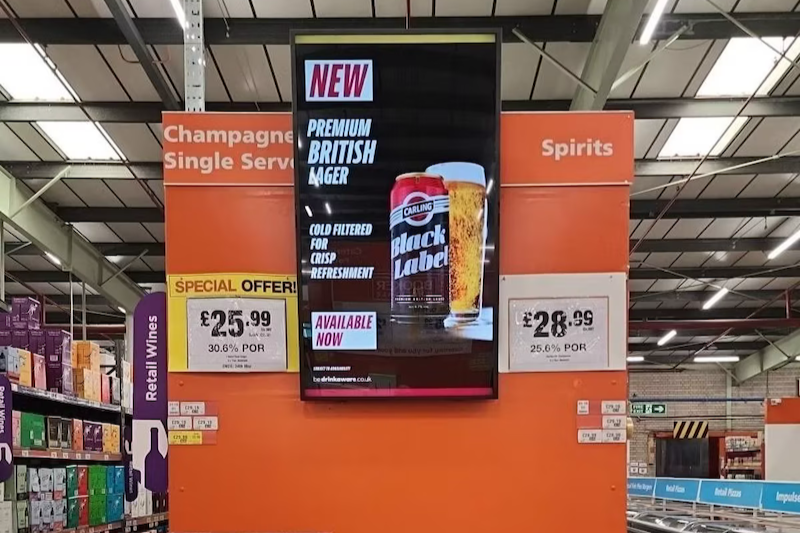
The roll-out of digital media screens continues apace across the UK grocery landscape, with Morrisons announcing new installations of digital advertising screens in 300 UK stores. Today’s speed suggests that 2026 will be a tipping point for the technology, and as retailers continue to invest, there is now a race to commercialise these advertising slots effectively.
For brands, this means increasing competition for targeted, contextual placements in prime stores and aisles; for retailers, it means a drive to tie data together with the kind of operational workflow which can help them maximise customer engagement and advertising funds.

3. The beginning of the end for the barcode
The barcode has played a critical role in retail for more than 50 years, but its familiar form is approaching a radical dimensional shift. Major entities like Walmart, Amazon and PepsiCo have begun pilots of more advanced QR code-based systems, able to hold vastly richer product information.
Consumers gain instant access to detailed nutritional, ethical and usage content. Retailers, through the same code, can access extra data which will enable deeper supply chain management, allowing statistics like provenance, freshness and vintage to be tracked and updated in real-time.
Together with ESELs, QR codes could introduce far more granular retailing options, but the increased complexity suggests the transition will take time. We can expect the growth of trials in 2026, but even retail giants are not anticipating full adoption before 2027.
4. Membership hyper personalisation comes of age
Simple loyalty schemes and their broad member only pricing will continue long into the future, but the data driven design of loyalty initiatives is set to inform a far narrower customer retention methodology in the coming year.
Inspired by models like Waitrose’s ‘Little Treats’ scheme, which offers targeted gifts to customers depending on their level of spend, a new breed of hyper personalised offers will take the stage through many more retailers.
Customers will be won through how much their favourite retailer knows about them, and the uniqueness and relevance of those gifts, whether hyper-useful or just the kind of thing that puts a smile on their faces.
5. AI reaches equilibrium
As LLMs take their place as part of day to day life, and as AI services start to become the expectation rather than the exception, so the influence of predictive AI, machine learning, and data science will begin to play a more crucial role in our working lives. From forecasting to service personalisation to automated decision making, AI will increasingly shape the way retailers work.
For instance, Retail Express’ Promotion Optimisation & Automation functionality can analyse vast datasets and use its findings to inform optimal pricing, promotional mechanics, and timing. AI is about working smarter, and 2026 marks the point at which using it for quick data driven decision-making becomes standard practice across retail.
RTIH AI in Retail Awards
RTIH proudly presents the first edition of its AI in Retail Awards, sponsored by VenHub Global, 3D Cloud and EdTech Innovation Hub.
As we witness a digital transformation revolution across all channels, AI tools are reshaping the omnichannel game, from personalising customer experiences to optimising inventory, uncovering insights into consumer behaviour, and enhancing the human element of retailers' businesses.
With 2025 set to be the year when AI and especially gen AI shake off the ‘heavily hyped’ tag and become embedded in retail business processes, our newly launched awards celebrate global technology innovation in a fast moving omnichannel world and the resulting benefits for retailers, shoppers and employees.
Our 2025 winners will be those companies who not only recognise the potential of AI, but also make it usable in everyday work - resulting in more efficiency and innovation in all areas.
Winners will be announced at an evening event at The Barbican in Central London on Thursday, 29th January. This will kick off with a drinks reception in the stunning Conservatory, followed by a three course meal, and awards ceremony in the Garden Room.