
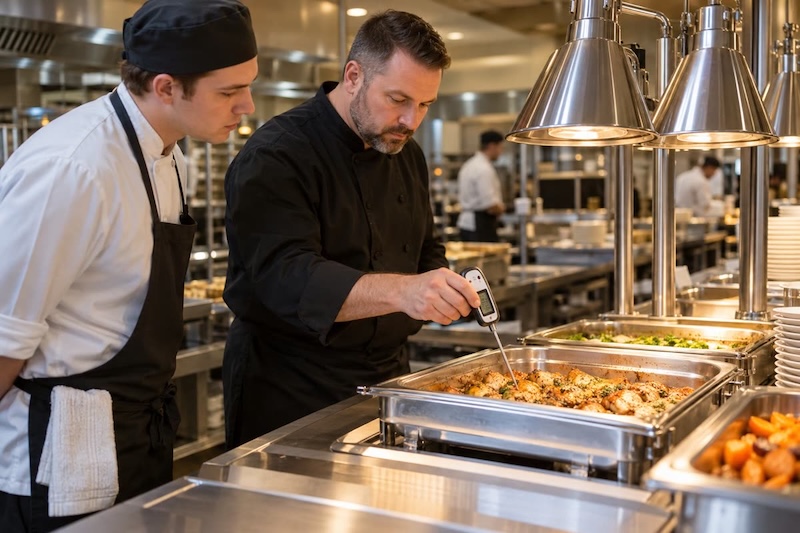
Food is now part of a lot of shops that never used to sell it. In-store cafes, bakery counters, hot food to go, tasting stations and sampling promotions all mean more retail staff handling open food, often alongside their usual job on the shop floor.
I'm Director of Event & Food Safety. We've worked on the food safety side of UK shows and events since 2007, and a big part of that is making sure the people handling food have been trained. The same question comes up in retail all the time: how do you get staff trained when they work shifts, start at short notice and can't all be taken off the floor for a day?
What the law expects
UK food law asks food businesses to make sure anyone handling food is supervised and instructed or trained in food hygiene to a level that matches their work. It doesn't name a specific certificate, but in practice a Level 2 food hygiene certificate is the usual standard for staff who handle food, and Level 3 for supervisors and managers who are responsible for food safety in a store.
If an environmental health officer visits, one of the first things they'll ask is how staff were trained and whether you can show it. A certificate for each person is the simplest answer.
Why online training fits retail
Classroom courses mean booking a date, covering shifts and losing a day of staff time for each person. In a store with a changing rota and seasonal staff, that rarely works.
Online training gets round most of it. Staff can work through short video lessons on a phone or tablet between shifts, stop and pick up where they left off, and take the assessment when they're ready. Certificates are issued as soon as someone passes, so a new starter can be trained in their first week rather than waiting for the next course date. For a manager, buying seats for a whole team and sending each person their own login takes a few minutes.
At Event & Food Safety we run online Level 2 and Level 3 food hygiene courses built this way. Level 2 takes about three hours and Level 3 about six to seven, both endorsed by the Institute of Hospitality and designed by a Chartered Environmental Health Officer.

What good training actually covers
Whatever course you choose, check it covers the things that cause most problems in a retail setting:
Temperatures.Chilling, cooking, reheating and hot-holding, and checking them properly with a probe rather than guessing.
Allergens.Giving accurate allergen information is one of the most common failings, especially on sampling stands and counters where products change often.
Hand washing.Cross-contamination is easy where staff move between the till, the shop floor and the food counter, so hand washing has to be routine.
Records.Knowing what to write down and why, so the store can show what it does if anything is ever questioned.
Training is only the start, but it's the part a store can get sorted quickly. Getting it done before the next busy season is a lot easier than explaining afterwards why it wasn't.

About the author
Tom Watts is Director of Event & Food Safety, which advises on food safety at UK shows and events and runs online Level 2 and Level 3 food hygiene courses.



Comments (0)
No comments yet.