Zoho enters the ERP race - what it could mean for retailers weighing their next systems move
Zoho announced at its Zoholics USA 2026 conference that it's building out an ERP product, one being positioned as a direct challenger to the likes of SAP, Oracle, and NetSuite.
Reports around the announcement point to a staged roll-out, with India named as the first market to get access, starting in January 2026, and other regions expected to follow once early feedback comes in. For a company that built its reputation on affordable, modular business software, stepping into ERP territory is a statement. It says Zoho no longer wants to be the tool that plugs the gaps between other people's platforms. It wants to be the platform.

That announcement lands differently depending on who's reading it. A manufacturing company already running a legacy ERP probably shrugs. A retailer, especially one juggling five or six disconnected tools just to keep the lights on, reads it very differently.
The stack most retailers already know too well
Picture a mid-sized retail operation right now. Shopify handles the storefront. A separate warehouse management system tracks what's actually sitting on the shelves. Accounting lives in QuickBooks or something similar, updated manually because nothing talks to anything else automatically. A CRM sits off to the side, mostly ignored because nobody has time to keep it synced. Multiply that across three or four store locations, and reconciling inventory counts becomes a monthly ritual involving spreadsheets, group chats, and someone quietly redoing last month's numbers at 11pm.
Suddenly the ERP announcement feels much less abstract.
What's actually being promised, stripped of the marketing language
Three modules matter most if you're running a retail business:
Warehouse management that's supposed to reflect real stock levels without a nightly batch sync doing the heavy lifting.
Sales and order management built to handle multiple channels feeding into one order pipeline, rather than treating online and in-store as separate universes.
A direct line between inventory visibility and financial reporting, so a stockout or a slow moving SKU (the product code that tracks a specific item in inventory) shows up in the numbers without someone manually pulling reports from two different systems and stitching them together in Excel.
None of that is revolutionary on its own. What makes it worth a second look is who's promising it. Zoho already owns a meaningful chunk of the small-to-midsize retail world through Zoho Inventory, Zoho Books, and Zoho CRM, and an ERP that genuinely ties those pieces together instead of leaving them as separately-branded modules with awkward handoffs is a different proposition than a brand-new vendor making the same promise from scratch.
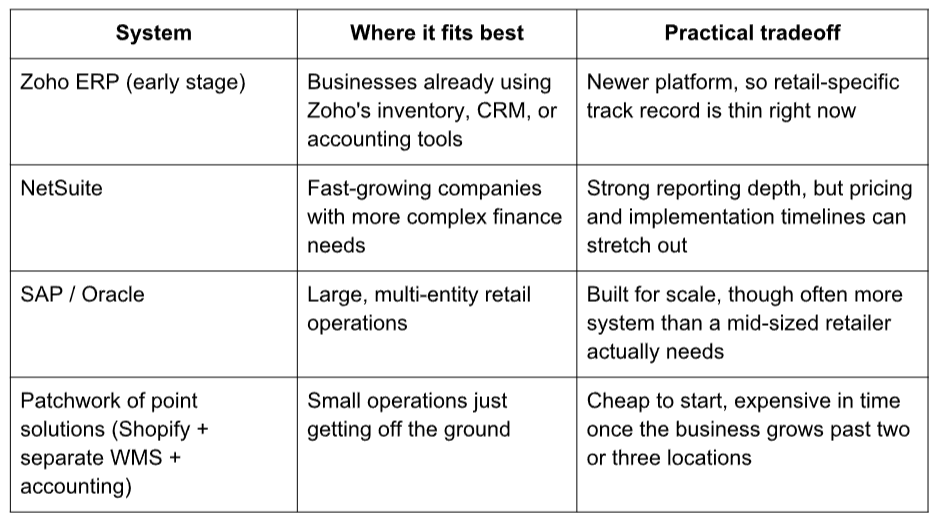
How it stacks up against what's already out there
This isn't urgent for every retailer
Not every retailer needs to care about this yet. The ones who should probably fall into a few groups: multi-location retail businesses tired of reconciling inventory across stores by hand, growing direct-to-consumer brands that outgrew Shopify's native inventory tools months ago, and distributors expanding into retail who need warehouse and sales data talking to each other from day one. If a retailer is comfortable with their current stack and it isn't causing daily friction, there's little reason to jump early on a product that's still finding its footing.
Retail data doesn't migrate cleanly
The technology story is one thing. The migration story is another, and it's the part that tends to get glossed over in launch announcements.
Retail data is messier than most industries want to admit. SKU histories accumulate years of inconsistent naming. Inventory records carry adjustments nobody documented properly. POS (point-of-sale, meaning the checkout system that logs each in-store sale) integrations were often built by whoever was around at the time, patched together rather than designed. Moving all of that into a new ERP without losing accuracy, or without a few weeks of mismatched stock counts, is not a small task.
Nobody plans for a bad migration. It just happens gradually, one mismatched field at a time.
For retailers already considering Zoho ERP, it's often worth speaking with an experienced Zoho consulting partner before planning the migration. Teams that have worked through SKU mapping, POS integrations, and historical inventory data before are more likely to spot issues early, when they're still relatively easy to fix. That can make a noticeable difference once the system goes live and day-to-day operations depend on accurate inventory and sales data.
The announcement is only the beginning
Zoho stepping into ERP doesn't automatically change anything for retailers today. What it does is put a new option on the table, one worth a second look if the current setup already feels like it's held together with tape. Whether that option turns into a serious contender or just another module retailers half-adopt will depend less on the announcement itself and more on how it holds up once actual inventory, actual customers, and actual busy Saturdays start running through it.