
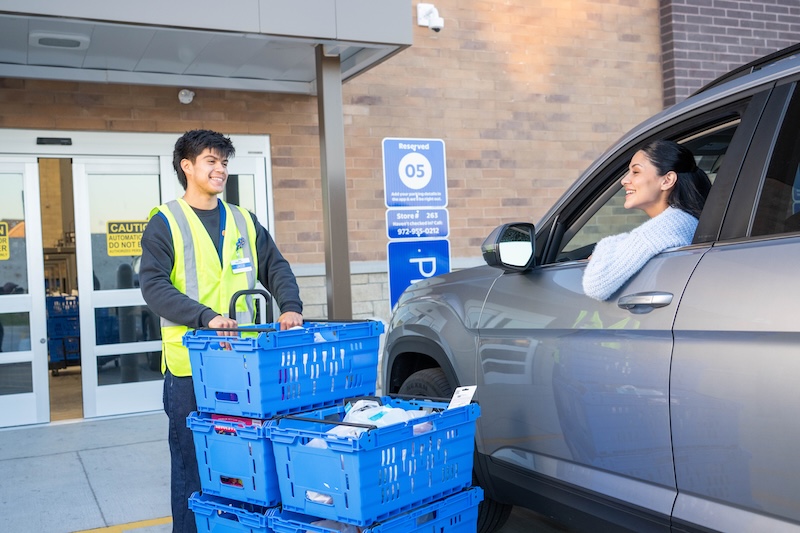
Most curbside pickup systems prioritise speed. Retailers track promise times, picking accuracy and the minutes between arrival and handover. Those measures matter, but they miss a basic fact. The pickup area is a shared space where cars, customers and employees pushing trolleys move at the same time.
The connected systems that coordinate orders can also coordinate safety. This article separates what retailers deploy today from what they could adopt. It also explains why software works best alongside physical controls.
What connected curbside pickup looks like today
Walmart offers a useful reference point because it publishes its process. Walmart Canada's help centre sets out the curbside pickup steps. The customer receives a ready notification. They then select "I'm on my way" in the app, an email or a text link. On arrival, they park in a marked bay, select "I've parked" and enter the bay number and vehicle colour. An associate then brings the order out. The page also lists a phone alternative, using the number on the parking sign.
Walmart Canada's mobile check-in guidance says the app uses device location to estimate arrival. It adds that location use stops once the customer reaches the store. Walmart's US materials describe a similar check-in and bay process. Walmart Commerce Technologies also markets Store Assist, an app for store pickup and curbside fulfilment. Its published material says check-in alerts staff to arrivals, prompts them to serve the earliest first and shows pickup location details.
These sources describe order coordination. They do not describe sensors, cameras or analytics built for safety, and this article does not suggest that Walmart uses them. Every safety technology discussed below is a proposed application, not any retailer's deployment.
Where physical risks arise
Digital check-in changes how a car park behaves. Arrivals cluster around ready notifications and popular time slots. Drivers circle for open bays, reverse into spaces and glance at phones to enter a bay number. Employees cross traffic lanes with loaded trolleys, and customers step out to open boots. These are plausible operational hazards, not findings about any retailer.
Car parks form part of a retailer's premises, so injuries there usually raise premises liability questions. The standard of care varies by jurisdiction. The legal considerations surrounding Walmart injury claims illustrate why incident documentation, property maintenance and customer safety procedures matter for large retailers. Its coverage includes the steps that follow an incident. For operators, the practical lesson is simple. The records that run a pickup operation can also show what happened when something goes wrong.
Technology that could reduce physical risk
Arrival forecasts, staffing and bay availability
Check-in data already tells a store when customers are coming. Retailers could combine it with booked slots, arrival estimates from device location and historical patterns to forecast peaks by the quarter hour. Planners could then match staffing to demand, open extra bays or limit bookings in crowded windows. Fewer queuing vehicles means fewer drivers manoeuvring in tight spaces. A forecast helps only if someone owns the response.
Sensors, computer vision and digital signage
Bay occupancy sensors could confirm which bays are free, and digital signs could direct drivers to them. Cameras with video analytics could flag queues beyond a set length, vehicles stopping in traffic lanes or pedestrians in vehicle routes. Signs could warn drivers when employees are crossing.
Capability is not the same as demonstrated safety benefit. Detection accuracy depends on lighting, weather, camera position and calibration. Frequent false alerts can teach employees to ignore the system. Retailers should test detection in their own conditions and decide in advance who responds to each alert.
Employee communication and automated notifications
Order systems already tell staff which customer has arrived and where they parked. Retailers could extend that with alerts that show the safest route to a bay. Alerts could also warn when a vehicle is reversing nearby or hold a delivery run until a lane clears. Automated messages could ask customers to stay in their vehicles until handover where the site layout calls for it. Prompts must stay short, because employees carrying orders cannot read long messages.
Why technology must complement physical measures
Software cannot compensate for a poor layout. Lighting, pedestrian routes, signage, surface condition and line marking set the baseline, and connected tools build on it. A digital sign does little in a dark corner of the car park. A sensor can flag a pedestrian, but it cannot stop a car when no separated route exists. Maintenance belongs on the list too. Potholes, worn markings and failed lights undermine any connected system.
Regulators set physical expectations for these spaces. In Great Britain, the Health and Safety Executive publishes guidance for retailers on workplace transport. It says vehicles and pedestrians that share a route need enough separation. It treats speed limits as an important part of traffic control and says to avoid reversing where possible. It also says employers must keep others affected by their work safe, which includes members of the public. Duties differ in other jurisdictions, so retailers should check local requirements.
Using incident data to improve the system
Connected pickup generates records that most car parks never had. Check-in times, bay assignments, handover timestamps, camera clips and employee reports can reconstruct an incident quickly. They can also reveal patterns. Repeated near misses at one bay beside the store entrance, for example, point to a layout problem worth fixing. Retailers can compare near misses by bay, time of day and weather to see which conditions matter. Timestamped records also let a retailer answer questions from insurers, regulators and customers with facts instead of recollection.
Retailers should record near misses as well as injuries, because near misses expose risk before anyone gets hurt. Retention schedules matter too. Automatic overwriting can erase footage before anyone reviews it. Incident procedures should say how long to keep relevant material and who can authorise a hold.

Comments (0)
No comments yet.