How performance marketing is reshaping digital advertising
Digital advertising used to be easier to explain. A brand bought some media, put out messages to an audience, and expected that this would lead to more business. Some campaigns focused on raising awareness, while others concentrated on making sales. These two areas often remained separate, or at least made it seem that way. Performance marketing has brought these two areas closer together, even if they don't seem to be the same thing anymore.
Now, more advertisers want campaigns that can be assessed, tuned, and tied to actual actions. It's just a click, but it's never enough. A view is never enough, especially when it comes to real budgets in 2026. Companies want registrations, purchases, reliable sales leads, app downloads, subscriptions, deposits, repeat orders, and revenue. This demand is quietly changing how digital ads are made, how money is spent, and how agencies, platforms, partners, and brands show their impact.
Photo credit: Unsplash.
Why Performance Marketing Is Growing
The simple reason is pressure. Marketing budgets are watched closely, and companies want clearer proof that their advertising spend is helping them to grow. According to Gartner's 2026 CMO Spend Survey, awareness and conversion now make up 62.6% of total media spend. This is because marketing leaders are allocating budgets to acquisition and digital channels in search of growth.
That detail is important. It shows that marketers are not only thinking about making their brand visible or making sales. They are trying to connect both ends of the sales funnel. Being aware of something is still important, but people now expect to see real results.
Performance marketing is a good fit for this because it lets advertisers compare different channels, creative assets, landing pages, traffic sources and audience groups more directly. It doesn't make things clearer. Marketing is never that simple. But it gives teams a better way to ask: what made the customer more likely to take action?
From Impressions to Outcomes
Traditional digital advertising usually focused on getting the ad seen by as many people as possible, how often it was seen, how many people clicked on it, and so on. These measures still matter, but they don't have as much impact. A campaign can attract a lot of people and still not be useful. It can even deliver low-cost clicks that vanish within seconds, like nothing happened.
Performance marketing makes the question the opposite. Instead of just wondering how many people saw an ad, advertisers look at what happened after that first encounter.
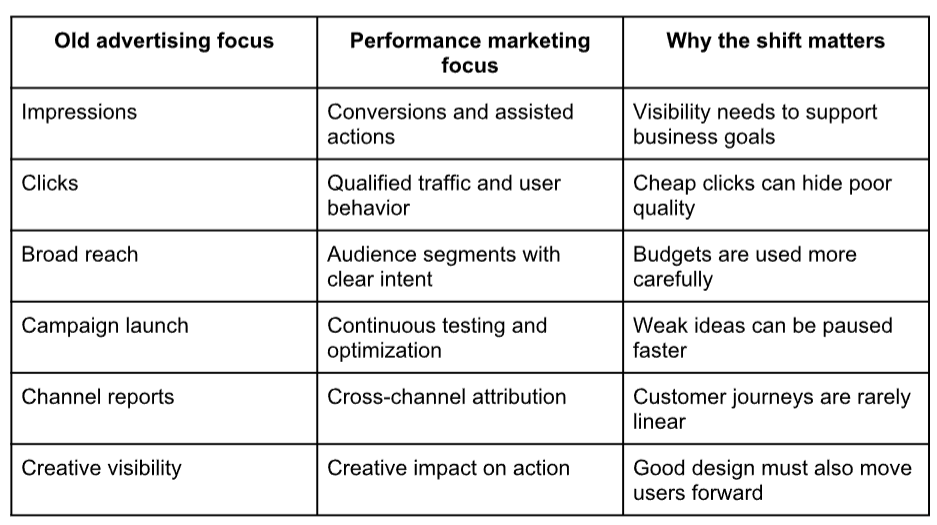
On paper, this looks obvious. In practice it changes everything, how campaigns are built, how teams report results, and how success is judged
Performance Marketing Makes Testing Central
One of the biggest changes is the rise of non-stop testing. Performance teams rarely bet on a single creative, a single audience, or one landing page for long. They test lots of different things, like headlines, calls to action, where things go, formats, GEOs, offers, payment models and even funnel steps.
This has made digital advertising more like rapid experimentation. A campaign is no longer just launched and left alone. It is watched, adjusted, trimmed, grown, sectioned and rebuilt. Sometimes it's quite obvious. The good thing is how fast it is. If a message doesn't land, the team spots it early and stops wasting money. If one group responds better, we can use more money there. If a landing page gets visitors but doesn't lead to sales, it's obvious where the problem is.
The problem is that teams can end up focusing too much on short-term results. Not every important channel makes money straight away, and not every early test shows everything. Performance marketing works best when advertisers understand which indicators matter at each step in the sales process.
Better Attribution, Harder Questions
Performance marketing has made it more important to be able to see how well something has worked. A customer might watch a video, read a review, click on a search ad, compare prices, come back later via retargeting, and only then decide to buy. Which channel deserves credit?
There is no perfect answer. But if you don't ask the question, you might make a worse decision. If each conversion is only assigned to the last click, the upper-funnel channels can look unimpressive even when they help start the journey. If you give too much importance to "awareness", then lower-quality visits may keep receiving a budget.
Modern advertisers need a more balanced view. They look at how customers find your site, how they interact with it, how much they spend, how long they stay and how much you can charge them.
The Role of Affiliate and Partner Channels
Affiliate and partner marketing are closely tied to the performance shift because they often operate around measurable actions. A partner may be paid for a lead, sale, registration, first deposit, or revenue share. That makes the model attractive for advertisers that want to connect spend with outcomes.
But partner channels also need some discipline. Having more partners can mean reaching more people, but it can also mean more risk. This could mean low quality traffic, duplicated conversions, attribution conflicts, fraud, and inconsistent messaging that makes people uneasy. A strong programme needs solid tracking, clear rules, quality checks, and honest payout models that make sure everyone is rewarded fairly.
A 2026 research paper, Turning Trust to Transactions, looked at affiliate links on YouTube and showed how common affiliate marketing has become in creator-led environments. The paper also raised concerns around disclosure and transparency. This is a useful reminder for advertisers that performance channels still depend on trust. If the audience feels tricked, they might make a quick purchase, but this could have a negative effect over time.
Why Exclusive Offers Matter More
As competition in performance advertising increases, advertisers and partners are looking for any advantage they can find. One of them is access to better offers, or maybe offers that are more exclusive. If all the partners are pushing the same product with the same words and the same terms, the profit margins get smaller quickly. The creative angles start to feel repetitive too. The audience notices, and they move on.
Exclusive offers can help partners stand out, because they might come with better terms, more custom landing pages, special bonuses, private GEOs, or conditions that are not visible to everyone. In areas where there is a lot of competition, like online gaming, fintech, subscriptions and entertainment, these differences can have a big effect.
For partners working in gaming-related acquisition, Exclusive iGaming offers - Riddick’s Partners can be relevant when the goal is to work with offers that are not simply copied across the whole market.
Creatives Are Becoming More Accountable
Performance marketing has also changed how creative work gets treated. In the past, people mostly judged a creative idea by its style, originality, or whether it suited the brand. These things still matter, but now the creative also has to prove whether it drives action, not just attention.
This doesn't mean that all ads should be ugly, loud and aggressive. Actually, weak, aggressive adverts often get people to switch off quickly. The performance is good and the creative team understands the audience's needs. A user who doesn't know much about something might need more information. A visitor who has been here before might need some reassurance. If someone stops filling out a form, they might need a gentle reminder. Strong creative work answers practical questions
● What problem does the user recognise, right now?
● What benefit is obvious in the first few seconds?
● Why should the user trust the offer, really?
● What is expected next from the user, like immediately?
● Does the message actually match what they see on the landing page?
● Can the creative be tested across multiple variations at the same time ?
● Is the outcome evaluated by quality, not just clicks and cheap metrics?
Performance marketing has made creative work more data informed, without removing the imaginative part. Just less shielded from reality.
Fraud and Traffic Quality Are Bigger Priorities
Performance marketing can be linked to fraud, because payouts are linked directly to actions. If you have fake leads, bots, duplicate accounts, click injection, cookie stuffing, incentivised sign-ups and low quality traffic, your campaign might look good but your business might suffer.
This is why traffic quality has become a major concern. Advertisers are looking beyond simple conversion rates. They want to confirm that people pass the verification process, make purchases, stay active, come back later, and end up generating revenue.
Performance teams now need stronger fraud checks, audits of partners, post-conversion analysis, device and behaviour signals, and clear rules for rejected conversions.
How Performance Marketing Changes Teamwork
Another big change is happening in-house. Performance marketing makes people in different teams work closer together. Marketing, sales, analytics, product, finance and customer support all need to share the same information.
If sales teams say the leads are weak, marketing has to hear that. If users drop on the payment page, the product and technical teams must repair it. If one channel delivers low-cost conversions but weak customer retention, the finance team should be involved before the decision is made.
The best teams do not see campaign reports as separate marketing documents. They connect them to things like earnings, customer quality, keeping customers, and profit. This makes digital advertising a way to grow, not just a way to spend money.
Final Thoughts
Performance marketing is changing digital advertising because it changes what people expect from advertising. Businesses no longer just want to see what is happening, they want proof, learning, optimisation, and a clearer connection between campaigns and growth.
This shift affects everything: attribution, creative work, landing pages, partner channels, fraud prevention, reporting, and teamwork. It makes advertising more accountable, but also more demanding.