Best HR systems for the UK mid-market in 2026
A Bristol software firm ran its first 80 people on a tidy SMB HR tool, and for a while it fit like a glove. Holiday requests, a staff directory, a few onboarding checklists, all in one friendly app. Then the business crossed three hundred staff, opened a second office in Manchester, and started bringing on IR-35 contractors for a run of client projects.
Suddenly the tidy tool couldn't answer basic questions. Payroll lived in a spreadsheet that a finance manager reconciled by hand every month, off-payroll status sat in a separate tracker, and reporting to the board meant exporting three CSVs and hoping the numbers agreed. The team hadn't done anything wrong. They'd simply outgrown software built for a smaller company, and the best HR systems for the UK mid-market exist to catch a business at exactly that moment, when SMB core HR runs out of road but full enterprise weight would be overkill.
That middle band, roughly two hundred to two thousand employees, has its own demands: native UK payroll that talks to HMRC, lifecycle automation that survives a reorganisation, and a single people record that doesn't fracture the day you add a second entity or a pool of contractors. This guide compares ten platforms on how well they carry a growing UK firm through that stretch without forcing a re-platform, with honest trade-offs and pricing on each so you can match a system to how your organisation actually scales.
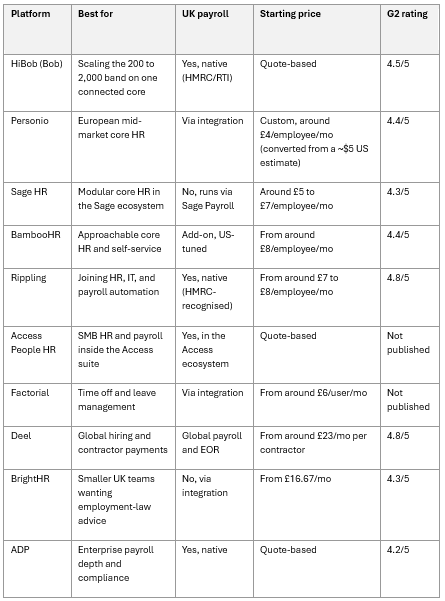
How the 10 best HR systems for the UK mid-market compare
Mid-market HR teams rarely have the headcount to bolt a payroll engine onto a core HR tool and wire the two together by hand every pay cycle. Here's a snapshot of where each platform fits, whether UK payroll runs natively, entry pricing, and user ratings, with a full breakdown of every option below.
1. HiBob
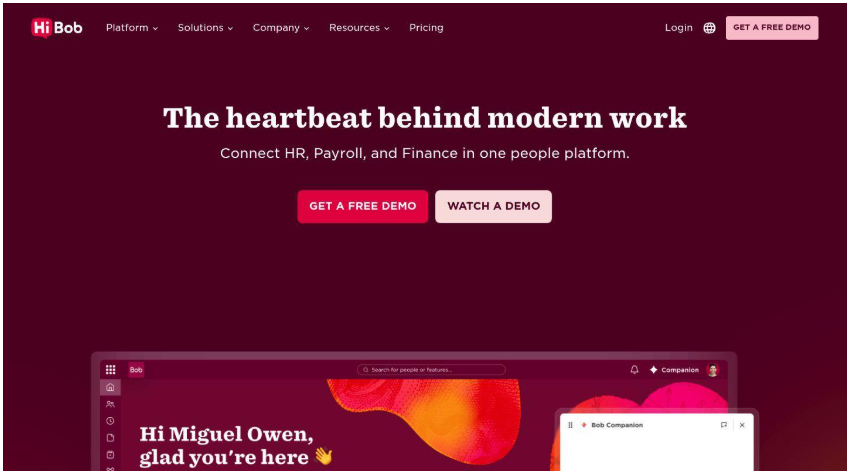
Bob sits at the head of this list because it's tuned for the precise stretch these pages cover: a UK company that has left SMB core HR behind yet has no appetite for enterprise bulk just to keep payroll, people data, and lifecycle automation on one system.
Highlights:
Bob Core keeps a single people record and a real job architecture, so roles, levels, departments, and reporting lines stay aligned while the org chart shifts underneath them.
Joiner, mover, and leaver workflows fire document collection, approvals, and access changes on their own, which retires the manual checklist a coordinator would otherwise run after every move.
Native UK payroll runs in-platform with HMRC submissions and RTI, pension auto-enrolment, and IR-35 off-payroll handling, so PAYE, contractor status, and pay all sit against the same record rather than in a side spreadsheet.
A large connector marketplace and an open API tie Bob to finance, benefits, and identity tools, while Payroll Hub stretches payroll coverage past the UK for firms with staff in other countries.
Considerations:
Pricing stays off the page, so buyers work through sales to model a cost rather than reading list rates up front.
In-platform payroll covers the UK and US directly, with other countries linking through Payroll Hub instead of one native engine.
Some users find the engagement surveys a little rough around the edges.
Pricing: Bob quotes around Bob Core plus whichever suites a firm switches on, such as payroll, talent, and compensation, and buying a suite usually lands cheaper than stacking single modules; most teams go live in weeks, and G2 reviewers rate it around 4.5/5, with the UK listing citing more than 2,300 reviews.
2. Personio
Personio grew up as a European core-HR platform for small and mid-sized firms, which makes it a sensible pick for a UK team that wants tidy records with strong coverage across the continent, sitting closer to the SMB end of the mid-market than to enterprise scale.
Highlights:
Employee records, documents, and org data live in one place, lifting routine admin off a lean HR team.
Time-off tracking and configurable approval flows clear the everyday requests that pile up in inboxes.
Connections to Slack and Outlook surface requests and approvals inside the tools people already run each day, with built-in hiring and onboarding bringing candidates through their first days.
Considerations:
Reviewers flag a limited mobile app and customisation that could use work.
The product centres on Europe and has stepped back from the US market, so firms eyeing North American growth may find coverage thinner.
Some users describe it as clunky for routine tasks.
Pricing: Personio scopes custom quotes to headcount and modules, with third-party estimates near £4 per employee per month (converted from a ~$5 US estimate), and it rates around 4.4/5 on G2 across roughly 840 reviews.
3. Sage HR
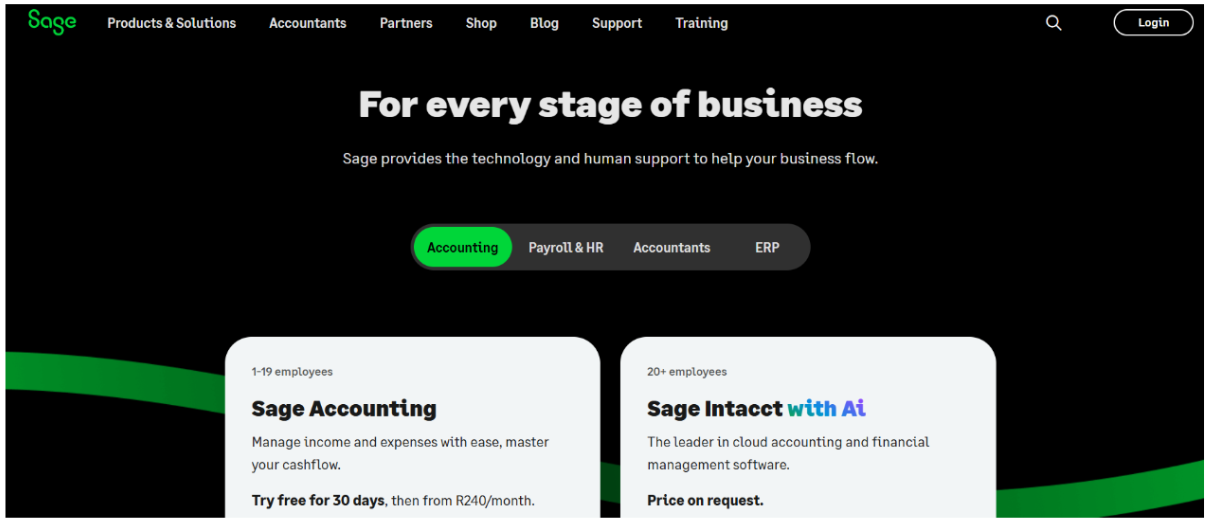
Sage HR carries modular core HR under a brand plenty of UK finance teams already recognise, and its main pull is the wider Sage stack it plugs into, though payroll is where the catch sits at mid-market scale.
Highlights:
You switch on the modules you need, from core HR and leave through to shift scheduling and performance, rather than committing to one fixed bundle.
Links into the broader Sage ecosystem suit businesses already running Sage for accounts and finance.
Self-service lets staff manage their own holiday and records through the app, trimming routine queries, while optional modules cover reviews, goals, and rota scheduling.
Considerations:
There's no native payroll, so RTI submissions and auto-enrolment run through separate Sage Payroll rather than one shared engine.
Reviewers say the interface can feel basic and less intuitive once tasks get complex.
Teams needing depth or a true all-in-one tend to feel the limits.
Pricing: Sage HR runs around £5 to £7 per employee a month depending on the modules you add, and it rates around 4.3/5 on G2 from a smaller base of roughly 90 reviews.
4. BambooHR
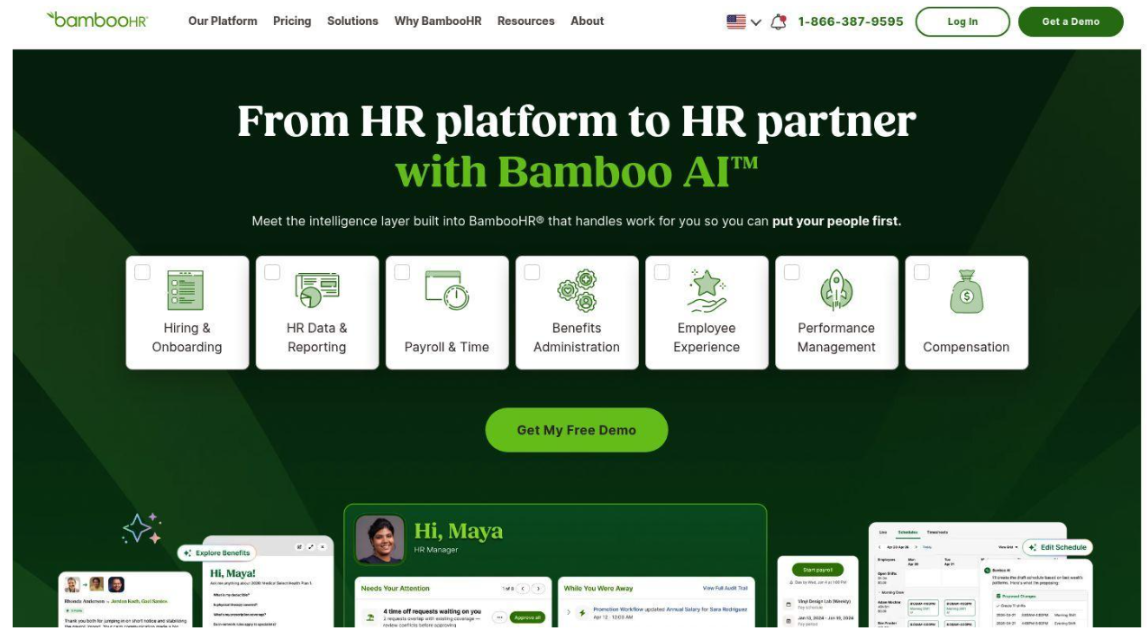
BambooHR keeps a loyal base thanks to a clean, low-friction interface that staff pick up with barely any training, which makes it an easy on-ramp for a UK firm after approachable core HR and a smooth onboarding flow.
Highlights:
Employee records, time-off tracking, and a shared company calendar sit in one hub reviewers repeatedly call easy to use.
Digital paperwork and pre-start checklists get documents signed before a new hire walks in, a genuine strength of the onboarding flow.
A built-in ATS runs job postings and candidate records with automated applicant emails, and an open API plus a broad catalogue link it to the wider stack.
Considerations:
Several reviewers say it starts to feel limiting as a company scales, with rigid reporting and thin analytics that often push you to extract data by hand.
Payroll arrives as a paid add-on tuned for US staff rather than a native UK engine, so a growing UK firm bolts on a separate payroll route.
Pricing: BambooHR uses tiered, mostly quote-based pricing that opens around £8 per employee a month once converted from its US headline rate, with higher Pro and Elite tiers and a monthly floor for the smallest teams; it rates around 4.4/5 on G2 across more than 5,000 reviews.
5. Rippling
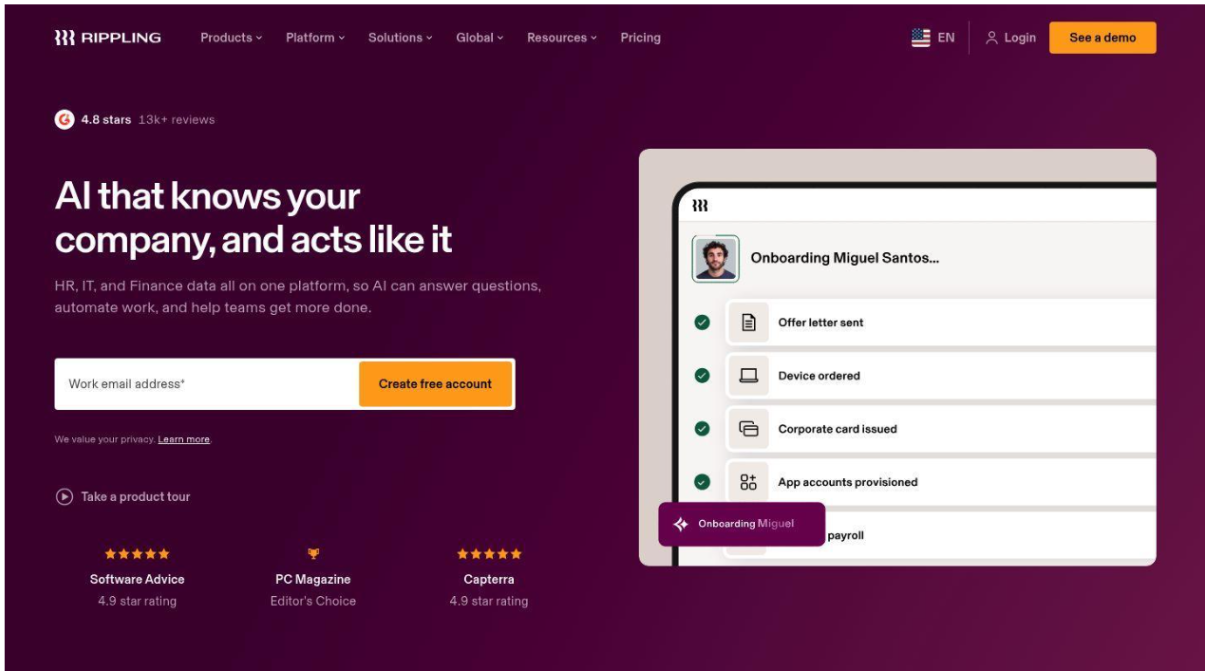
Rippling swings wide, folding HR, IT, and payroll into one system so a single hire can kick off pay setup, app access, and a configured laptop from one workflow, which lands it firmly in scope for a UK mid-market buyer.
Highlights:
HMRC-recognised native UK payroll covers RTI, auto-enrolment, minimum wage alerts, and statutory documents like P45s and P60s.
A single platform carries people data, payroll, app provisioning, and device management, so one onboarding action reaches all of them together.
A rules engine triggers downstream actions on its own, the layer reviewers single out as the most valuable, feeding a built-in ATS so a new hire's accounts set up without manual steps.
Considerations:
Reviewers describe the platform as cluttered and disjointed, with a steep learning curve for new admins.
Users report that sales can over-promise against what actually sits behind the higher pricing tiers.
Pricing: Rippling opens around £7 to £8 per user a month, though the final figure hangs on which modules a firm switches on and isn't fully transparent up front; it rates around 4.8/5 on G2 across more than 12,000 reviews.
6. Access People HR
Access People HR pitches itself as HR and payroll for small and mid-sized UK businesses chasing a single source of truth, sitting within the broader Access software suite, so its fit depends heavily on how far you buy into that ecosystem.
Highlights:
The platform aims to hold HR and payroll as one source of truth rather than two systems that drift apart.
People HR plugs into the wider Access suite, letting finance, HR, and operations share a vendor.
Core HR, absence, and self-service cover the everyday workload, and the product carries G2 leader badges in its segment.
Considerations:
The payoff hinges on adopting the wider Access ecosystem, so a firm after a best-of-breed standalone tool gets less from it.
It reads as less modern than newer platforms built around a single core, and public pricing isn't listed.
Pricing: Access People HR quotes rather than publishing rates, so buyers scope a cost through sales, and it doesn't carry a headline G2 score in this comparison.
7. Factorial
Factorial leans hard into time-off and leave management, and that focus is where it pays off for smaller and mid-sized teams whose main headache is absence tracking rather than end-to-end payroll.
Highlights:
Time-off tracking with clear request and approval flows anchors the product and handles a common HR headache well.
Reporting on absence patterns hands HR a read on trends rather than raw request logs.
Employee records, documents, and self-service cover the day-to-day basics at an affordable entry point for smaller mid-market teams.
Considerations:
Reviewers say a few features still need refinement rather than feeling finished.
Customisation calls for technical knowledge to configure, which slows a lean HR team, and UK payroll runs through integration rather than natively.
Pricing: Factorial opens around £6 per user a month once converted from its headline rate, scaling with the modules you add, and it carries no numeric G2 rating here, so treat its standing as less established than the rated platforms.
8. Deel
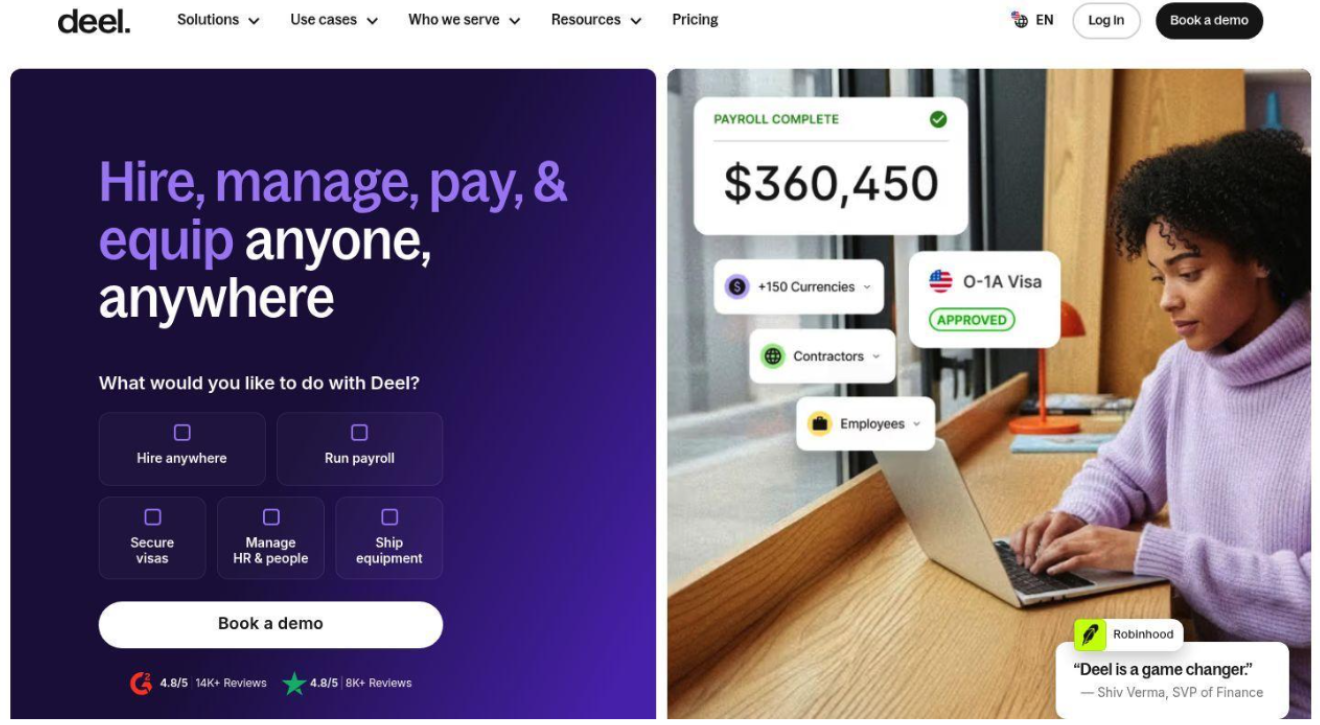
Deel earned its reputation on cross-border employment, running contractor payments and employer-of-record coverage across more than 150 countries where a buyer holds no local entity, which is the draw for a UK team hiring abroad at speed.
Highlights:
Deel onboards and pays contractors in many countries while managing local compliance and tax documents.
Employer-of-record coverage employs workers abroad on your behalf with no need to stand up local entities.
Localised agreements and tax forms run through a clean interface reviewers rate well, with a Deel HR layer holding records alongside the global-pay tools.
Considerations:
Reviewers say it isn't cost-effective for UK-only companies, since the pricing model is shaped around global coverage.
Setup can feel involved for smaller teams, and the offboarding experience draws criticism, with steep withdrawal fees noted.
Pricing: Deel opens around £23 to £31 a month per contractor, with EOR priced separately near £400 per employee a month, and it rates around 4.8/5 on G2, a score that reflects its global-pay strength rather than UK core HR.
9. BrightHR
BrightHR aims at smaller UK teams and shift-based businesses that want HR admin paired with employment-law advice on tap, so it works best as a stepping stone for a firm still growing into the mid-market.
Highlights:
Employment-law guidance around the clock reassures teams without in-house HR expertise, a level of cover a lean team can't easily buy elsewhere.
Scheduling and absence tracking suit shift-based and smaller operations.
Central document storage and a mobile app let staff handle requests and records from their phones.
Considerations:
Reviewers say it runs short on depth of analysis and can feel pricey for what it delivers.
Reporting is limited and payroll isn't native, so a scaling firm outgrows it and wires in a separate payroll tool.
Pricing: BrightHR opens around £16.67 a month, scaling by team size and plan, and it rates around 4.3/5 on G2 across roughly 116 reviews.
10. ADP
ADP is the name a lot of established organisations trust for payroll, and its UK offering stretches decades of payroll scale into a wider HR platform with deep tax and compliance coverage, though its enterprise leaning is the trade-off a mid-market team has to weigh.
Highlights:
ADP handles complex payroll and tax with the scale a large operation leans on, running native UK payroll with statutory reporting covered rather than a bolt-on.
Configurable analytics and large-scale benchmarking data let admins compare workforce metrics.
For multinationals, it runs payroll across many countries with local compliance support.
Considerations:
Reviewers call customer service unresponsive and the interface outdated, with cumbersome navigation.
Basic tasks can span several disconnected areas, users flag aggressive upselling, and the platform's enterprise weight can sit heavily on a mid-market team.
Pricing: ADP quotes rather than publishing rates, with HR functions often sitting behind modules a firm adds on and third-party estimates placing per-employee costs on the higher end; it rates around 4.2/5 on G2 across more than 11,000 reviews.
What to weigh when choosing an HR system for a mid-sized UK company
A platform that fit at 80 employees often strains at 800, so the real question isn't only what a system does today but how it holds up as you hire and add complexity. As you compare mid-market HR software UK options, score each shortlisted system on these points:
Native UK payroll, not a bolt-on: Confirm the platform runs PAYE, RTI submissions, and auto-enrolment in-platform, so pay and people data share one engine instead of a monthly reconciliation.
IR-35 and contractor handling: If you take on off-payroll contractors, check the system supports IR-35 status alongside employee records rather than in a separate tracker.
One connected core: Look for a single people record spanning HR, payroll, and reporting, so a reorganisation or a second entity doesn't fracture your data across tools.
Lifecycle automation: A joiner, mover, or leaver should trigger document collection, approvals, and access changes on its own, without a coordinator re-keying details.
Room to scale: Check the platform carries you from a few hundred to a couple of thousand staff on the same instance, so a growth spurt doesn't force a migration.
Total cost, not sticker price: Add up which modules cost extra and watch how the bill climbs with headcount, because the add-ons decide what you actually pay.
Responsive support: Scan UK reviews for how fast support replies, since a mid-sized team seldom has the cover to ride out slow help during a pay run.
Which HR system for the UK mid-market fits your team best in 2026
The right HR system for a mid-sized UK company comes down to where your friction sits. Personio, Sage HR, BambooHR, and Factorial keep earlier-stage core HR approachable but lean toward the SMB end, with payroll that often runs through a separate tool. BrightHR suits smaller shift teams wanting employment-law advice, Deel solves cross-border hiring, and ADP brings enterprise payroll depth with the weight to match.
Bob earns the top spot for the specific problem this list is about: carrying a growing UK firm through the two hundred to two thousand band on one connected core, with unified people data, joiner-mover-leaver automation, and native UK payroll that handles HMRC, RTI, and IR-35 against the same record. For a company crossing a few hundred staff and adding entities or contractors, that single thread is what separates a platform you scale with from one you replace. As UK mid-market complexity climbs through 2026, the best HR systems for the UK mid-market will be the ones that hold HR and payroll together rather than the ones a growing firm has to stitch by hand.
Frequently asked questions
What counts as a mid-market HR system in the UK?
A mid-market HR system is one built for companies roughly in the 200 to 2,000 employee band, sitting above SMB core-HR tools but below full enterprise HCM suites. In the UK specifically, that means it should handle native payroll with HMRC and RTI, pension auto-enrolment, and the kind of lifecycle automation and reporting a business needs once a single HR admin can no longer track everything by hand. The tell is whether the platform holds HR and payroll on one people record rather than treating payroll as a side spreadsheet or a separate vendor.
How is mid-market HR software different from UK SMB tools?
SMB tools do a fine job of holiday requests, a staff directory, and light onboarding for a team of a few dozen, but they tend to thin out on payroll, reporting, and automation as headcount climbs. Mid-market HR software UK options add native UK payroll, deeper analytics, configurable workflows, and a job architecture that survives a reorganisation or a second entity. The practical difference shows up when a firm crosses a few hundred staff: SMB tools start needing spreadsheets and side trackers, while a mid-market platform like Bob keeps pay, records, and reporting on one connected core.
Does the HR system handle UK payroll and IR-35?
It depends on the platform, and this is where mid-market buyers get caught out. Several tools on this list run core HR well but push payroll through a separate engine, such as Sage HR routing pay through Sage Payroll, or BambooHR offering a US-tuned add-on. Others, including Bob, Rippling, and ADP, run native UK payroll with HMRC submissions and RTI. If you take on off-payroll contractors, confirm the system supports IR-35 status handling alongside employee records; Bob, for instance, covers UK payroll and IR-35 against the same people record rather than in a separate tracker.
Can a UK HR system scale from 200 to 2,000 staff without switching?
A well-chosen one can, and that's the point of buying mid-market rather than SMB software. The risk is picking a tool built for smaller teams that forces a re-platform once you hit a few hundred staff, which means a painful migration and retraining just as the business gets busier. Platforms built around a single connected core, holding HR, payroll, and analytics on one people record, are the ones that carry a firm across that band. Bob is designed for exactly this stretch, going live in weeks and scaling from mid-market into multinational without a rebuild.
How long does UK HR software implementation take?
Timelines vary widely by platform and complexity. Lighter core-HR tools can go live in a few weeks, while enterprise systems with heavy configuration and IT involvement can run for many months. For a mid-sized UK firm, the sensible middle ground is a platform that stands up in weeks rather than quarters, especially when payroll needs to be running against a live HMRC deadline. Ask each vendor for a realistic go-live estimate for your headcount and module mix, and treat a nine-to-eighteen-month projection as a sign the tool leans more enterprise than mid-market.