.png)

A people director at a 600-person UK logistics firm once told me her payroll provider and her HR system had never spoken to each other. Every month her team exported a spreadsheet of starters, leavers, and pay changes from one tool, cleaned it by hand, and re-imported it into another before the HMRC deadline.
One mistyped IR-35 status held up a contractor payment for three weeks. That gap between HR and payroll is the precise problem the best HRIS software for mid-size and large companies sets out to close, and it's why this category looks different from the lightweight tools aimed at small teams.
For a company running 200 to 5,000-plus employees, an HRIS isn't a directory of names. It's the system that pays people right, keeps an audit trail for HMRC, and moves a new hire from offer letter to first payslip without anyone retyping a field. Below are ten platforms worth shortlisting, with the features, pricing, and trade-offs that matter once a UK workforce outgrows spreadsheets.
What is HRIS software?
An HRIS (human resources information system) is the central record for everyone a company employs and the engine that runs the daily work around them. It holds employee profiles, contracts, and pay details, then automates the routine that surrounds them: onboarding checklists, holiday approvals, role changes, and offboarding. For a UK employer, the system also has to handle statutory leave, pension auto-enrolment, and reporting that satisfies HMRC.
The line between an HRIS, an HRMS, and an HCM blurs at the mid-market and large end, where buyers expect payroll, talent tools, and analytics in the same login. What separates a strong system for a growing UK firm is whether payroll runs native inside it or bolts on. Native UK payroll keeps tax codes, IR-35 determinations, and the lifecycle of joiners, movers, and leavers on one dataset, so the people who joined this month get paid this month without a manual handoff.
Best HRIS software for mid-size and large companies in 2026
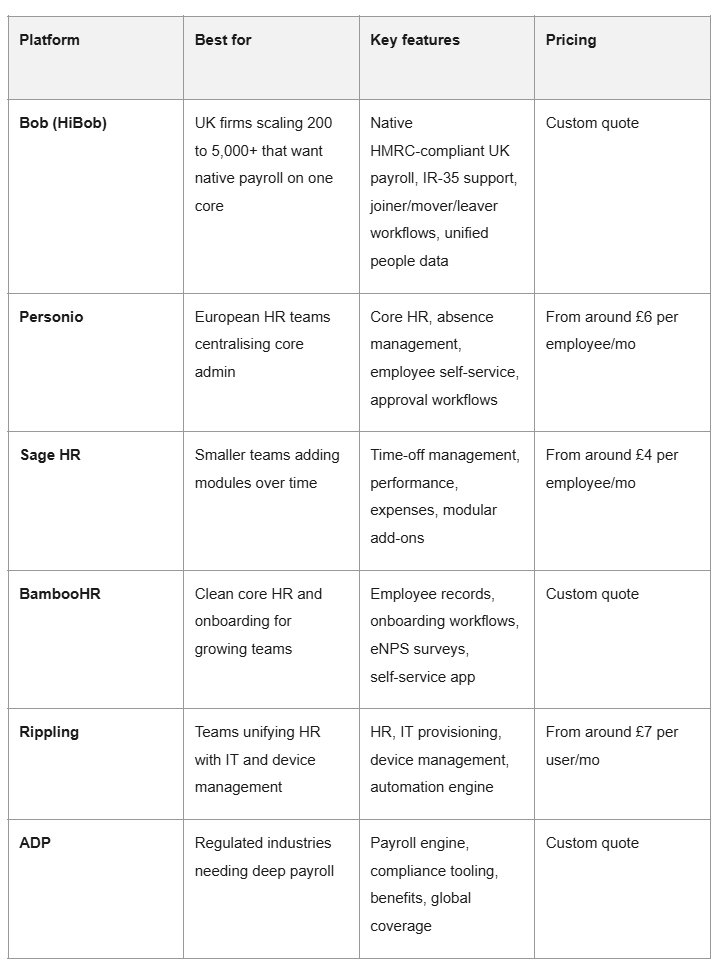
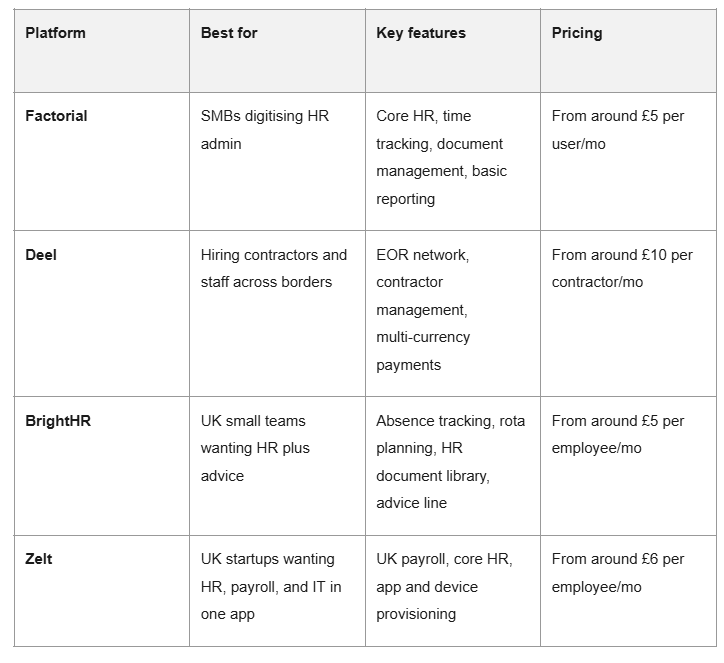
Here's a side-by-side look at how the ten platforms compare on what each does best, the standout capabilities, and where pricing lands. Use it as a shortlist, then read the detailed entries for the trade-offs.
1. Bob (HiBob)
Best for: UK companies scaling between 200 and 5,000-plus employees that want native payroll running on the same core that drives the rest of HR.
Bob, HiBob's HR and payroll system, settles the question most growing UK firms wrestle with: should payroll live inside the HRIS or sit beside it. Bob runs native UK payroll on its core, so the data that drives a payslip is the same data HR edits every day. The engine is built for British employers: HMRC compliant submissions, IR-35 determinations for off-payroll contractors, and centralised payslips, P11Ds, and P60s without a separate filing exercise. A payroll admin sees a joiner's tax code, a mover's mid-year salary adjustment, and a leaver's final pay in one place, each tied to the same record the hiring manager and the employee see.
The other half of Bob's value sits in the lifecycle workflows that feed payroll. Joiner, mover, and leaver processes run as policy-based flows: a new hire triggers onboarding tasks, document collection, and a payroll record in one motion, while a leaver kicks off offboarding and a clean final-pay calculation. Every step writes to an audit-ready history, which matters when a workforce of several thousand has to prove who changed what and when. Managers and employees handle approvals through a mobile-first interface that people use without training, part of why HiBob holds a 4.5 G2 rating across about 1,811 reviews.
Bob isn't the cheapest option per head, and its native payroll covers the UK and US rather than every market a sprawling multinational might touch, where the Payroll Hub connects local providers instead. For a UK firm in the 200 to 5,000 band, the pairing of HMRC ready payroll and lifecycle automation on a single dataset is hard to match.
Key features:
● Native UK payroll: HMRC compliant submissions, IR-35 contractor support, and centralised payslips, P11Ds, and P60s, all run inside the same system as core HR.
● Joiner, mover, leaver workflows: Policy-based automation moves a person from offer to first payslip and from notice to final pay, with document collection and approvals built in.
● Unified people data: One record per employee feeds HR, payroll, and reporting, so a salary change or a new starter updates everywhere at once.
● Audit ready process history: Every workflow logs who did what and when, giving larger teams the trail they need for HMRC and internal governance.
● Mobile first self-service: Employees and managers run approvals, requests, and updates from their phones, which keeps adoption high across a distributed workforce.
Pricing: Custom quote, modular by suite. Most UK firms start with Bob Core and add UK Payroll.
2. Personio
Best for: European HR teams that want to centralise core admin and self-service in one place.
Personio built its reputation across Germany and the wider European market as a tidy way to consolidate employee records, absence management, and approval workflows. For a mid-sized UK office that's part of a European group, it brings order to scattered processes and gives staff a clean self-service portal, with onboarding and offboarding checklists that keep the team from missing steps as headcount grows.
The trade-offs show up as a company scales. Reviewers on G2 point to limited customisation, with workflows and reports that feel rigid when needs stray from the standard setup, plus missing features around performance management and a reporting layer that lacks the drill-downs a data team expects. The platform's centre of gravity remains Europe, so UK firms wanting native workforce planning or deep configuration often outgrow it.
Key features:
● Core HR records, contracts, and document management
● Absence and time-off management with approval routing
● Employee self-service for requests and personal data
● API integrations with tools like Greenhouse and Microsoft 365
Pricing: From around £6 per employee per month, with paid add-ons that raise the total.
3. Sage HR
Best for: Smaller and mid-sized teams that want to start with core HR and bolt on modules as needs grow.
Sage HR, once known as CakeHR, gives teams a modular path: begin with leave and core HR, then add performance, scheduling, or expenses when the budget allows. UK finance teams already running Sage Intacct often like the familiar format and the sync between products, and the reimbursement flow earns consistent praise for being quick and organised.
Where it strains is depth and breadth. G2 reviewers describe a limited scope once requirements get serious, with advanced features locked behind extra modules that push up the cost. Several flag integrations that don't always hold up and an interface that feels basic for complex tasks during setup. One reviewer summed it up as solid for simple HR but frustrating once you need depth, integrations, or genuine all-in-one functionality.
Key features:
● Modular design covering core HR, performance, scheduling, and expenses
● Granular time-off policies with multi-approver routing
● Expense submission and reimbursement tracking
● Sync with other Sage products like Intacct
Pricing: From around £4 per employee per month for core, rising as modules are added.
4. BambooHR
Best for: Growing teams that want a clean core HR system and strong onboarding.
BambooHR is known for an interface employees navigate with almost no training, which makes it a popular first proper HRIS for companies leaving spreadsheets behind. Onboarding workflows are a genuine strength, the self-service app handles PTO, directories, and records well, and eNPS surveys with AI topic summaries give HR a read on sentiment without combing through every comment.
The constraints surface at scale. G2 reviewers cite limited customisation again and again, plus reporting that feels rigid for complex data needs, and many flag that payroll comes as an extra paid module geared to US staff rather than UK rules. One reviewer described the wider product as feeling like a basic filing cabinet, with a thin AI feature set. For a UK firm that needs HMRC-ready payroll on the same core, that payroll gap is the sticking point.
Key features:
● Clean employee records and self-service mobile app
● Onboarding and offboarding workflow automation
● eNPS and wellbeing surveys with AI summaries
● 150-plus integrations and an open API
Pricing: Custom quote, with payroll, benefits, and advanced reporting as paid add-ons.
5. Rippling
Best for: Teams that want to unify HR with IT provisioning and device management.
Rippling stands out by tying HR to the IT stack: hire someone and the system can create their accounts, assign a laptop, and set permissions on its own, then strip all of it when they leave. For lean ops teams juggling onboarding across HR, IT, and finance, that automation engine saves real hours, and the single-login experience suits fast-growing companies that treat HR and IT as one problem.
The flip side is that HR can feel secondary to the IT crossover, and the breadth comes with friction. G2 reviewers describe a steep learning curve and a platform that overwhelms new users given how many features it packs in. Others note reporting that gets complex, occasional slow loading, and pricing that climbs as modules stack up. A few flag that the holiday and leave handling feels Americanised, which matters for a UK team needing statutory accuracy.
Key features:
● HR, IT, and finance unified on one platform
● Automated onboarding with account and device provisioning
● Identity and access management with role-based permissions
● Workflow automation engine across modules
Pricing: From around £7 per user per month, rising with added modules.
6. ADP
Best for: Larger or regulated organisations that need a deep, established payroll engine.
ADP has run payroll at scale for decades, and that heritage is its strongest card. For organisations in regulated sectors, the payroll accuracy, compliance tooling, and benefits administration are dependable, and the global coverage suits companies with employees across many countries. The service model, with named account contacts and a chat feature reviewers single out, gives larger teams a support line when payroll can't wait.
The cost is a less modern experience. G2 reviewers often describe an interface that feels dated and clunky, with a report menu that's hard to navigate and a learning curve that takes time to climb. Support quality draws mixed reviews, and a recurring complaint is heavy upselling, with one reviewer noting repeated sales calls for products a smaller organisation doesn't need. For a mid-market UK firm that wants a modern, self-serve experience, those trade-offs weigh against the payroll depth.
Key features:
● Established payroll engine with compliance tooling
● Benefits administration and tax filing support
● Global payroll coverage across many countries
● Service model with named account support
Pricing: Custom quote, often quote-based and rising with added modules.
7. Factorial
Best for: Small and lower-mid-market teams digitising HR admin for the first time.
Factorial packages core HR, time tracking, document management, and basic reporting into an affordable bundle that suits SMBs moving off spreadsheets. It localises for UK and Irish requirements and gives growing teams a single place for records, absence, and approvals without a heavy implementation. For a company in its first few hundred employees, the price point and quick setup are the draw.
The limitation is reach. Factorial leans toward the SMB end, and its depth in workforce planning, advanced analytics, and complex payroll thins out as a company climbs toward the larger mid-market. Teams that cross a few hundred staff often find the configuration and reporting don't stretch to multi-entity structures or the governance a larger UK firm needs, which means a re-platform later. It's a sound starting system rather than one built to carry a 5,000-person workforce.
Key features:
● Core HR records and document management
● Time tracking and absence management
● Basic reporting and approval workflows
● UK and Ireland localisation
Pricing: From around £5 per user per month.
8. Deel
Best for: Companies hiring contractors and full-time staff across multiple countries.
Deel made its name solving cross-border hiring: its employer-of-record network lets a UK company employ someone abroad without opening a local entity, and its contractor management handles localised agreements and multi-currency payments. For a firm whose main headache is global hiring rather than domestic HR, that country coverage earns its keep.
The catch is that Deel is EOR-first, not a core HRIS for a UK-centric workforce. Its strength is employing and paying people across borders, so a company whose main need is domestic UK payroll, lifecycle workflows, and day-to-day HR admin for a few thousand local staff finds Deel solving a different problem. Reviewers note that EOR and global payroll pricing runs higher than domestic-only tools and that product depth varies country to country. For a mid-size or large UK employer, it works better as a complement than as the system of record.
Key features:
● Employer-of-record network across many countries
● Contractor management with localised agreements
● Multi-currency payments and tax-form handling
● Immigration and equipment support
Pricing: From around £10 per contractor per month, with EOR priced higher per employee.
9. BrightHR
Best for: UK small teams that want HR basics paired with employment advice.
BrightHR targets UK small businesses with a practical bundle: absence tracking, rota planning, a document library, and an employment-law advice line that smaller firms without in-house HR value. The mobile app handles holiday requests and shift management well, and the advice element gives owners confidence on tricky UK employment questions. For a team of a few dozen to a couple of hundred, it covers the essentials at a low price.
The boundary is scale. BrightHR is built around SMB workflows, so its depth in payroll, workforce planning, and complex reporting is light for a larger organisation. As a company grows past a few hundred employees and needs native payroll on the same system, multi-layer approvals, and richer analytics, the feature set tends to run out before the requirements do. It's a strong fit at the small end and a stretch at the larger end of this list.
Key features:
● Absence and holiday tracking with a mobile app
● Rota and shift planning
● HR document library and templates
● Employment-law advice line
Pricing: From around £5 per employee per month.
10. Zelt
Best for: UK startups and smaller scale-ups wanting HR, payroll, and IT in a single app.
Zelt is a newer UK-built platform that combines core HR, UK payroll, and IT provisioning in one tool, which appeals to early-stage companies that want to avoid stitching together separate systems from day one. For a UK startup, having payroll and app provisioning beside the employee record is a clean starting point, and the local focus means UK tax and statutory handling is baked in rather than retrofitted.
The constraint is maturity and scale. Zelt leans toward startups and smaller scale-ups, so its workforce planning, analytics, and configuration depth are lighter than what a 1,000 to 5,000-person organisation demands. As headcount and complexity grow, larger teams tend to need stronger governance, deeper reporting, and the breadth of a more established suite. It's a capable system for a UK company in its first growth phase rather than one proven across the full range.
Key features:
● Core HR records and self-service
● Native UK payroll
● App and device provisioning
● Single-app experience for HR, payroll, and IT
Pricing: From around £6 per employee per month.
Features to look for in HRIS software for a growing UK company
Once you've got a shortlist, the next step is judging which system fits a workforce that's heading past a few hundred people. These are the capabilities that separate a tool built for small teams from one that carries a mid-size or large UK company.
Native UK payroll
The biggest dividing line is whether payroll runs inside the HRIS or bolts on. Native UK payroll keeps tax codes, IR-35 determinations, and statutory deductions on the same dataset as HR, so a salary change made by an HR manager flows straight into the pay run, with no export-clean-import cycle to create errors and missed HMRC deadlines.
Joiner, mover, and leaver automation
A growing company processes starters, internal moves, and leavers all year. The system should turn each into a workflow that collects documents, sets up the payroll record, routes approvals, and, on exit, triggers a clean final-pay calculation. Manual checklists break down once the volume climbs.
Audit-ready records and HMRC compliance
Larger UK employers need to prove who changed what and when, both for HMRC and internal governance. Look for a system that logs every workflow step and produces P11Ds, P60s, and submission records without a separate exercise.
Reporting and adoption
A people team supporting thousands fields requests for headcount, turnover, and cost figures most weeks, so the HRIS should hold one trusted record per employee and let you slice the data without exporting first. None of that helps if people don't use the system, so a mobile-first interface that managers and employees navigate without training is what keeps the data accurate.
Choosing the right HRIS for a mid-size or large UK company
The best HRIS software for mid-size and large companies hinges on one question that lighter tools sidestep: does payroll run on the same core as the rest of HR. For a UK firm scaling between 200 and 5,000-plus employees, native HMRC-compliant payroll, IR-35 handling, and automated joiner, mover, and leaver workflows on a single dataset are what keep pay accurate and the audit trail clean as headcount grows.
HiBob earns the top spot because it puts all of that on one connected core, so a new hire's data drives their first payslip without a manual handoff and a leaver's exit triggers a clean final-pay run. Personio and BambooHR bring tidy core HR but lean on payroll add-ons, Rippling and Deel solve adjacent problems in IT and cross-border hiring, and the SMB-focused options run light at the larger end. Match the shortlist to where your workforce is heading, give native UK payroll the most weight, and the field narrows fast.
Frequently asked questions
Should an HRIS include UK payroll or is a separate payroll system better?
For a growing UK company, native payroll inside the HRIS tends to win because it keeps tax codes, deductions, and pay changes on the same record HR already manages, removing the export-and-reimport step that causes errors. Bob runs HMRC-compliant UK payroll on its core, so a starter, mover, or leaver flows into the pay run without a handoff. Separate payroll can work, yet it reintroduces the data gap that a unified system closes.
How does an HRIS handle IR-35 for off-payroll contractors?
A capable UK HRIS lets you record an IR-35 status against a worker and process their payments according to that determination, keeping the decision and its paper trail on the same system as the rest of payroll. Bob supports IR-35 contractor handling inside its native UK payroll, so determinations sit alongside payslips and HMRC submissions rather than in a separate spreadsheet. That matters when an audit asks you to show how each contractor was assessed and paid.
Can an HRIS automate onboarding for a larger workforce?
Yes, and at scale it's essential. The system should turn a new hire into a workflow that collects documents, creates the payroll record, and routes approvals without anyone retyping data. Bob runs joiner, mover, and leaver processes as policy-based flows, so a starter moves from offer to first payslip in one motion and every step writes to an audit-ready log. That automation is what keeps a people team sane when it's processing dozens of changes a month.
What's the difference between an HRIS for a mid-size company and one for a large enterprise?
Mid-size systems prioritise quick setup and clean core HR, while platforms built for thousands of employees add deeper governance, multi-layer approvals, richer reporting, and payroll that holds up under complexity. The strongest options span both, scaling from a few hundred to several thousand staff on the same core without forcing a re-platform. Look for that continuity, since the system that runs a 300-person company should still fit at 3,000 without a migration.
What should a UK firm expect to pay for an HRIS at 200 to 5,000 employees?
Pricing tends to run per employee per month, often starting around £4 to £10 for core HR, with payroll, advanced reporting, and extra modules adding to the total. Several leading platforms use custom quotes because cost depends on headcount and which suites you need. Budget for implementation and the add-ons that turn a basic plan into a full system, since the lowest sticker price seldom reflects what a larger workforce ends up needing.

Comments (0)
No comments yet.