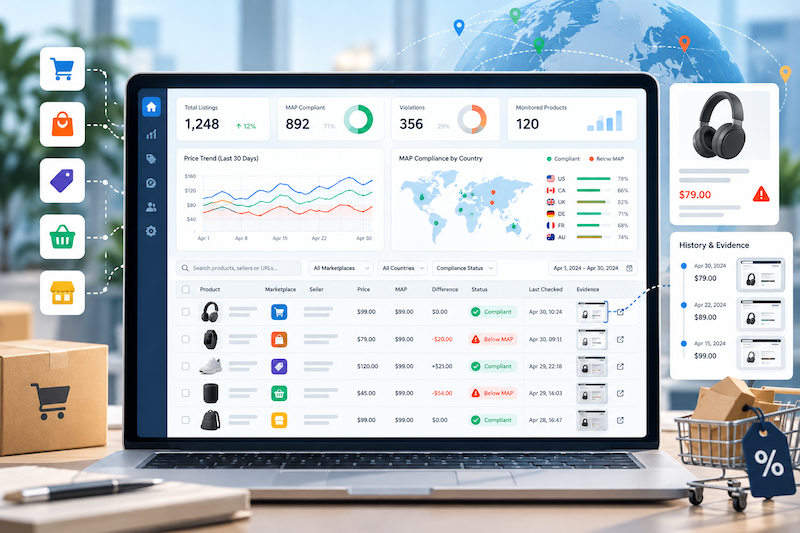
How to choose a MAP monitoring tool
A minimum advertised price policy is only as strong as your ability to see who breaks it. Most brands discover this the hard way. The policy is written, resellers sign up to it, and a year later a distributor calls asking why they should hold the line when a marketplace seller has been advertising below MAP for months.
Nobody saw it, so nobody acted, and the compliant resellers noticed both.
The monitoring tool is what turns a policy document into something enforceable. This guide covers how to choose one: what to settle before you talk to vendors, the criteria that separate the tools, and how to run a trial that tells you the truth.
Write down your scope first
Vendors will happily demo features for an hour. Whether any of it matters depends on facts only you know, so settle them first:
Where your products are advertised: your resellers’ own webshops, marketplaces, comparison sites, or all three.
Which countries and currencies are involved, and whether your policy sets different minimums per market.
Roughly how many products and how many sellers you need to watch, including the ones you have not authorised.
Who will act on violations: a brand manager with an hour a week, or a team with an enforcement process.
That one page of answers does more to narrow the field than any comparison chart. The market for MAP pricing software runs from simple price trackers to platforms built around the whole enforcement workflow, and your scope decides which end you need.
Coverage: the tool must look where violations happen
Violations concentrate in the channels you watch least. Authorised dealers you speak to weekly are rarely the problem; the third-party marketplace seller you have never heard of usually is.
So test coverage against your real channel list. A tool that watches webshops but reads marketplaces poorly, or covers your home market but not the countries your distributors export to, leaves exactly the blind spots the violators use.
Ask how new sellers are discovered. Your unauthorised sellers, by definition, are not on any list you can provide.
Product matching decides whether alerts are true
Every alert rests on one claim: this listing is your product. When the match is wrong, the price comparison is meaningless, and a false accusation sent to a reseller costs more goodwill than a missed violation.
Matching is hardest exactly where MAP problems live: listings with missing or wrong barcodes, retitled products, bundles and multipacks, and grey-market sellers who avoid identifiers on purpose.
Ask vendors two questions. How are matches made when the listing has no clean identifier, and how are they verified before an alert reaches you? A tool that cannot answer the second question will make you the verification step.
Seller identity makes a violation actionable
A price without a seller behind it is a fact you cannot act on.
The tool should tell you who is advertising below MAP, not just where. On marketplaces that means identifying the seller behind each offer, keeping their history, and letting you tell authorised resellers from unknown ones at a glance.
Repeat behaviour matters as much as identity. Most violations come from a small group of sellers, and enforcement works when you can see who violates persistently rather than treating every alert as new.
Evidence your enforcement can stand on
Enforcement conversations are evidence conversations. A reseller can dispute a phone call; a dated record of their listing, with the advertised price and where it appeared, is much harder to argue with.
Check what the tool records for each violation, how long the history is kept, and whether you can export it in a form your notices, your legal counsel or a marketplace complaint can use.
History also proves the positive case. When a big retail partner asks what you are doing about MAP, a record of violations found and resolved is the answer.
Alerts and reports someone will actually use
The failure mode of monitoring is not missing data. It is a weekly export nobody opens.
Match the checking frequency to how fast your market moves, and make sure alerts can be filtered to what each person needs: new violators for the enforcement owner, a status summary for management, a per-distributor view for the sales team.
If your process escalates from a friendly notice to consequences, look for a way to track each seller’s stage, so escalation follows the record rather than someone’s memory.
Edge cases separate the serious tools
Ask every vendor how they handle:
Used and refurbished offers. Most MAP policies apply to new products only; a tool that cannot tell the difference floods you with false violations.
Bundles and multipacks. A three-pack below three times MAP is not necessarily a violation, but naive per-unit maths will flag it.
Strikethrough and cart pricing. MAP governs the advertised price; tools should read what is actually shown on the page.
Promotions you have approved. Brand sanctioned promotional windows need a way to be excluded, or every sale season becomes an alert storm.
Currency and market differences. A policy with per-country minimums needs monitoring that compares each listing with the right minimum, in the right currency.
Questions for every demo
Which marketplaces and countries do you cover today, for products like ours?
How do you match listings without clean identifiers, and who verifies the matches?
How do you identify the seller behind a marketplace offer?
What does a violation record contain, and what can we export?
How quickly does a new violation reach us after it appears?
What happens to price checks as our catalogue or seller list grows, in effort and in cost?
What does onboarding look like, and how long until real coverage?
Red flags
Coverage limited to one marketplace, when your violations spread across many channels.
Prices without seller identity, which turns every alert into a research task.
No verification step behind matching, so your team becomes the accuracy check.
Pricing that scales per listing or per check in a way that punishes growth.
Long setup projects before you see your first real violation.
Contracts that lock you in before the tool has seen your own catalogue.
Run the trial like the real job
A demo shows the vendor’s best products. A trial should show yours at their worst.
Load the products that cause you trouble: the ones sold through long distribution chains, the ones with messy listings, the markets where you suspect grey imports. Include the sellers you already know violate, and see whether the tool finds them without being told.
Then judge three things: how many known violations it found, how many of its alerts were real, and whether the person who owns enforcement can work from it without a spreadsheet on the side.
Dedicated platforms, Altosight among them, run trials on your own catalogue, which is the only version of the test that predicts what daily use will look like.
The decision
Weight the criteria by your own scope. A brand selling through marketplaces in one country needs seller identity and matching accuracy above all. A brand with distributors across many markets needs coverage and per-market minimums first.
The cheapest tool usually costs the difference in unseen violations, and an unenforced policy is more expensive than either: it trains the whole market to ignore your minimum.
Choose the tool that lets one person see the market, trust the alerts and act on the record. That is the entire job.