
The strongest third party risk management (TPRM) software for FCA and PRA supervised firms, compared alongside supplier relationship management software as the PS26/2 register deadline approaches
The FCA spent four years telling regulated firms to map their important business services, then checked the homework. It published its operational resilience review on 27th March 2026, a year after the transition period closed, and the findings landed on third parties. Vulnerabilities in supplier arrangements stood out as the weak spot, and much of the mapping it saw stopped at the IT estate. If your firm runs supplier oversight from spreadsheets, that review describes you, and it explains why vendor risk management software moved from a procurement convenience to a supervisory necessity.
The calendar gives the finding teeth. On 18th March 2026 the FCA and the Bank of England published PS26/2, which brings defined incident reporting plus notification of material third-party arrangements and an annual register submission, with rules in force from 18th March 2027. That hands every FCA firm a 12-month window to get its third-party records into a state it can submit every year. A register that has to reconcile with contracts, materiality assessments, regulator notifications and exit plans is a database job, and the firms treating it as a spreadsheet job will find out in the worst way.
This comparison ranks nine platforms against that reality: the register you'll owe the regulator, the contract terms SS2/21 expects to see, the mapping the 2026 review found wanting, and the monitoring that runs between assessments. Each platform earns its place for a specific kind of buyer.
Which UK financial firms carry third party risk in 2026?
Every firm the FCA or PRA supervises, in practice. The operational resilience rules have applied since 31 March 2022, and since 31st March 2025 firms must stay within their impact tolerances for each important business service through severe but plausible scenarios. The FCA's framing leaves no gap to hide in: a third-party failure that breaches your impact tolerance is your responsibility. Steady state means the regulator now measures outcomes rather than preparations, and its March 2026 review shows it looking hardest at the supplier layer.
Concentration risk got its own answer in the summer. On 13th July 2026, HM Treasury designated the first four critical third parties under SI 2026/777: AWS EMEA SARL, Google Cloud EMEA Limited, Microsoft Ireland Operations Limited and Oracle Corporation UK Limited. Most regulated firms run at least one of the four somewhere in their stack. Read the designation framework before you relax, though. The regulators state in terms that the critical third party rules don't change the responsibility firms carry for managing their own third-party suppliers. Designation adds oversight of the providers without removing a single duty from the firm, so you still need your own record of which services run on each designated provider, how concentrated that dependency is, what the contract says about it and what the exit route looks like.
Then there's the exposure that arrives through contracts rather than statute. DORA binds EU financial entities and has applied since 17th January 2025; it doesn't bind a UK only firm. A UK firm inside an EU group, or selling ICT services to EU financial entities, meets it anyway, through Article 30 contract terms flowing down and through inclusion in customers' registers of information. Those registers face real scrutiny: in the ESAs' dry run, 6.5% of registers passed every data-quality check, and missing mandatory information drove 86% of the errors across 1,039 participating entities. A UK supplier that can't produce clean, structured data on demand becomes its customer's data quality problem, which is a poor position from which to renew a contract.
What is vendor risk management software?
Vendor risk management software identifies the third parties an organisation depends on, assesses what could go wrong with each, monitors them between assessments and holds the evidence a supervisor or auditor will ask for. In an unregulated company that's good hygiene. In a UK financial services firm it maps onto specific rulebook text.
Start with PRA supervisory statement SS2/21, which reads less like guidance and more like a data model. Chapter 6 sets written-agreement minimums, chapter 7 covers data security, chapter 8 demands audit and access rights, chapter 9 governs sub-outsourcing and chapter 10 requires business continuity provisions and documented exit plans. Those are contract clauses, and a platform either tracks them as structured fields against each arrangement or leaves you re-reading PDFs at review time. The same statement has PRA firms keeping an outsourcing register that distinguishes material arrangements and notifying the regulator before material outsourcing begins, with the board unable to outsource its own accountability.
One misreading worth clearing up: FCA SYSC 8 doesn't require a register today. It keeps full responsibility with the firm and demands contract terms that preserve supervision and regulator access while allowing termination without disruption; the register duties sit in SS2/21 for PRA firms and arrive for FCA firms through PS26/2 from 18th March 2027. Software that treats the register as a report you generate, rather than a document you compile, is the difference between a submission window and a submission crisis.
Vendor risk, third party risk, or material arrangements?
The category answers to several names, and the differences matter less than buyers fear. Vendor risk management grew out of supplier oversight, where a vendor sells you goods or services on an ongoing basis. Third party risk management stretches wider, taking in contractors, software providers, intra-group service companies and market infrastructure. Supplier relationship management software comes at the same population from the performance side rather than the risk side.
UK regulators have settled their own vocabulary: PS26/2 speaks of material third-party arrangements, and SS2/21 of outsourcing and third party risk management. The practical advice is to buy for the widest definition in play. A platform that holds any external dependency, scores its materiality and carries its contract will serve whichever label your compliance team prefers, and that's how this list judges the nine below.
The best vendor risk management software for UK financial services
The order below weighs four things: how much of the register and evidence burden the platform absorbs, how far its contract coverage reaches, what its monitoring catches between assessments, and what reviewers on the major review platforms report about living with it. Here's how the nine stack up.
1. Gatekeeper (for firms that want the register, contracts and monitoring on one dataset)

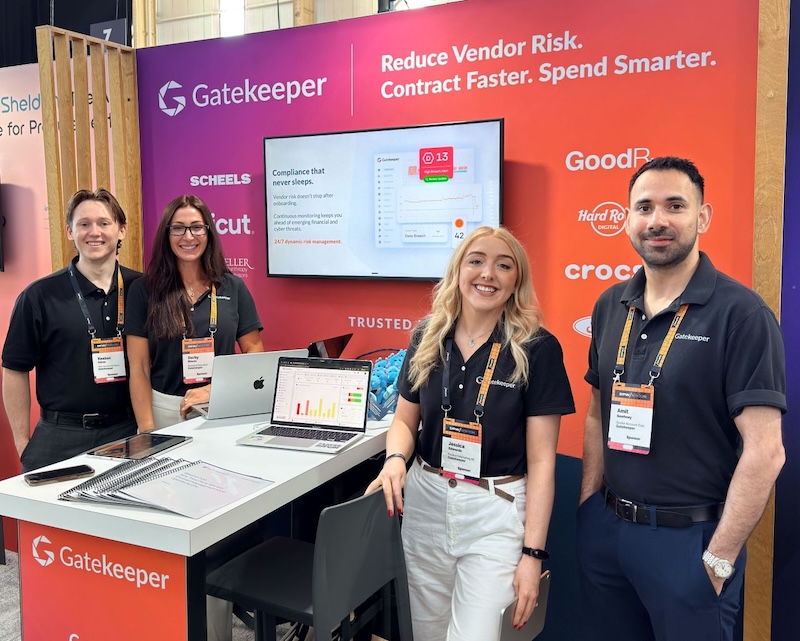
Gatekeeper keeps in one place what this category usually splits apart. One record holds each third party's risk assessments, contract clauses, compliance evidence, and spend. The unified dataset helps firms prepare for register submissions, SS2/21 clause reviews, diligence trails, and renewal tracking. Gatekeeper is headquartered in the UK and covers financial services as a dedicated sector, positioning compliance as a continuous state instead of an annual scramble.
Risk coverage that runs between reviews
Screening happens before signature: the platform checks each vendor against certification and security requirements and blocks non-compliant third parties rather than noting them. After signature, monitoring keeps watch around the clock across sanctions lists, financial stability signals, cyber security posture and regulatory news, feeding a Risk Register that scores each third party from probability and impact variables. Gatekeeper's AI agents do the chasing that burns analyst hours elsewhere: they collect certificates, attestations, insurance evidence and security questionnaires from third parties, then flag gaps and expiries so the evidence trail stays audit-ready without anyone running a quarterly collection exercise by email.
Contract terms where SS2/21 looks for them
Because full contract lifecycle management lives on the same record, contract terms and obligations can be tracked directly alongside third-party risk profiles rather than remaining buried in PDFs. Audit and access rights, sub-outsourcing permissions, continuity provisions and exit plans can be captured against each arrangement, AI agents extract and track obligations, and renewal dates can't sneak past a team that sees them beside the risk score. Gatekeeper's own compliance posture helps the due diligence your firm will run on it: its trust centre holds SOC 1 and SOC 2 attestations, both Type II, together with ISO 27001:2022 and ISO 9001 certificates. Gatekeeper also supports DORA, which suits firms whose EU customers push Article 30 terms down the chain.
Pricing and sizing
Gatekeeper's plans scale by third-party count. Every plan includes unlimited users, contracts and eSign licences, plus all 50+ AI agents at no separate AI charge. Implementation is a fixed, scoped fee agreed up front. Commercial pricing details are tailored through a direct scoping consultation.
UK financial services proof
Gatekeeper's customers report a 75% reduction in audit preparation time. Its financial services customer base includes Funding Circle, FNZ, and SumUp, demonstrating its relevance to organisations managing complex supplier relationships and compliance requirements. The Funding Circle case study provides a UK financial services example of how Gatekeeper supports stronger contract governance and third-party oversight.
What reviewers report
Gatekeeper holds 4.5/5 across 94 reviews on G2 as of October 2026, with an average implementation time of four months, according to G2. Reviewers highlight smooth implementation and contract tooling, though some note a learning curve during setup when configuring complex workflows or custom reporting views.
2. Graphite Connect (for firms that need supplier data verified before it enters the ERP)

Graphite Connect borrows its structure from social networks. Suppliers hold verified profiles they maintain themselves, buyers onboard from that shared record, and the platform validates supplier identity and banking details, plus tax identification and standing on the US Office of Foreign Assets Control (OFAC) sanctions list, before anything lands in the ERP. That design speaks to a pain every finance team owns: fraudulent bank-detail changes, which Graphite counters with controls built to stop them, backed by an extensive audit trail. The user base skews large, with 26 of its 31 G2 reviews coming from enterprises, and the overall score sits at 4.4/5.
Reviewers praise the onboarding flow and flag the filing. One verified enterprise user in entertainment wrote that "The vendor setup process does not allow me to upload documents to a single location within the vendor profile", in a review on G2, where Graphite Connect holds 4.4/5 across 31 reviews. Another reviewer reported a setup of around six months driven by banking and country-specific requirements, so the clean data comes after real configuration work.
Scope is the real boundary for a UK financial services buyer. Graphite centres on onboarding data. There is no contract lifecycle or spend management here, and no life of contract performance tracking either. Therefore, the register, the SS2/21 clause evidence, the renewal calendar and the ongoing monitoring all need a home elsewhere. It hardens the front door better than anything else in this field. The rest of the house is yours to furnish.
3. SmartSuite (for firms that would rather build their own risk workspace)

SmartSuite isn't a purpose-built TPRM product; it's a no-code work platform whose GRC suite ships a named third party risk management solution, and its framework list includes operational resilience, which will catch the eye of any UK firm staring at impact tolerances. Teams shape the process themselves, with AI workflow agents that summarise updates, classify requests, draft content and trigger next steps, governed from a central control centre. The platform's own compliance posture is solid for the price point: SOC 2 Type II, ISO/IEC 27001, GDPR, HIPAA and PCI-DSS all feature, though SmartSuite publishes no hosting region, so residency goes on the evaluation sheet as a question rather than a fact. It's also the one platform here with published entry pricing, from $12 per user per month on the Team tier through $30 Professional and $45 Enterprise tiers to custom Signature plans.
The trade is clear once you have run the build. What you configure, you maintain. A register template is only as current as the person who built it, and the regulatory logic lives in your head rather than the product. Per-user pricing cuts the other way from unlimited-seat rivals, since compliance, legal, finance and internal audit each add cost when they join the process. There is no spend analytics and no contract lifecycle depth described. For a small risk team with strong process instincts and a thin budget, it is a credible starting point.
4. Kodiak Hub (for firms that treat suppliers as relationships before risks)

Kodiak Hub, a Stockholm company started in 2017, serves UK buyers from an office on York Street in London and brings the strongest supplier-engagement story in this field. The platform is modular: supplier data, risk monitoring, performance analytics and collaboration tooling slot together as needed, and its resilience monitoring casts a wide net, from macro and sanctions exposure through climate and disaster events to financial and media signals. On G2 it scores 4.4/5 across 31 reviews, and a 3-month average implementation makes it one of the quicker rollouts here. The company holds ISO 27001 certification.
The question for an FCA or PRA firm is what happens after the scorecard. Kodiak Hub reads supplier relationships well, but nothing on its pages speaks the register language of SS2/21 or PS26/2. It stops short of owning the agreement itself, with no execution step and no obligation tracking described. Spend sits outside the product as an outcome claim rather than a module. A UK financial services team could run supplier performance here with real success and still face the material-arrangement register with a spreadsheet.
5. JAGGAER (for firms that need underperforming suppliers corrected, not just scored)

JAGGAER sells supplier management as part of JAGGAER One, its source-to-pay platform, and the feature that earns its slot here is what happens when a supplier slips. Performance dips trigger development and corrective action plans on their own, with automated scoring on delivery and quality feeding the decision, plus risk models that weigh financial stability alongside geographic exposure. Document validation runs with AI assistance, and a 360 Supplier Snapshot presents each supplier's standing on a single screen.
G2 puts average implementation at 9 months against a 4.1/5 score across 86 reviews, with cost-perception at the most expensive grade. For a UK financial services buyer, no contract lifecycle features sit on the supplier management pages, evidence is scattered across modules, and a performance focus assumes governance exists elsewhere.
6. Zycus (for firms that want outside risk intelligence arriving pre-stitched)
Zycus publishes the deepest external data-source list in this field. Its Merlin Risk Radar blends Dun & Bradstreet credit data, RapidRatings financial health signals, EcoVadis ESG ratings and the buyer's own internal performance history into Supplier Risk Cards that alert in real time. For a risk team that wants outside-in intelligence across a large supplier population without stitching the feeds together itself, that architecture is the draw.
Zycus builds for large enterprises, settling the fit question for most mid-sized firms before commercials begin. Contract work files under a different product and gets no mention on the supplier risk pages. Review evidence sits at 3.6/5 across 13 reviews on G2, where summary feedback flags limited customisation as a recurring gripe.
7. Precoro (for firms that want purchasing discipline before risk tooling)

Precoro reaches this list from the purchasing side, and the honest framing is that risk was never its brief. It earns the slot on two rarities instead: it publishes what it costs, with Core from $499 and Automation from $999 when billed by the year, and it carries the strongest G2 average in this field, 4.7/5 across 212 reviews. The working surface is procure-to-pay. Suppliers arrive through a portal that captures tax paperwork, certifications, insurance evidence and NDAs; an agent reads each uploaded contract for the renewal date and the commitments inside it; the payables layer matches invoices in two-way and three-way forms and catches duplicates. SOC 2 Type II and GDPR sit among its certifications.
A UK financial services buyer should read the boundary as written. There's no purpose-built risk layer here: nothing screens or scores a third party, and no outside intelligence follows a counterparty's credit or cyber standing, so the agent that spots a renewal can't say whether the company behind it still deserves one. Lower tiers meter seats too, which taxes every compliance, legal and audit colleague added to the process, and the material-arrangement register stays a job for another system. For a firm that wants purchasing under control first, with supervisory evidence handled elsewhere, it's the most transparent purchase on this page.
8. Coupa (for firms that already run its spend suite)
Coupa earns its place for one buyer in particular: the organisation that has already standardised on its spend management platform and wants supplier risk handled inside the estate. The supplier module brings a self-service portal, risk automation across information security, anti-bribery, GDPR and further domains, real-time alerts when risk rises, and recommendations that carry teeth, up to a hold on a high-risk supplier. Signals from Coupa's buyer community add a data layer individual firms can't build alone. The UK footing is real too, with a London office and a security page listing ISO 27001:2022, ISO 27701, SOC 1 and SOC 2.
Risk capability arrives as modules of a spend suite. Coupa's supplier management pages make no mention of contract lifecycle management, which lives in a separate product line. Coupa's G2 profile shows a 4.2/5 rating across 570 reviews.
9. SAP Ariba (for firms that run SAP end to end)

SAP Ariba closes the list as the reference choice for enterprises that run SAP end to end. Agents front the 2026 positioning: nine of them work in a single loop under the Supplier Management Assistant, spanning supplier discovery, risk evaluation, long-term monitoring and policy compliance, with risk tracking woven through the spend and supplier lifecycle. Inside an SAP estate, that native alignment is something no independent vendor can match, and supplier management sits beside source-to-contract within the same suite.
Ariba holds 4.1/5 across 798 reviews on G2, with complaint themes led by complexity and interface design. Average implementation runs 6 months per G2, and everything routes through SAP owned infrastructure. For a UK firm needing a material-arrangement register standing within the PS26/2 window, a multi-quarter configuration effort is a hard sell unless the organisation made its SAP decision long before this shortlist.
What third party risk management software earns UK firms
The nine platforms above differ in shape, but the return on the category comes down to the same handful of outcomes for a regulated firm.
A register you can generate instead of compile
PS26/2 turns the register of material third-party arrangements into an annual submission from 18th March 2027, and PRA firms already keep registers that distinguish material arrangements under SS2/21. When arrangements, materiality flags, notifications and evidence live in one system, the register becomes a report run in minutes; when they live across spreadsheets and inboxes, it becomes a quarter of reconciliation work that starts again every year.
Contract clauses that stand up as evidence
SS2/21 chapters 6 to 10 define what a compliant outsourcing agreement contains, from audit and access rights through sub-outsourcing controls to continuity provisions and documented exit plans. Software that holds those clauses as structured fields lets a firm answer a supervisor's question with a filter instead of a file review, and the same discipline serves DORA Article 30 terms when EU customers push them down the chain.
Mapping that reaches past the IT estate
The FCA's March 2026 review called out mapping that treats third-party dependency as an IT inventory. Platforms that tie each supplier to the business services it underpins, score concentration across providers, flag the services running on the four designated critical third parties and keep the exit route in view give firms the picture the regulator asked for, with the firm's own duties intact, just as the designation framework insists.
How to pick the right vendor risk management software
The shortlist test for a UK financial services firm fits in seven questions.
- Register output: can the platform produce your material-arrangement register as a generated report, in a structure you could submit? Ask for a sample during the trial, not after signature.
- Clause coverage: are SS2/21 chapter 6 to 10 terms trackable fields, so audit rights, exit plans, continuity terms and sub-outsourcing permissions become filters across the whole portfolio?
- Monitoring between assessments: what signals arrive without anyone asking, across financial health, cyber signals, sanctions lists and negative news, and who receives the alert when one moves?
- Materiality and notification workflow: does the system flag material arrangements and route the pre-notification the PRA expects before material outsourcing begins?
- Concentration analysis: can you see every service running on a single provider, including the designated critical third parties, in one view?
- Evidence collection: who chases the certificates and questionnaires: AI agents, an outsourced analyst team, a supplier portal or your own inbox, and where does the audit trail live?
- Commercial model: does pricing scale on users or on third parties, and what does it cost to give compliance, legal, finance and audit a seat at the same record?
Choosing vendor risk management software before March 2027
The 2026 supervisory review told UK firms where they're weak, and PS26/2 set the date by which the weakness becomes measurable. Between now and 18th March 2027, every FCA firm gets to decide whether its first annual register submission is a report or an archaeology project, and it makes that decision the day it picks the platform, not the week the submission falls due.
Gatekeeper provides a unified structure where arrangements, contract clause tracking, monitoring alerts, and collected evidence come together to help firms compile necessary regulatory submissions. The eight platforms behind it serve narrower briefs well, from verified onboarding data to corrective supplier action. Test each candidate against your third-party list and rulebook obligations today.


Comments (0)
No comments yet.