Loyalty programmes that actually work: lessons from outside retail
The familiar loyalty pitch in retail arrives at the least loyal moment of all… the checkout. Join the app, collect a handful of points, get a birthday perk, and maybe unlock member pricing before a second purchase ever happens.
It can feel less like the start of a relationship than a hurried transaction layered with nicer language. Many retail schemes never close that gap, as they are efficient at gathering sign-ups, then strangely weak at changing habit.
Outside retail, however, there has been less room for that kind of decoration. Airlines compete in markets where fares can be compared in seconds. Hotels use membership programmes to pull guests away from third-party booking sites.
Casinos build around repeat visits and longer stays, knowing the experience goes flat quickly when every property starts to feel interchangeable. In those sectors, loyalty programmes had to earn their keep, and the good ones do not simply reward the last purchase, they shape the next one.

Photo credit: Unsplash.
Loyalty Has to Change the Economics
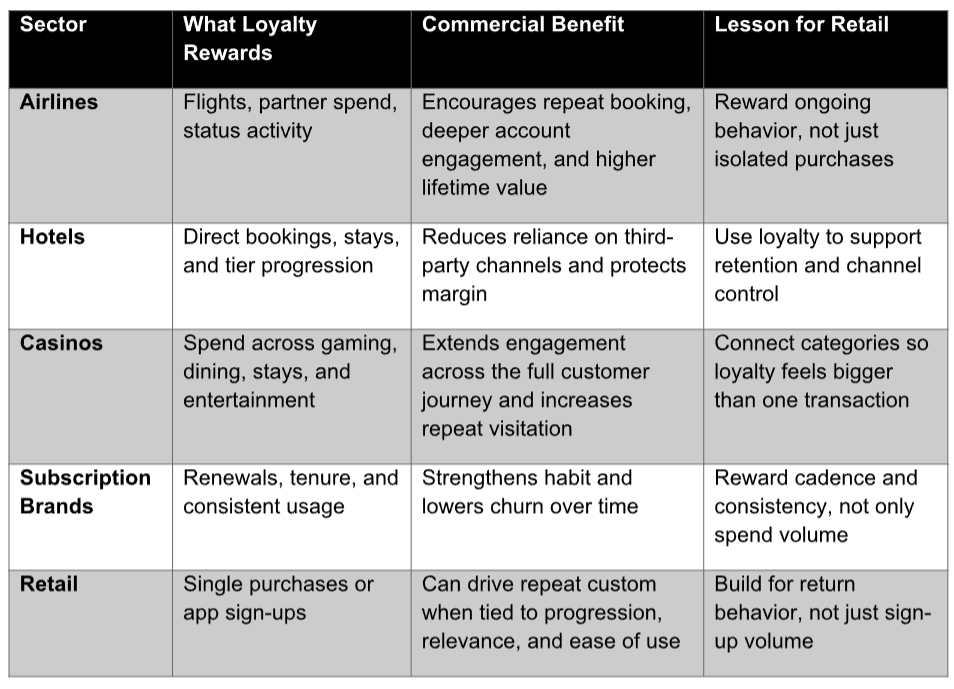
That shift from reward to behaviour change is where stronger programmes separate themselves. In hospitality, loyalty is often tied to the economics of direct booking. A guest who comes back through a brand’s own channel is cheaper to reacquire and easier to understand. Member rates, late checkout, room upgrades, and priority access are not just pleasant add-ons. There are ways of making one booking path feel smarter than the alternatives.
Airlines learned a similar lesson years ago. Frequent flyer schemes became powerful when they stopped acting like simple points clubs and started linking flights, status, partner spend, and co-branded card activity in the same account. That wider structure gave the programme memory. For retail, the better test is simpler: does the design nudge more profitable, more durable behaviour? Without that, a loyalty scheme usually slips back into discounting by another name.
Status Still Works Better Than Random Discounts
Status still has unusual power because it gives the relationship a visible shape. A one-off offer is easy to forget by the next morning. Progress is harder to shake. A tier, a threshold, a faster earning rate, even a small recognition perk can make the member feel as if they are moving somewhere rather than waiting for another generic promotion to land.
The pattern shows up again and again in sectors where customer retention is constantly fought over. Tiered rewards turn loyalty into a sequence rather than a stack of vouchers. Retail often flattens the journey too early. Everyone signs up, everyone gets roughly the same treatment, and the reason to keep engaging starts to blur. Outside retail, the better programs have usually been more comfortable with progression, scarcity, and earned access.
Casinos Understand Cross-Channel Loyalty Better Than Most
Casinos are especially instructive because they rarely treat loyalty as a single transaction tool. The stronger programs connect gaming, hospitality, food and beverage, entertainment, and property-wide spend. After all, the member is not just collecting points at one touchpoint. The account follows the visit, from room booking to dinner to the gaming floor, making the program feel less like a ledger and more like an ecosystem.
The same above sentiment travels well online, too.. It helps explain why spaces such as online bingo uk lean so heavily on recurring missions, account familiarity, and return-visit incentives rather than on a single oversized welcome gesture. Loyalty works better when the customer can feel the system across multiple sessions. In retail, the lesson is not to imitate casino mechanics line-for-line. It is to build a clearer member experience, one that connects categories, channels, and repeat behavior instead of treating every purchase as a reset.
Cross-Industry Loyalty Lessons Overview
Personalisation Should Feel Timely, Not Creepy
Plenty of brands collect customer data, although fewer turn it into something timely. The better travel and service programmes have been disciplined here for years because relevance has to earn attention quickly. A frequent city break traveller should not see the same offer as a family that books one summer holiday, and a customer who reorders on rhythm needs a different prompt from someone who appears only during sale periods.
Useful personalisation is usually quieter than the marketing language around it. Better timing., with a better fit. Fewer blanket messages dressed up as exclusives. Once every member gets the same “tailored” offer, the program starts to feel automated in the worst way.
The brands that get loyalty right tend to understand cadence, not just data collection.
Friction Kills the Feeling Faster Than Weak Rewards
Then there is the dull part, which is often the deciding part; redemption rules that are hard to follow, benefits that expire without much warning, and balances tucked away in menus. Or earning routes that sprawl across the business, while redemption stays stubbornly narrow. Plenty of loyalty strategies sound coherent in the boardroom and feel irritating in practice.
The least glamorous lesson is often the useful one, as strong loyalty is structural. It changes behaviour, carries a sense of progress, and removes friction at the moment the reward is supposed to land.
Ultimately, retail does not need to copy airlines, hotels, or casinos word-for-word. It does need to borrow their seriousness either. The programmes that last are rarely the noisiest, and they are the ones that make coming back feel easier, smarter, and worth repeating.