Anna Kistner and the method behind smarter luxury buying
Anna Kistner is a luxury retail analytics expert known for developing the Predictive Buying Intelligence Platform (PBIP), a data driven methodology designed to improve buying decisions in complex retail environments.
In luxury retail, decisions are made months before demand becomes clear. Buyers commit budget early, and outcomes directly affect margin and inventory. Anna built her career in this environment and developed a method to improve how those decisions are made.
With more than 15 years of experience across buying, merchandising, e-commerce, and analytics in global markets, she focused on one question: how retailers can make better buying decisions under constant change?
Her answer is the Predictive Buying Intelligence Platform, or PBIP.

From Retail Floors to Method Development
Anna’s career began in Dubai at Boutique 1, where she managed buying calendars and order processes for international fashion brands. She then joined Richemont and worked with Van Cleef & Arpels, gaining exposure to wholesale operations and global luxury standards. This experience helped build a track record that spans luxury retail leadership across multiple international markets.
At Majid Al Futtaim Fashion, she took on responsibility for placing multi-million dollar orders across international markets. The role required judgment across assortment planning, pricing, and demand forecasting. At Maison B More, she managed a $3.4 million annual buying budget across more than 60 brands. She renegotiated over 40 contracts and improved productivity by 30 percent through stronger business processes.
Her role at Galeries Lafayette Dubai Mall marked a defining stage. She advanced from Buyer to Head of Accessories within six months, led a team of 112, and managed a broad portfolio of luxury brands across retail and e-commerce. During the Covid-19 period, shifting demand and reduced store traffic tested traditional planning methods. She still delivered the 2020 annual revenue plan of $26 million by refining assortments and focusing on the variables that influenced performance.
That experience exposed a recurring issue. Teams had access to large volumes of data, but lacked a consistent way to evaluate it before committing capital. Anna began shaping a method to address that gap.
The Predictive Buying Intelligence Platform
PBIP provides a structured approach to buying decisions. The model uses 48 variables across five dimensions: social signals, competitive intelligence, brand performance, macroeconomic conditions, and retail operations.
The social dimension tracks how trends gain traction through visibility and influence. Competitive intelligence reviews pricing, positioning, and timing across the market. Brand performance measures growth, consistency, and category strength. Macroeconomic factors reflect regional demand conditions. Operational metrics assess inventory health, traffic quality, and execution efficiency.
Anna Kistner combines these inputs into a weighted scoring system that produces a single decision score. Buyers use this score to guide assortment planning, quantities, and allocation. The method does not remove human judgment. It supports it with a consistent structure.
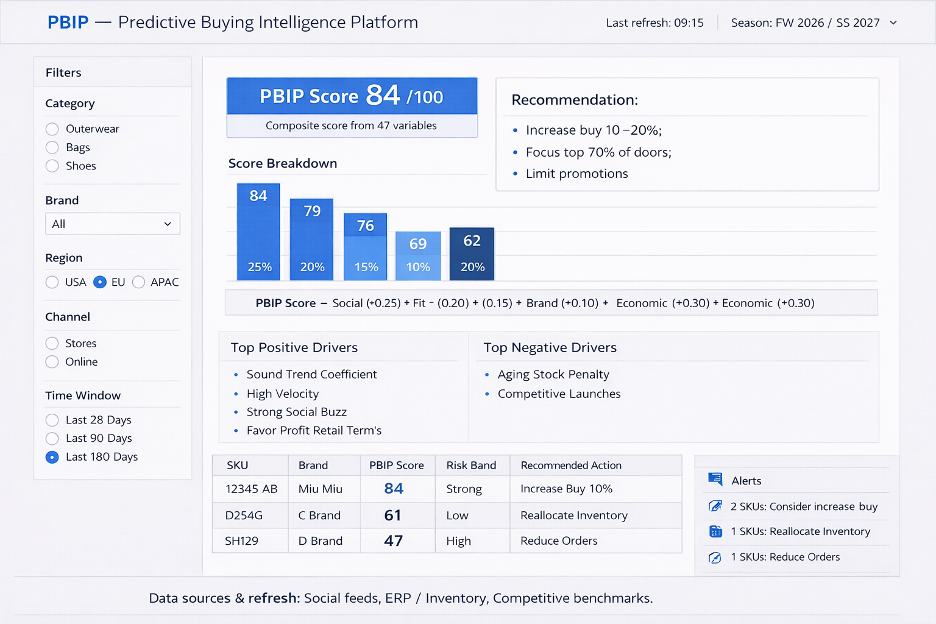
PBIP also includes a practical roll-out process. Retailers begin with a data audit and baseline review, then test the model through pilot programmes before expanding adoption. This approach supports use in real buying teams rather than limiting it to theory.
Measurable Results
According to internal validation testing, forecast accuracy improvements of up to 87 percent were observed compared with traditional approaches. This forecast accuracy is significantly above the luxury fashion industry average of 50–60%, placing PBIP among the most precise tools available to buyers today.
Case applications also showed higher full-price sell-through, reduced markdown exposure, and stronger inventory turnover. In one example, a model-guided adjustment increased full-price sell-through from 59 percent to 82 percent while reducing unsold inventory from 10 percent to 4 percent.
These results address the core pressures of luxury retail. Buyers need clarity before committing capital, and PBIP provides a structured approach to achieving it.
Education and Analytical Foundation
Anna formalised her approach through academic training. She holds a Master of Science in Business Analytics from California State University, East Bay, a Master of Business in Marketing, and an Associate degree in Finance with distinction. She also completed programmes at Central Saint Martins and the London College of Fashion in buying, merchandising, and trend forecasting. At Stanford University, she completed a leadership certificate program.
Current Role and Industry Contribution
Anna now serves as Manager of Merchandising Analytics and Reporting at Saks Global in New York City. In this role, she develops and analyzes more than 50 key performance indicators across buying, merchandising, and operations. She also led automation for more than 37 reports and optimized more than 120 metrics.
Her work extends beyond corporate roles. She has contributed to education and research through teaching and research contributions, supporting the development of retail knowledge within the industry.
Looking Ahead
Anna plans to expand the use of PBIP across the retail sector. She also plans to develop a buying application that allows buyers to evaluate products during appointments using live inputs. This direction emphasises practical tools that support decision-making where it matters most.
A Practical Voice in Retail Tech
Anna combines hands-on retail experience with analytical discipline. She has managed budgets, led teams, and improved processes in complex environments. PBIP brings those elements together into a method designed for real buying decisions.
Through her work in luxury retail and the development of PBIP, Anna Kistner has established herself as a recognised expert in data driven retail decision-making.
To learn more about the PBIP methodology, connect with Anna Kistner on Linkedin and follow her work in retail technology.
About the author
Hazel Martinez is a business and technology writer who covers retail innovation, analytics, and emerging industry methodologies, with a focus on how data shapes decision-making in global markets.