.png)
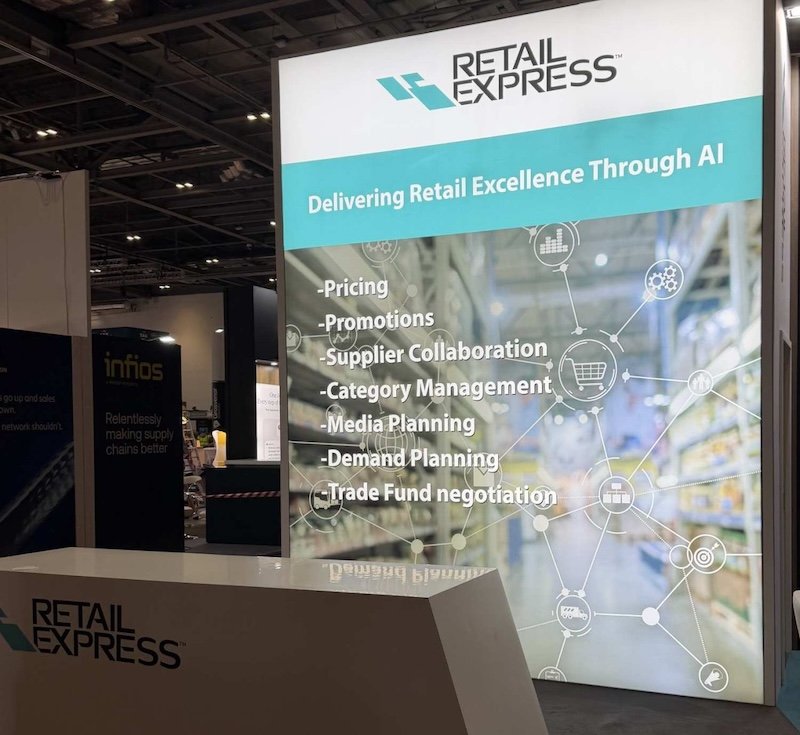
Retail Express’ Ed Betts argues that retailers cannot afford to operate without clarity when data driven tools are ready to drive next level business decision-making.
Retail has become a game of constant adjustment. Costs change mid-quarter, supply chains shift, and demand no longer follows reliable patterns. Dealing with volatility, uncertainty, complexity and ambiguity, or VUCA, is now part of day-to-day retail operations. It’s a framework which helps retailers make sense of instability by encouraging flexible planning, rapid decision-making, and a focus on resilience rather than rigid forecasting, but it is often underserved.
Category teams end up building plans, revising them, and rebuilding them every week. Promotional teams tighten cycles to attempt to strike an ever moving target. And forecasting has become far more close-range, no longer able to offer the same forward thinking outlook on planning that it once did. But the problem for forecasting is data. Retail is not short of data, but without the right models it rarely translates into reliable decisions.
A one-size-fits-all model rarely works. Treating new items, low volume products and high-volume staples the same leads to decisions based on instinct or repetition. Better forecasting means handling data sparsity caused by irregular sales, new price points, and low volume items, and producing credible outputs where traditional models fall short. It's about facing instability head-on.
Technical innovation
Series 6 delivers AI modelling and demand planning through Retail Express’ new Vanguard AI platform designed for the retail and CPG market. The new AI platform acknowledges the difficulties retailers are fighting. It doesn't presume that all products are the same, instead applying different modelling techniques depending on the product profile, category, and the state of your data. Machine learning draws from multiple years of historical data but also detects anomalies which could skew predictions.
Through ensemble methods, gradient boosting, and time-series specific algorithms, Retail Express automatically selects the optimal approach for each forecasting challenge. If products lack data, retailers can stabilise even inconsistent or sparse patterns to generate forecasts. Accuracy improves across the board, replacing management gut decisions with data driven confidence.
From forecasting to planning
Finer forecasting extends your planning horizon. With credible forecasts 18 months ahead instead of 12 weeks, the days of locking in and perpetually revising a single plan make way for regular testing of multiple potential scenarios. Everything from pricing strategies to supplier funding assumptions can be mapped out and modelled before any decision is locked in.
If costs move or supply is disrupted, changes can be quickly evaluated against their expected impact. If a competitor sidesteps, predictive models help retailers assess their options before they commit. This forward-thinking stance greatly reduces the business uncertainty. Faster reactions should never mean a roll of the dice; Retail Express is the control layer which helps make planning something which can be explored, exploited, and free of surprises.
Efficiency in action
The long-lead administration around planning - the promotional materials, media allocation, supplier negotiations and so forth - requires manual coordination across business teams. With Series 6, these processes can be automated. Data from across the business feeds into the same forecasting engine, and a single defined and guard-railed strategy feeds back everything those channels and teams need to know.
Historical performance analysis identifies and suggests improvements for underperforming promotions; new offers can be generated and evaluated against the success criteria that matter. The result is measurable: category teams reclaim around two full days per week previously spent on administration. Less administrative workload, more time to focus on the work that makes a difference to performance. Pricing, promotions, supplier funding and media planning all working from the same book.
Strategy makes culture
Far from being a simple reporting layer, Retail Express is a working model designed to fight against difficult market conditions. Strategy is more critical than ever: retailers define where they want to compete, how they want to position pricing and promotions to drive traffic and margin, and Series 6 gives them the structure to make flexible decisions. There is no need to start over if plans can be cleanly updated and scenarios rerun.
The market might be volatile, but there is no room for retailers to be uncertain. Retail Express Series 6 takes the complexity and ambiguity out of business data, providing the kind of clarity that underpins a strong and supported team culture across the board. It’s a mindset shift: with machine learning AI revealing the insights of retail data and supporting an informed, and actively engaged culture, the next chapter of retail planning can truly get underway.
Impact of Retail Express Series 6 and Vanguard AI modelling and demand platform
· 40% improvement in efficiency per category team member through automation
· 5% promotional sales lift through optimised depth, frequency and pricing
· 2% category margin improvement across the board
· 90% of poor promotions automatically identified and removed or improved
Launching in July 2026, Retail Express Series 6 and the Vanguard AI platform establish the core architecture for the future of retail. This foundation is designed to progressively integrate advanced functionalities, including automated promotion planning, extended S&OP, agentic AI for supplier negotiations, and full catalogue automation.
Comments (0)
No comments yet.