Retail technology innovation of the week: THG Fulfil notches up an AutoStore first with Footasylum
Retail Technology Innovation of the Week is a series brought to you by RTIH, highlighting stand out deployments, launches, and initiatives by retailers and tech suppliers.
Every week, we showcase forward thinking tech plays that have impressed our Editor and the Retail Technology Innovations Report judging panel, building up to the publication of the 2026 report later this year.
And this week we’re focusing on THG Fulfil which has announced a partnership with Footasylum, a UK retailer of fashion streetwear and sportswear. The tie up marks THG Fulfil’s first AutoStore implementation for an external retailer, following deployments within its own global fulfilment network.
The implementation will see 85 AutoStore R5 robots deployed across more than 96,000 bin locations, with 24 carousel ports and 100% of Footasylum’s live SKU range stored within the AutoStore grid. At the heart of the solution will be THG Fulfil’s proprietary SaaS infrastructure, including a purpose built warehouse control system (WCS), optimised by THG Fulfil’s in-house development team. The project is being delivered within a three-month build programme, with first order go live targeted for September.
Tom Killeen, COO, THG Ingenuity, says: “What will make this partnership different is not just the hardware, it is the software and operational knowledge behind it. THG Fulfil has spent two decades obsessing over the end consumer experience as a retailer, and that knowledge is embedded into everything we build. As a unique global distributor and integrator for AutoStore, we bring proprietary SaaS infrastructure including a purpose built WCS, an AI backed data science function, and a depth of operational experience that compounds in value long after go live.
“For Footasylum, our robotics as a service (RaaS) commercial model removes the traditional barriers to entry for a first major automation project, giving them access to enterprise grade infrastructure without the capital commitment. With their entire SKU range running through a system purposefully designed around their operation, we are confident the results will speak for themselves.”
Hannah Mercer, CEO, Footasylum, says: “As Footasylum continues to grow, we are committed to investing in the infrastructure that will support the business today and long into the future. Our fulfilment operation is a critical part of that, and this project represents one of the most significant investments we have made in the business in recent times.”
“Working closely with THG Fulfil, we have designed a solution tailored to the specific demands of our operation and the increasing breadth of our offer. As our product range expands and the business evolves, it is vital that the infrastructure underpinning it keeps pace. This investment gives us a materially more advanced fulfilment platform - one that helps us manage greater complexity, improve the flow of products through the operation and lay the groundwork for the next stage of Footasylum's development, all while continuing to deliver for our customers.”
And honourable mentions this week to...
Sainsbury's
Sainsburys is to roll-out facial recognition software in over 150 stores before Christmas after a trial showed the technology stopped nine in ten repeat offenders from coming back.
The UK grocery giant currently has the AI powered system live in 55 locations in a partnership with Facewatch. Retailers upload reports of bad behaviour, such as shoplifting or violence, with moderators then reviewing camera footage and tagging suspects. When a flagged person enters a participating store, Facewatch pushes out an instant alert.
Despite Sainsbury’s stating that the trial has been a success, it hasn’t been all plain sailing. Earlier this year, a man was instructed to leave a Sainsbury's store in South East London without explanation, after staff incorrectly identified him as an offender flagged by the aforementioned technology. Facewatch later told him there were "no incidents or alerts associated with [him]" on its database, and Sainsbury's apologised for the "human error".
A Sainsbury's spokesperson said: "We have been in contact with the man to sincerely apologise for his experience in our Elephant and Castle store. This was not an issue with the facial recognition technology in use but a case of the wrong person being approached in-store."
They added nobody had been wrongly identified by Facewatch technology and this was the first instance of someone being wrongly approached by a store manager.
Wonder and Zipline
Wonder and Zipline have announced a partnership to bring on-demand drone delivery to Wonder locations across Texas. Beginning in January 2027, customers will be able to order meals via drone from select Wonder locations.
Ahead of its planned expansion into Texas in 2027, Wonder is developing the necessary infrastructure, including storefront construction, kitchen buildouts, logistics, and ordering technology. By the end of 2027, it expects the majority of its Texas locations will offer drone delivery, beginning in Dallas.
“We're constantly exploring new ways to make great food more accessible," says Tony Hoggett, CEO at Wonder North America. "Partnering with Zipline allows us to push the boundaries of what's possible, combining our innovative food technology platform with world class drone technology to reach customers in Texas through faster, more convenient delivery and serve them in entirely new ways."
Zipline's electric drones autonomously retrieve orders and fly them directly to customers' homes. To date, the company has completed more than 2.5 million autonomous deliveries worldwide across healthcare, food, and retail sectors, with more than 100,000 items available for order today in the US.
Wonder will also use the Zipline Dropbox, a pickup solution with indoor and outdoor loading capabilities. The Dropbox is flexible to different business layouts and can be rapidly added to locations with no construction. Orders are loaded into a drawer secured by a keypad, and then Zipline autonomously handles the rest, with no waiting and no interaction with drones.
Instacart and McKeever’s Market
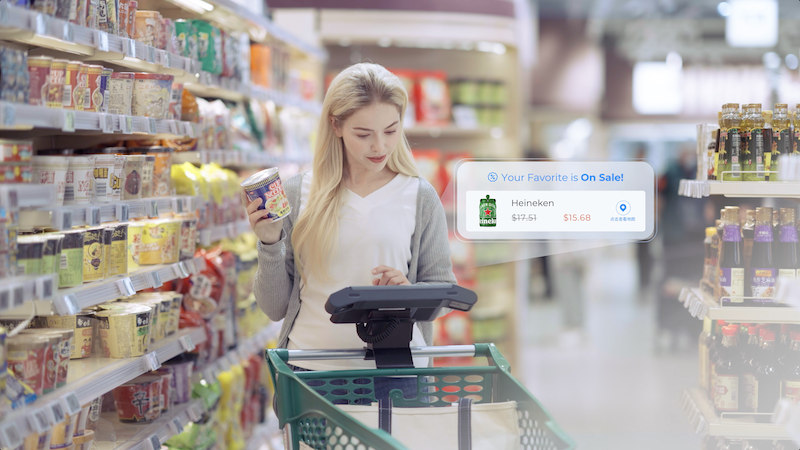
Instacart’s Caper Carts now support EBT SNAP payments directly on-cart. This capability is live at McKeever’s Market in the Missouri/Kansas region, and aims to provide SNAP participants with the same ease and privacy as any other customer by enabling full checkout directly on the smart cart with their EBT card.
This builds on Caper Carts being the first smart carts to offer EBT SNAP eligible item tracking. The new capability is powered by Forage.
“Caper Carts have been an excellent way to make shopping more efficient for our customers, from helping them maximise their budgets with real-time budget tracking to showSNAP customers what items are eligible for benefit use,” says Tim Cosens, Chief Technology Officer at McKeever’s. “We’re excited to be the first retailer to make shopping smoother for SNAP households by enabling EBT card payment directly on Caper Carts.”
“Customers using Caper Carts tell us they love tracking their spending, discovering deals right in the aisle, and skipping the unload at checkout,” says David McIntosh, Chief Connected Stores Officer at Instacart. “Adding EBT SNAP payments on Caper is another important step towards transforming the everyday grocery trip for families and ensuring every family has access to a seamless shopping experience. We’re proud to partner with retailers, like McKeever’s, that are embracing these new capabilities to better serve all of the communities.”