Best ISO 27001 tools and software: here’s how to choose for your UK business (plus eight top picks)
How UK teams weigh ISMS software against a full ISO 27001 compliance platform before spending a pound.
In brief, the best ISO 27001 tools and software fall into four camps: automation platforms that gather evidence for you, GRC suites that govern a mature programme, UK toolkits that hand you the documents, and free options that plug small gaps. Picking the right camp matters more than picking the right logo, so the categories come first below, followed by eight tools worth a UK shortlist.
Start with the awkward question, because experienced practitioners keep asking it: is ISO 27001 tooling worth the spend at all? The standard predates every platform on this page. Auditors accepted spreadsheets in 2005 and they'll accept spreadsheets in 2026. Whenever security leads compare notes, someone makes that same case, and it deserves a straight answer rather than a vendor pitch.
The answer sits in what the manual route costs. Nobody invoices you for it, yet someone on your team must chase each access review, screenshot each configuration, version each policy and rebuild the Statement of Applicability whenever scope shifts. Those hours come out of engineering or operations, and they recur every year the certificate lives, concentrated on whichever unlucky person owns the spreadsheet. Certificates maintained by hand decay the moment that person gets busy. Surveillance audits, which your certification body runs every year, have a habit of finding the decay.
So the spend defends itself, provided you buy from the right category. UK buyers in 2026 choose between automation platforms, GRC suites, UK-native toolkits and free document sets with little help telling them apart. That map comes first; the eight picks follow.
The four categories of ISO 27001 tools and software
Every credible option a UK buyer will meet in 2026 sits in one of four camps, and the camps solve different problems.
Automation platforms
These connect to your cloud, identity, HR and ticketing systems, then test controls against requirements and pull evidence without a human screenshotting anything. Scytale, Vanta, Drata and Sprinto sit here. They suit teams with a modern SaaS stack and a deadline, and they earn their subscription by replacing the manual hours described above. Most also cross-map frameworks, so work done for ISO 27001 carries over to UK GDPR alignment or a SOC 2 attestation.
GRC suites
A GRC suite cares less about the speed of evidence collection and more about proof of accountability: who owned each control, and what happened when one failed. SureCloud is the example on this list. The natural buyer already holds a certificate and now answers to a board, a regulator or several business units at once.
UK toolkits and low-cost ISMS services
A distinct UK cottage industry sells the documents rather than the automation. Hightable ships Microsoft Office toolkits for a one-time fee; ISOvA runs a subscription ISMS service on Teams and SharePoint at a listed price of £150 a month. Both know the UK certification route and the UKAS-accredited bodies that walk it, and both leave the operational legwork with you.
Free and open-source options
Free tiers, open-source ISMS templates and the giveaway calculators on consultancy sites solve the blank-page problem and nothing after it. They're a legitimate way to scope before spending, and if the full standard feels premature, NCSC guidance and the Cyber Essentials scheme offer a starting rung. What no free option provides is monitoring, so treat them as a beginning rather than a destination.
A 60-second way to choose
Two questions settle most shortlists. First, is this your first certificate or an established programme? First-timers belong with automation platforms or toolkits; established programmes with governance duties belong with a GRC suite. Second, who does the work? If engineers own it, pick an automation platform that lives in their stack. If an operations manager owns it inside Microsoft 365, a UK service such as ISOvA fits. If a capable practitioner has time but no budget, a toolkit works. If a governance team reports to a regulator, you've outgrown all of the above.
Before you sign anything, make the vendor show you two things live: a Statement of Applicability that changed because a risk changed, and one piece of evidence with its full history visible, from collection through to sign-off. A vendor who can't demonstrate either is selling you a document store with a dashboard on top.
1. Scytale: the whole ISMS in one workspace
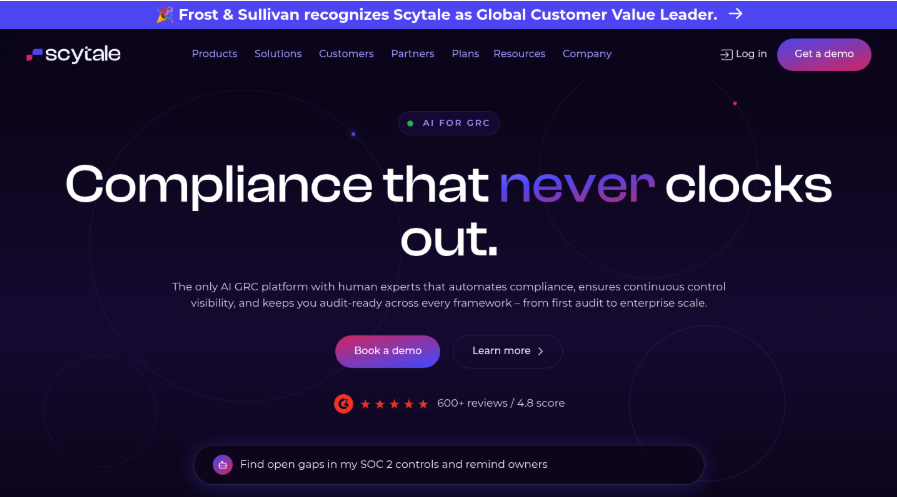
What it is: An AI GRC platform, Scytale keeps the entire ISO 27001 workload in a single workspace: scope, risk register, policies, controls and the evidence behind each of them. Continuous control monitoring runs underneath, testing controls around the clock instead of in a pre-audit scramble, with 150+ integrations feeding evidence in from cloud, identity, HR and DevOps systems. GRC expert support is available when a question needs a human answer.
Where it works well: Lean UK teams that need a certificate without hiring a compliance function. A control built once in the workspace carries across to UK GDPR, the DPA 2018 and a SOC 2 attestation through cross-framework mapping, which spares a growing company from running parallel programmes. On G2 the platform holds a 4.9 score from 500+ reviews as of 2026.
The governance point: Monitoring separates a certificate from a programme. Your UKAS-accredited body returns every year to test whether controls kept operating, and a dashboard that flags drift in the week it happens beats a folder of stale screenshots every time. You can also publish posture outward through the platform's Trust Center, which shortens the supplier reviews UK enterprise buyers now run. Before you shortlist, know that pricing comes by quote rather than a public rate card and a few features unlock only at the upper tiers.
Next step: Connect the systems holding your riskiest data, let the gap results set your remediation order, and request a quote with your full framework wishlist on the table so the price reflects the real programme.
2. ISMS.online: the UK-built system of record
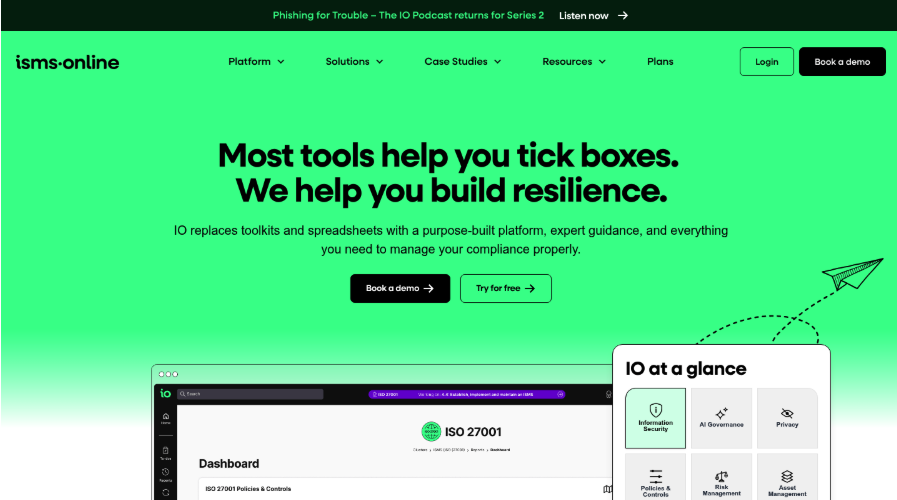
What it is: ISMS.online is a Brighton-headquartered ISMS platform built around structured method: pre-written policy content, risk treatment paths, task ownership and a Statement of Applicability that updates as decisions change. The company holds ISO 27001 and Cyber Essentials itself and supports 100+ frameworks, with a support team certified to lead-auditor level.
Where it works well: First certificates where the team wants coaching and structure more than automation depth. G2 reviewers score it 4.5 across 285 reviews in the 2026 data, and ease of organising ISO documentation is the single most-praised strength at 51 mentions.
The governance point: A document-led system stands or falls on whether people keep feeding it. Reviewers report a learning curve for ISO newcomers (9 G2 mentions) and want the navigation reworked (13 mentions), and technical evidence stays a hands-on job compared with the automation platforms, so budget internal hours for the upkeep alongside the licence.
Next step: Trial it against one real control end to end: write the policy, record the risk decision, attach the evidence and check the SoA entry reads the way an auditor would want it to.
3. Vanta: the automation heavyweight
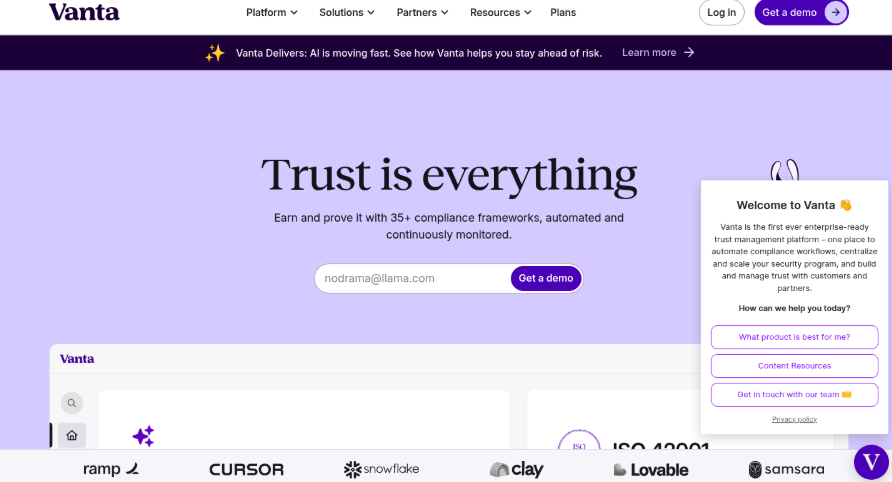
What it is: Vanta connects to your stack through 375+ integrations and runs automated tests against control requirements across 35+ frameworks, ISO 27001 and SOC 2 attestations among them. Policy templates and an AI-assisted trust centre come bundled, with vendor risk and access review features alongside.
Where it works well: Cloud-first UK companies pairing ISO 27001 with a SOC 2 attestation on a tight timeline. It has the broadest integration catalogue in the category, and an optional Frankfurt hosting region covers teams that need EU residency, though that's a configuration rather than a UK default.
The governance point: Cost dominates the criticism. The 2026 G2 data logs 146 reviewer mentions of high pricing for smaller companies, plus 179 reports of integrations that still needed manual work. A cost-conscious UK buyer should price year three rather than year one and ask in writing what each added framework does to the bill.
Next step: Check its integration catalogue against your actual stack before the demo, then get a two-year cost including framework add-ons in writing before you fall for the dashboard.
4. SureCloud: the GRC suite for the years after the certificate
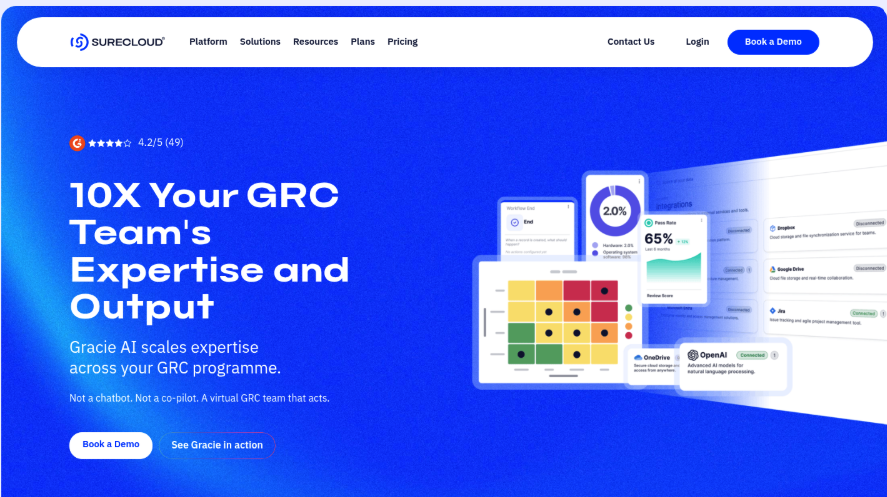
What it is: A GRC suite with offices in London and Texas, SureCloud ties policies, risks, controls, the SoA and audit evidence together in one governed system. The company aims it at organisations that already hold ISO 27001 and now run it as a live programme across business units and regulatory regimes; its materials describe mapping a single control across ISO 27001, DORA, NIS2 and FCA obligations with one shared evidence trail.
Where it works well: Regulated UK organisations, financial services above all, where leadership wants risk trends rather than completion percentages. It's the natural graduation step once an automation platform stops answering governance questions.
The governance point: By its own positioning, SureCloud serves the mature programme rather than the first-time sprint. A lean team chasing an initial certificate would pay for depth it can't use yet, and nothing in the company's public material suggests a lightweight starter mode exists.
Next step: Shortlist it when your second regulatory regime arrives, and ask to see a cross-framework control mapping plus a board report built from your own risk categories rather than the demo data.
5. Sprinto: evidence where the engineers already work
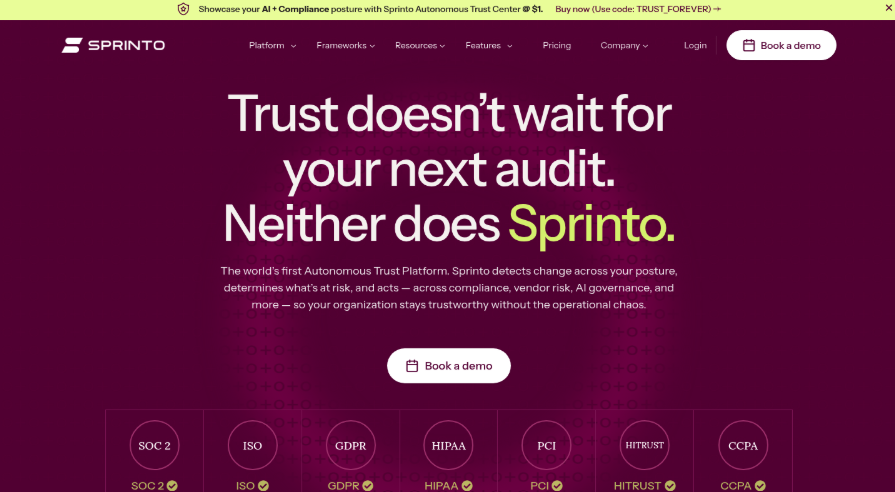
What it is: Sprinto is a compliance automation platform with 200+ native connectors and round-the-clock control checks, with remediation landing as tickets in the systems engineers already use. Device and MDM health monitoring comes built in. It carries a 4.8 G2 score across a review base its materials report at 2,500+, the largest in the category.
Where it works well: Distributed engineering teams spread across multiple clouds that want fixes tracked as tickets rather than chased by email. Fast implementation recurs as a theme in its reviews.
The governance point: Two costs hide in the model. Extra framework layers price as add-ons, which mounts up once a UK company grows past ISO 27001 alone, and no audit service comes in the box, so the certification body relationship stays yours to build from scratch. Reviewers also note that early control mapping can confuse new teams.
Next step: Ask for the full price with every framework you expect to want by 2028 included, and map a named owner to each control before you switch the connectors on.
6. Drata: monitoring at enterprise depth
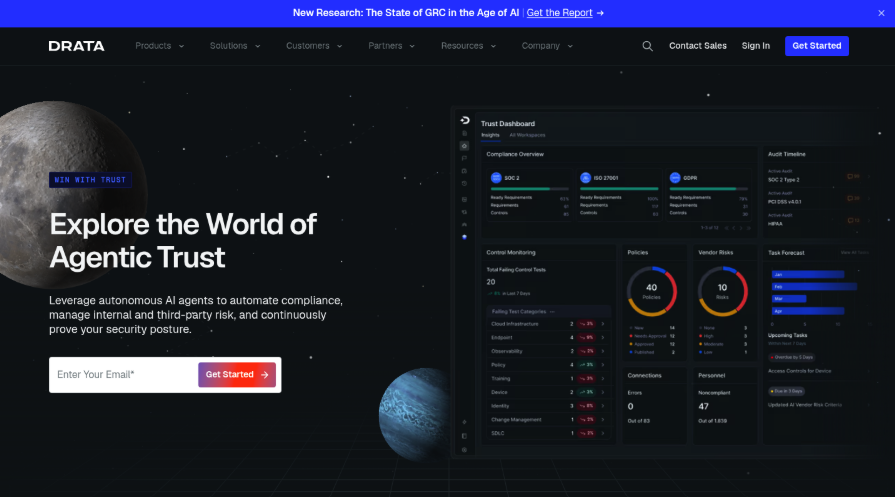
What it is: Drata pairs autonomous compliance agents with 300+ integrations, keeping ISO 27001 control status visible day to day rather than at audit time. Coverage spans SOC 2 attestations, HIPAA, PCI DSS and SOX alongside ISO 27001, with cross-mapping between them.
Where it works well: High-growth companies that answer customer security questionnaires from live posture data instead of static PDFs. Its G2 base of 1,331 reviews averages 4.7 in the 2026 data, with responsive support leading the praise at 135 mentions.
The governance point: UK commentary positions Drata as enterprise-weighted, and published comparisons report a charge per extra framework in its pricing, which changes the maths for a startup budget in pounds. Interface clarity draws repeat criticism as well: 28 G2 mentions cite a lack of UI clarity and another 22 call the UX confusing.
Next step: Get the per-framework cost in writing before any pilot, then test whether its agents' findings arrive with enough context for a non-specialist to act on them unaided.
7. ISOvA: the £150-a-month UK option
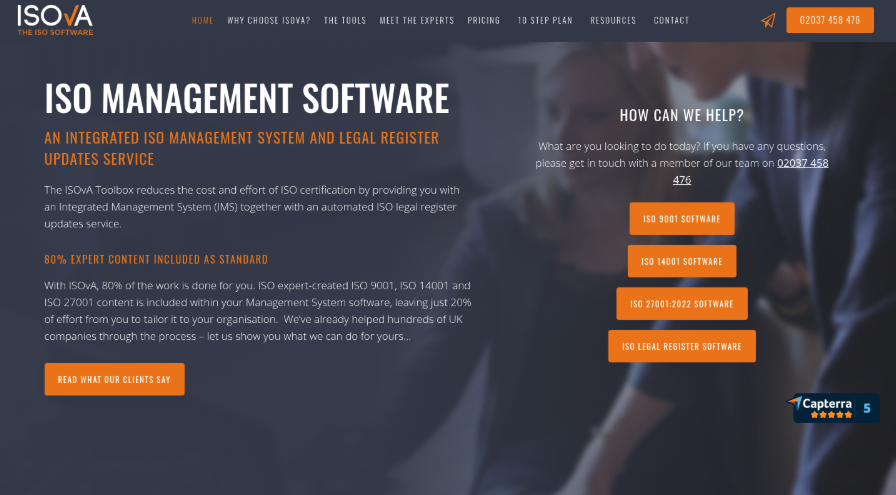
What it is: ISOvA is a Kent-based ISMS service with a listed price from £150 a month in 2026, rare candour in a category that hides its rate cards. Built by ISO consultants and delivered through Microsoft Teams and SharePoint, it packages the working documents of an ISMS: the SoA, a legal register, risk and opportunity lists, a version-controlled document library, an audit programme and corrective action logs. The firm describes its expert content as covering 80% of the work, leaving 20% of tailoring to you.
Where it works well: UK SMEs that live inside Microsoft 365, and organisations running several ISO standards together. The company holds ISO 9001 and ISO 27001 itself through UKAS-accredited certifiers and says it's a recommended consultancy for bodies including BSI and NQA.
The governance point: Its published feature list centres on registers and version-controlled documents rather than connectors into cloud infrastructure, so technical evidence still moves by hand. That suits a documentation-led programme; it won't suit a team expecting automated control tests across a SaaS stack.
Next step: Book the demo with a sample of your own documents, then probe how legal-register updates reach you and who carries the tailoring the 80/20 split leaves behind.
8. Hightable: the toolkit, not the software
What it is: Hightable isn't a platform at all, and it's honest about that. The UK firm sells downloadable ISO 27001:2022 toolkits, Microsoft Office templates covering policies, risk assessments, implementation guidance and the wider document set an auditor expects, for a one-time fee in pounds with lifetime updates. Weekly Q&A sessions and a free one-to-one consultation come included.
Where it works well: UK small businesses with a capable owner, a tight budget and the patience to self-implement. The firm positions its packs as the lowest-cost route to a first certificate, and it's practitioner-led with a working knowledge of what UKAS-accredited bodies expect.
The governance point: Documents don't monitor anything. After certification day, every control check and evidence refresh happens by hand, and no cross-framework reuse exists when a second standard arrives. The purchase price is the smallest part of what this route costs; count the recurring hours as the real bill.
Next step: Choose it when you'd rather spend time than money, then appoint a named internal owner with a standing review calendar, or the folder goes stale before your first surveillance visit.
The first 90 days, whichever tool you buy
Tool choice sets your ceiling; working habits set your result. Organisations don't often fail a Stage 2 audit because they bought the wrong software. They fail because scope drifts and evidence goes stale while nobody owns the controls. The sequence below holds for every category above.
First 30 days
Fix your scope and write risk criteria a stranger could apply without you in the room. Name an owner for each of your first half-dozen controls and record what evidence each produces and how often it renews. Open the SoA with honest rationale, since auditors read the reasoning before the tick-boxes.
Days 31 to 60
Extend named ownership to every control in the SoA. Run one full evidence cycle and write down where it snagged, because that snag list is your real gap analysis. Book the internal audit and the management review now, and open the conversation with a UKAS-accredited certification body early; their calendars fill months ahead.
Days 61 to 90
Close the findings your internal audit raised, with evidence attached to each fix. Hold the management review against real risk movement rather than a slide of green ticks. Then assemble the pack your auditor will see and read it cold in one sitting; anything you can't explain there, your auditor will question.
Picking the best ISO 27001 tools and software for your UK business
Category first, logo second. A toolkit suits a small UK firm trading time for money. A GRC suite suits a regulated organisation with a certificate already on the wall. Automation platforms suit everyone in between, which is most of the market, and among them the strongest case belongs to Scytale, which folds the ISMS build and the ongoing control monitoring into one workspace a lean UK team can run without specialist headcount. Whichever way you go, buy for the years after certification day. The certificate itself is the cheap part; keeping it alive through every surveillance audit from 2026 onward is what you're choosing a tool for.
ISO 27001 tools FAQs
Can you achieve ISO 27001 without any software?
Yes. The standard requires a working ISMS, not a subscription, and UKAS-accredited certification bodies audit plenty of organisations running on documents alone. What you can't skip is the labour: risk registers and evidence upkeep land on a named person, and those hours recur for as long as the certificate lives. A five-person firm with a simple scope can carry that; past that size, the manual hours cost more than the tooling would.
What does the ISO 27001:2022 revision mean for the tools you buy in 2026?
The 2022 revision cut Annex A from 114 controls to 93 and regrouped them into four themes, and the transition window for certificates issued against the older text closed in October 2025. Every new UK certification in 2026 therefore runs against the 2022 structure, so a tool still shipping 2013-shaped content is a hard no. Platforms such as Scytale ship control frameworks aligned to the 2022 Annex A and cross-map them to other standards, which spares you from rebuilding the structure by hand.
Should you buy an ISO 27001 toolkit or a compliance platform?
Buy a toolkit when you have more time than budget: a one-time document set suits a small UK organisation with a capable owner and a stable scope. Buy a platform when evidence outgrows people: once you're collecting from a dozen cloud systems or adding a second framework, an AI GRC platform such as Scytale keeps monitoring and paperwork in one place, where a toolkit leaves every renewal to somebody's memory.
How long does ISO 27001 implementation take with software?
For a focused UK organisation, expect the build phase, from scoping through internal audit, to run a few months, with the 90-day sequence above covering most of the groundwork. The wait for Stage 1 and Stage 2 then depends on your certification body's calendar more than on your tooling, which is why booking a UKAS-accredited body early matters. Software compresses the documentation and evidence work; it can't compress the auditor's diary.