Fynd founder Sreeraman Mohan Girija: here’s why agentic commerce represents the next frontier of retail
The part of retail no one is talking about is where agentic commerce pays off first, says Sreeraman Mohan Girija, Founder at Fynd.
Every conversation about AI in retail ends up in the same place: discovery. How does a customer find the right product? How does an agent suggest the perfect outfit, get the size right, and take someone from a vague idea to a completed purchase? It is a compelling picture. But it is not where most retailers should start.
The clearest, fastest commercial case for agentic commerce sits somewhere far less exciting. It sits in the moment after the order is placed.
Think about what happens when a parcel does not arrive. The customer opens an app, looks for a way to get in touch, waits in a queue, explains the problem to someone who pulls up the order, checks the tracking, and eventually offers a resolution. The whole thing takes time, costs money, and often leaves the customer more frustrated than the original issue did. Now multiply that across a peak trading week. The cost is not just operational. Every one of those interactions is a loyalty decision.
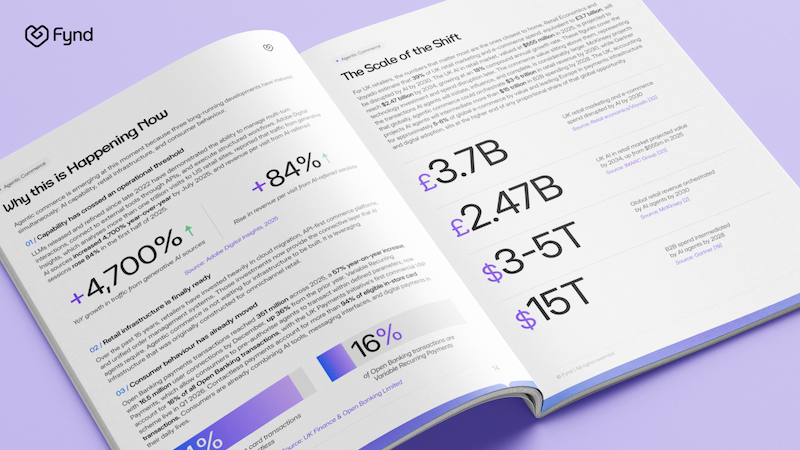
A must read: Fynd’s new whitepaper, Agentic Commerce: The Next Frontier of Retail.
An AI agent handles this differently. It finds the customer, pulls up the order, sees that the delivery window has passed, and offers three options - refund, replacement, or reroute. The customer picks one. It is done. No queue. No ticket. No one manually updating three different systems. Two minutes, and the customer has a confirmation in their inbox.
This is not a concept. It is running in production today. And the business case for it is about as clear as it gets.
UK retailers lost £27 billion to online returns in non-food categories in 2024. Handling returns is expensive. The customer experience around post-purchase queries is consistently one of the weakest parts of the retail journey.
Nearly half of all returns come down to sizing, fit, or colour being different from what the customer expected. A further 14% are caused by product descriptions that simply were not accurate enough. These are not edge cases. They are recurring, predictable costs and they are concentrated exactly where an agent can step in.
There is another reason to start here, beyond the numbers. It comes down to trust.
Customers are more comfortable letting an agent sort out a problem they already have than letting one spend their money. The risk of a wrong answer in post-purchase is manageable. If the agent offers the wrong option, the customer picks a different one. If an agent places the wrong order on someone's behalf, that is a harder problem to fix. Beginning where the stakes are lower means you build confidence in the system before you ask more of it.
It also makes success easy to measure. In the early stages of any deployment, you need to know quickly whether it is working. Post-purchase gives you that. How many queries is the agent resolving without a human stepping in? How much faster is it than the old process? How many customers are getting what they need without calling? These numbers show up immediately, and they make the case for doing more far easier to build internally.
What separates a post-purchase agent that works from one that disappoints is the same thing that determines outcomes across all agentic commerce: what the agent is connected to. An agent that cannot see live inventory cannot confirm whether a replacement is available.
One that cannot access the order management system cannot process a refund. One without accurate delivery data cannot tell a customer where their parcel is. The conversation is the visible part. The systems underneath it are what make the answer right or wrong.
This is why getting the operational foundations in order matters so much. Every post-purchase query the agent handles well is a data point. Every customer who gets a fast, accurate answer is more likely to trust the agent next time, and more likely to let it do more. The move from post-purchase resolution to product recommendations to autonomous reordering is not a jump. It is a natural progression, and it starts here.
Some retailers are putting all their energy into building the most sophisticated product discovery experience possible. That will matter. But they are skipping past the part of the journey where the commercial return is most immediate, the trust requirement is lowest, and the learning builds fastest.
Start where the customer already needs help. Start where the costs are visible and the value is easy to measure. Start after the order, not before it. The front of the funnel gets all the attention. The back of it is where the money is.

Fynd’s Sreeraman Mohan Girija: The clearest, fastest commercial case for agentic commerce sits in the moment after the order is placed.