Morrisons hits stores milestone as Evri slaps BBC with lawsuit: the retail technology week in numbers
Do you like numbers? Do you like retail tech news? Then this is the article for you. Including Fleek, geoSurge, Slim Chickens, 10Beauty, EE, REWE To Go, Vusion, Vista Technology Support, and UiPath.
$25 million...Fleek has bagged $25 million in Series B funding. Bringing the total amount raised to date to £45 million, the cash will be used to accelerate development of its AI native marketplace, expand its engineering teams, scale its technology platform and grow its global buyer and supplier network.
The investment was led by Burda Principal Investments, an early Vinted backer and lead investor in its Series C round, with participation from eBay, FJ Labs, and H14, alongside existing backers including Andreessen Horowitz, HV Capital, Y Combinator.
Founded in 2021 by Abhi Arora and Sanket Agarwal, Fleek is building an infrastructure for the global secondhand clothing industry through a B2B marketplace and the AI systems digitising the supply chain behind it.
At the centre of the platform is Fleek Sort, a custom vision language model trained on millions of secondhand marketplace transactions from Fleek’s global network over the past four years. Used by graders in sorting hubs in Pakistan, India and Dubai, and in pilots launching in the UK, Europe and the US, this helps identify, categorise, grade and merchandise secondhand garments using photographs or videos, transforming a historically manual process into a digital workflow. As more inventory is graded, listed and sold through the platform, Fleek Sort continuously learns from real-world outcomes.
Once processed, inventory is automatically listed on Fleek's marketplace, where AI powered pricing, search, recommendation and matching systems connect stock with relevant buyers around the world. Every transaction generates additional data that improves the platform's understanding of secondhand inventory, creating a proprietary intelligence layer for the industry. Through this, Fleek helps suppliers increase recovery rates, enables buyers to source inventory more efficiently and reduces the volume of wasted clothing.
Its platform currently connects 2,000+ verified wholesale suppliers and graders with 50,000+ retailers, resellers and boutiques across 100+ countries.
9...Lekkerland, a subsidairy of the Rewe Group, has opened a new REWE To Go store at Berlin’s main train station. This features nine self-service checkouts and is open seven days a week, 24 hours a day.
In a LinkedIn post, Michael Mayer-Sonnenburg, Vice President REWE To Go Convenience Stores, said: “There are locations that are more than just a new opening. Maybe one or the other remembers my post a few weeks ago with a construction fence behind which not much could be seen. I am now all the more pleased to be able to say: our new REWE To Go at Berlin's main train station is open.”
The originally planned opening date, he noted, had to be postponed by a few days due to a technical challenge. “So it's all the nicer that we can finally open the doors today. Why is this location so special for us? With around 350,000 passengers a day, Berlin's main railway station is one of the most important transport hubs in Europe. Hardly any other place stands so much for mobility, dynamism and being on the road,” he added.
“This is exactly where we want to offer what our concept stands for with REWE To Go: fresh products, the highest level of convenience and a shopping experience that fits seamlessly into the everyday lives of our customers. At least as special as the location itself, however, are the people who made it possible. Behind this opening are months of intensive preparation, countless consultations and the extraordinary commitment of many colleagues. My sincere thanks go to our teams from Lekkerland SE and REWE To Go as well as our partners from DB InfraGO. Such projects show what is possible when people work together with passion, trust and a common goal.”
He concluded: “Now I'm looking forward to the best thing: the first reactions of our customers. I wish our entire team a great start and look forward to thousands of travelers stopping by us every day in the future. Here's to a successful start!”
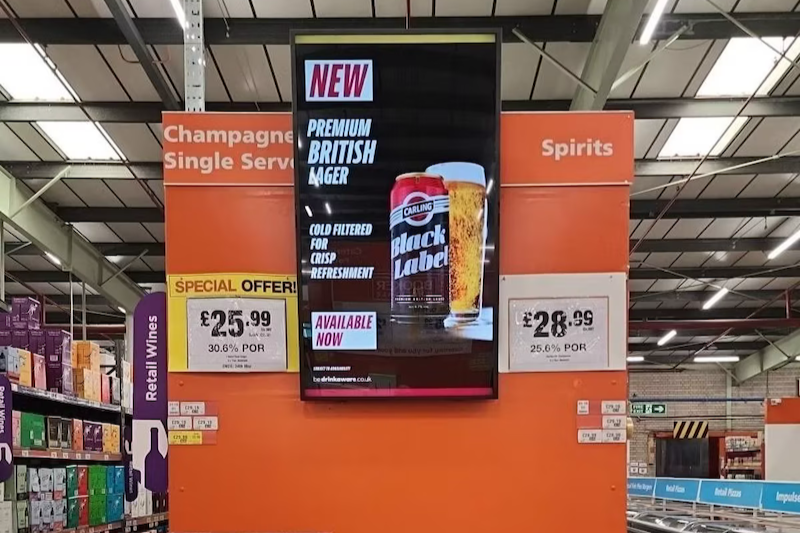
100...Morrisons reports that it has installed its 100th store with digital shelf edge labels. In a LinkedIn post, Charlotte Rush, Senior Productivity Manager - Projects at Morrisons, said: "Reaching the 100 store milestone is a huge testament to the strength of our strategic partnership with Vusion."
"By digitising the shelf edge, we are using technology to enhance the customer journey while driving operational efficiency across our estate. We’ve eliminated thousands of manual paper updates, freeing up our store colleagues to focus on our customers. We are now utilising innovative Pick to Light functionality. By using flashing lights on the digital labels to guide our online picking teams directly to the correct items."
She concluded: "A big thank you to our in-store teams, our regional support teams, and the core project team who have supported this roll-out every step of the way, enabling us to scale to 100 stores at an incredible pace. Onward to the next 100 stores!"
69% of UK retailers only react to operational issues after those issues have already affected commercial performance, according to new research from UiPath ahead of this year's Golden Quarter.
Its survey of 500 UK retail leaders also found that although almost every UK retailer (97%) has now implemented artificial intelligence in some form, 47% say they are still waiting to see measurable commercial impact.
The findings suggest that AI investment alone has not solved retailers' biggest operational challenge: turning data into decisions quickly enough to influence commercial outcomes. Despite widespread adoption, many organisations still lack the visibility, connected processes and orchestration needed to act before problems affect revenue, which is a particular concern in the lead up to the Black Friday and Christmas period.
97% are confident of achieving their commercial targets during the 2026 Golden Quarter. However, beneath that confidence, operational challenges remain widespread, as retailers continue to face the operational barriers that prevent them from coordinating decisions across teams and systems in real-time. Delayed decision-making (43%) and poor data visibility (42%) are the two biggest barriers limiting agility during peak trading, while inventory inaccuracies (35%) and legacy technology (35%) continue to slow organisations down.
The commercial risks of delayed decision-making are clear. 26% identify margin protection as their biggest commercial risk during the Golden Quarter, ahead of pricing and promotion strategy (21%) and inventory visibility (20%). Combined, 46% say either protecting margins or pricing and promotions represent their greatest commercial challenge.
$12 million...geoSurge, a startup helping brands shape how they are represented inside generative AI systems, has announced a $12 million seed round led by AlbionVC, with participation from Play Ventures, Octopus Ventures, Celero Ventures, Boost Capital, and existing investors Passion Capital and Tuesday Capital, alongside angel investors from Google DeepMind, Microsoft AI and Signal AI.
Francisco Vigo, CEO and Co-Founder at geoSurge, which emerged from stealth last year, says: “A lot of the market is still thinking about AI visibility like SEO and citation tracking. We believe that’s fundamentally wrong. As a data scientist I look at these systems differently; the real battleground is how models learn, understand, remember and represent brands over time. As models know more, they search less. Most companies in our space are still optimising for retrieval but we know the bigger opportunity is understanding and impacting the representations that increasingly drive AI generated outputs.”
Vigo adds: “Prompt level tracking and surface analytics will increasingly commoditise as AI infrastructure matures. Most of the current market is focused on the visible surface of AI systems, we believe that is a race to the bottom. The deeper opportunity is helping companies impact the underlying representation layer that drives those outputs. That’s what geoSurge is building.”
AlbionVC Investment Manager, Valérie Aelbrecht, comments: “The geoSurge team combines exceptional technical capability with a genuinely original market thesis. They are building foundational technology for a category we believe will become increasingly important as AI systems shape more commercial decisions.”
The company plans to use the funding to expand its global research and engineering teams, invest in AI infrastructure and compute capacity, and accelerate development of its Corpus Engineering discipline and broader AI visibility capabilities.
1...TRGC opened its first Slim Chickens restaurant in London Heathrow, Terminal 3 airside this past weekend. It worked with Vista Technology Support's new store opening team on this project.
In a LinkedIn post, Jon Knight, CEO at TRGC, said: "What an opening it was. The team were on point, on time, the food was top notch and the passengers extremely happy. Proud to be part of the team bringing premium QSR chicken to Heathrow."
James Pepper, CEO at Vista Technology Support, commented: "Congratulations to TRGC on the grand opening of Slim Chickens Heathrow T3. Well done to the TRGC and Vista Technology Support NSO project teams who worked tirelessly behind the scenes to ensure everything was in place for opening day. The restaurant looks fantastic. Good luck to all colleagues in the weeks ahead and the busy summer travel period."
Founded in Arkansas, USA, Slim Chickens has built a significant following in the UK with its buttermilk marinated chicken tenders, crispy wings, fresh sandwiches and house dipping sauces. It launched its first store in the UK in 2020 and currently operates over 70 locations on these shores.
43%...New research from ZigZag has found 43% of UK consumers take time off work or rearrange their day to wait for a delivery each month, amounting to approximately 32 hours of lost time annually, or four full working days. Of these orders, 22% either arrive late or don’t arrive at all.
2,000 people were surveyed for this. The findings reveal consumers are being left in “parcel purgatory”, as uncertain delivery windows, late parcels, and poor communication after checkout force shoppers to plan their working days around online orders. One in ten UK shoppers were unable to work while waiting for a delivery in the last month, wasting an estimated £214.5 million worth of working hours. The average time spent waiting for a delivery is 11% longer than the average UK consumer spends speaking with customer service lines.
The report also uncovered issues with post-purchase communications affecting a significant proportion of orders made online in the UK. Communication was found to fall short of expectations for one in five online orders, representing an estimated £23.5 billion worth of purchases. The consequences for retailers are significant: 62% of consumers stated that they would stop shopping with a retailer after a poor delivery experience, rising to 64% after a poor returns experience.
£1.2 million...Evri is suing the BBC for around £1.2 million over a Panorama programme that examined the pressures of working in one of its delivery units, and spoke to unhappy customers as well as couriers who said they struggled to make a living.
Evri disputes these claims and says it provides a fast, reliable and cost-effective delivery service. It also stresses that its couriers earn more than the national minimum wage.
In High Court documents it claims that it suffered "serious financial loss" and lost contracts worth more than £1.1 million as a result of the programme, which remains available to view online, as well as other sums. It claims that the BBC wrongly suggested it used "exploitative business practices" and misled a parliamentary committee by giving assurances its couriers weren't paid under the minimum wage. It is also seeking an injunction to stop the BBC repeating the claims.
The BBC has not yet filed a defence and has said it doesn't comment on ongoing legal cases. A hearing in the claim is yet to take place.
$23.5 million...Robotics company, 10Beauty, has raised $23.5 million in a funding round led by Story Ventures, bringing total funding to more than $70 million.
The firm’s machine performs the full manicure workflow, including polish removal, nail shaping, cuticle care, colour application, top coat, and drying. The system uses computer vision and precision robotics, while single use polish pods, similar in form to a coffee capsule, help make each manicure hygienic and repeatable. 10Beauty’s proprietary polish is vegan, non-toxic and designed to deliver a traditional manicure that lasts longer than a typical traditional polish manicure.
10Beauty is currently live with Ulta Beauty in Greater Boston and is now expanding to Chicago. New sites include Nordstrom in Natick, Massachusetts, Ulta Beauty’s new flagship store in Naperville, Illinois, 7am in Chicago is the company’s first nail salon partner, and the Belgrade Group in Boston its first hair salon partner. It has agreements in place for ~850 machines across its first retail partners.
The new funding will support technology development, operational readiness, and the broader roll-out of 10Beauty across retail and salon partners.
49%...Research from EE shows children are trading their parents’ childhood favourites for WiFi-connected toys. Its new study, conducted among 1,000 parents of 5-10-year-olds, found that 49% of children now play with digital toys multiple times a week, with 25% doing so every day. For most young children (68%), at least half of the toys in their toy box are now connected to the internet in some way.
Among the most popular connected toys are tablets (76%) and gaming consoles (59%), which four in five get access to before their eighth birthday.
Kelly Engstrom, Brand and Marketing Communications Director at EE, says: “As a parent, I have seen first-hand how technology influences playtime throughout different stages of childhood. The tug between beloved traditional and connected toys is very much the story of modern parenthood, playing out not just on the big screens but in homes across the nation.”
The digital transformation of playtime comes with its parenting challenges. 48% of parents say they have felt pressured by other families into gifting their child a connected toy. A similar percentage (46%) say there is not enough guidance on how to balance children’s playtime between connected devices and traditional toys.
Despite this, traditional toys remain a staple in many households, and three quarters of parents have actively encouraged their children to discover the toys they used to enjoy growing up. Three fifths have gone as far as hiding a WiFi-connected toy from their child, or restricted access to it, to encourage more traditional play.