E-commerce outsourcing Philippines: orchestrating the 2026 global supply chain
Executive Summary: The 2026 Operational Paradigm
In 2026, the competitive battlefield for digital brands has shifted from the storefront to the "Engine Room."
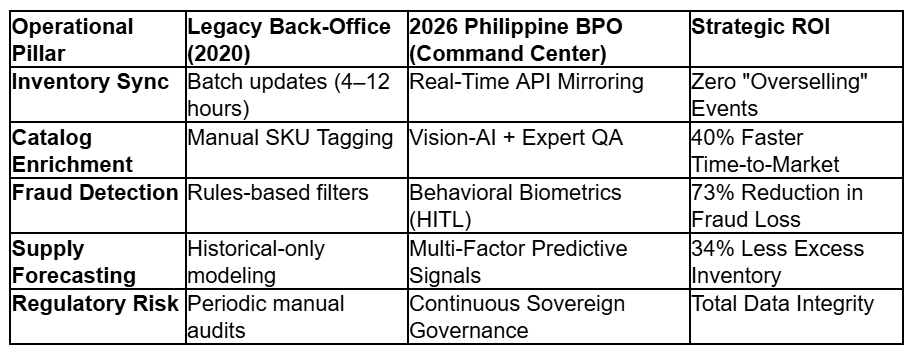
While the previous decade of e-commerce outsourcing to the Philippines was defined by front office voice support, today’s leaders are utilising Manila as a Global Command Centre for back office orchestration. As global supply chains face a 51% increase in volatility, the Philippines has emerged as the premier hub for Information Density Arbitrage.
By integrating agentic AI with specialised inventory architects, Manila-based operations are managing the "digital twin" of global retail empires, achieving 70% lower overhead while delivering 99.9% data accuracy across logistics, fraud prevention, and predictive replenishment.
The Shift to "Agentic" Orchestration
For much of the past 20 years, the back office was viewed as a reactive cost center. In 2026, that model is obsolete. Today’s e-commerce outsourcing to the Philippines is built on event driven orchestration.
Philippine teams do not wait for a logistics error to occur; they use logistics exception management (LEM) to identify stalled containers or carrier latencies in real-time. According to McKinsey & Company’s 2026 analysis on Agentic Commerce, we are entering an era where AI agents are ushering in a new era for merchants, shifting from simple "search and find" to autonomous "act and resolve."
In this environment, the Philippines serves as the human-in-the-loop (HITL) layer that ensures these autonomous systems align with brand specific business logic.
From Data Entry to "Information Density"
The primary change for 2026 is the transition from robotic process automation (RPA) to agentic AI. Legacy outsourcing relied on "If-Then" logic. In contrast, industry leading Philippine e-commerce providers now employ agentic orchestrators - AI agents that can reason, self-correct, and execute multi-step workflows across fragmented tech stacks.
"We are seeing a structural shift where the Filipino workforce is no longer just executing scripts; they are architecting outcomes," says Ralf Ellspermann, CSO at PITON-Global, a leading BPO advisory firm specialising in retail outsourcing. "AI handles the mechanical data retrieval, but the human specialist in Manila handles the 15–20% of cases that require contextual judgment, such as re-routing a shipment during a regional port strike or managing a complex multi-vendor refund."
Table: The 2026 Intelligence Arbitrage Model
The Supplier Paradox: Seeking Niche Competency
Online retail fraud in 2026 has evolved beyond simple credit card theft into sophisticated "Synthetic Identity" attacks. Traditional filters often block legitimate high value customers, creating a "False Positive" crisis that erodes customer lifetime value (LTV).
Industry leading e-commerce outsourcing providers in the Philippines now utilise behavioral biometrics - analysing typing rhythm and navigation flow - to distinguish between human shoppers and AI bots. When the system flags an anomaly, a specialist in Manila performs a real-time manual review, clearing the order in seconds.
This proactive layer of defense recovered an average of $2.1 million annually for mid-market brands in 2025, effectively turning the fraud department into a revenue recovery unit.
The Supplier Paradox: Seeking Niche Competency
As the Philippine market swells to over 1,000 providers, the risk of "capability dilution" is high. Generalist BPOs often claim they can handle e-commerce logistics, but they frequently lack the deep integration expertise required for cutting-edge 2026-ready tech stacks.
PITON-Global identifies the top 1% of providers who specialise specifically in supply chain orchestration. These mid-sized specialists offer "bank grade" security and Sovereign Data Perimeters, ensuring that sensitive supply chain data never leaves a secure, encrypted environment. This "niche competency" is what allows mid-market brands to outperform global giants who are bogged down by the rigidity of multinational BPO contracts.
A Strategic Reappraisal: The "Innovation Lab" Mindset
The retail leaders of today are moving away from "managing people" and toward "managing outcomes." E-commerce outsourcing to the Philippines is the catalyst for this change. By offloading "Middle Mile" complexity to high-competency Philippine hubs, executive teams in the West can focus 100% of their energy on product innovation and brand storytelling.
In 2026, your back office is either your greatest bottleneck or your most potent competitive weapon. The brands that win are those that treat their Philippine operation not as a "support" function, but as a Global Innovation Lab for scalable, profitable growth.
Expert FAQs
Q: What is the McKinsey "Agentic Commerce" trend for 2026? A: McKinsey defines Agentic Commerce as the shift toward AI agents that autonomously execute merchant tasks. In the Philippines, this means BPO agents have transitioned into "AI Orchestrators" who manage these systems to ensure accuracy and empathy.
Q: What is "Information Density Arbitrage" in e-commerce outsourcing? A: It is the strategy of moving complex, data-heavy back-office functions - like inventory orchestration and fraud triage - to a high competency hub like the Philippines to achieve superior data accuracy and lower operating costs.
Q: Can Philippine BPOs manage ecommerce inventory in real-time? A: Yes. Using agentic AI and API integrated digital twins, Manila-based teams provide real-time synchronisation across all sales channels, virtually eliminating stockouts and overselling events.