.png)

While AI ranks among the top enablers for retailers, executives have made limited progress in deploying the technology at scale, according to research by Tata Consultancy Services (TCS).
The study reveals only 24% of retailers currently use AI for autonomous decision-making, while 85% have not yet begun implementing, or are even planning for multi-agent AI systems. What’s more, to address the most strategic objectives, such as driving profitable growth and improving customer experience and loyalty, retail executives consider AI initiatives their most or second most preferred tactic.
And the more financially successful a retailer is, the more initiatives they have in the pipeline. Based on responses from more than 800 senior retail executives across 18 countries and five major subsectors, the study highlights the operational pressures currently shaping retail transformation.
Executives identify the ability to sense market shifts in real-time and utilising adaptive AI powered decision-making among their top priorities for the next one to two years, a signal that retailers increasingly see digital intelligence and agility as inseparable.
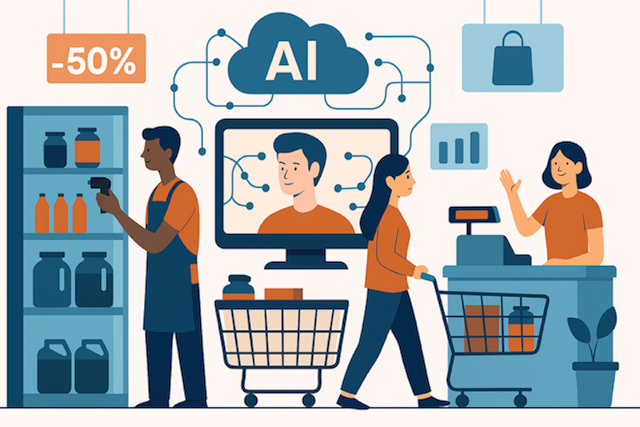
Despite AI’s strategic importance, deployment remains concentrated around customer facing applications. 51% of retailers are only just now making basic technologies, such as chatbots and virtual assistants, their top initiative, suggesting that adoption of advanced intelligence capabilities in retail remains at a superficial level. However, the study suggests these more basic tools will not transform retail economics without deeper integration across merchandising, supply chain, and pricing.
Krishnan Ramanujan, President of TCS’s Consumer Business Group, says: “Retailers today are united in their belief that AI will define the next era of competitiveness, yet most have only scratched the surface of its potential.”
“Our Global Retail Outlook reveals that the true opportunity lies in shifting from isolated experiments to pervasive intelligence embedded across the value chain. The retailers that master this transition will become more perceptive enterprises, capable of learning, adapting, and responding in real time. TCS is prepared to address the gaps in the value chain and is building AI led solutions to unlock the next phase of growth for retailers.”
The study also reveals that following cost optimisation, AI powered technologies are ranked among the top essential capabilities for 2026, with the ability to sense market changes and competitor moves in real time and adaptive AI powered decision-making capabilities ranked number two and three (out of ten) for retailers. In terms of retailers biggest hurdles leading into 2026, the workforce skills gap was near the top of challenges, second only to financial pressures.
Cheenttan Voraa, Global Head of Retail Consulting, says: “The retail sector is at a defining crossroads. Leaders recognise AI as an essential technology to stay ahead in the next era of competitiveness, yet most organisations remain early in their journey toward true enterprise intelligence.”
“Advancing from siloed use cases to connected, perceptive systems will require bold investments, not only in technology but in AI savvy talent, along with improved processes and operating models. TCS is committed to partnering with retailers and empowering them to lead in the AI era.”
Retailers see AI powered decision-making, faster time to market for products and services, and automated workflows among the capabilities that will most significantly impact performance in the near term, surpassing conventional business analytics and intelligence tools.
Executives also express strong urgency around cybersecurity and privacy and in the data still locked inside loyalty programmes, where fewer than half say they’re able to use such information to demonstrate marketing ROI, set pricing, or conduct product and assortment planning.
Key results from the survey include:
51% of retailers cite chatbots and virtual assistants as their leading AI initiative today, suggesting most retailers have not yet begun to use AI outside of isolated customer engagement platforms.
85% of retailers are not yet using multi-agent AI systems; 48% have no plans to do so
Only 33% of retailers see digital literacy programmes for employees as a way to achieve organisational transformation and talent upskilling.
Just 37% of retailers use loyalty insights to inform channel or store experience strategies, a missed opportunity to gain enterprise intelligence.
Only 45% apply loyalty insights to pricing and promotions.
39% of retailers are deploying AI powered demand sensing for supply chain resiliency.
42% plan to implement AI driven dynamic pricing to improve margin performance, but this needs to be handled with care to avoid “surveillance pricing” becoming a brand problem.
The top essential capabilities for 2026 for retailers include: number one cost reduction through optimisation, number two having the ability to sense market changes and competitor moves in real time, and number three adaptive AI powered decision-making capabilities.
RTIH AI in Retail Awards
RTIH proudly presents the first edition of its AI in Retail Awards, sponsored by VenHub Global, 3D Cloud and EdTech Innovation Hub.
This is now open for entries. Deadline for submissions is Friday, 5th December. It’s free to enter and you can do so across multiple categories.
Check out categories and entry forms here.
As we witness a digital transformation revolution across all channels, AI tools are reshaping the omnichannel game, from personalising customer experiences to optimising inventory, uncovering insights into consumer behaviour, and enhancing the human element of retailers' businesses.
With 2025 set to be the year when AI and especially gen AI shake off the ‘heavily hyped’ tag and become embedded in retail business processes, our newly launched awards celebrate global technology innovation in a fast moving omnichannel world and the resulting benefits for retailers, shoppers and employees.
Our 2025 winners will be those companies who not only recognise the potential of AI, but also make it usable in everyday work - resulting in more efficiency and innovation in all areas.
Winners will be announced at an evening event at The Barbican in Central London on Thursday, 29th January. This will kick off with a drinks reception in the stunning Conservatory, followed by a three course meal, and awards ceremony in the Garden Room.


Comments (0)
No comments yet.