Hybrid approaches and generational shifts: these are February's most innovative retail technology plays
RTIH Editor, Scott Thompson, brings you his stand out ‘future of retail’ technology deployments and launches from February, including Maple Group, Gander, Just Eat, Clarins, Loblaw Companies, Asos, 7-Eleven, AiFi, Lazada, Emporio Armani, Walmart, Uber, Manna, REWE, and Cimcorp.
Maple Group
Irish retail group Maple Group has become the first in the Republic of Ireland to use AI powered technology from Gander across its estate to tackle food waste.
It piloted the integration in January 2025, going live simultaneously across all seven stores in Donegal. And it has now committed to a full contract until the end of 2026.
Through integration with its Station Master EPoS, back office and handheld systems, reduced price products are instantly visible to shoppers via Gander in real-time. During the pilot, Maple Group increased its sell-through rate of reduced products from 30% in March to 57% by October, saving almost 60% of reduced-to-clear food from going to waste.
The initiative has also helped the group recover an additional €13,000 in 2025 while keeping perfectly good food in the food chain.
“This pilot has been transformative for our business,” says Arthur McMahon, Managing Director at Maple Group. “From a purely operational perspective, we have further reduced food waste across all seven stores by more than 27%, while the recovery of value has exceeded €13,000 in less than ten months.
“The integration of AI technology has allowed us to optimise stock visibility and drive measurable improvements in efficiency, all without impacting our daily store operations. These results confirm that sustainability and commercial performance can go hand in hand, and we are proud to be leading the way in Ireland.”
Uber
Uber Technologies and Manna have announced a partnership that will see Uber’s first European launch of drone deliveries.
Going live first in Ireland, the service integrates Manna’s autonomous drone delivery system with Uber’s platform and logistics experience. The pair are aiming to expand this into more European cities going forward.
“Autonomous technology is shaping the future of delivery, whether it’s on the streets or in the skies. By combining Uber’s scale with Manna’s proven aerial expertise, we’re bringing fast, efficient and sustainable delivery to consumers and merchants alike. We’re proud to launch in Europe and excited to introduce this technology to more Uber Eats customers over time,” says an Uber spokesperson.
“This partnership with Uber marks a defining moment for drone delivery,” says Eoghan Huston Chief Operating Officer at Manna Air Delivery.
“Over the past seven years, we’ve proven that autonomous aerial logistics can operate safely, reliably and at scale in real communities. Integrating with Uber’s global platform allows us to bring that capability to more consumers, merchants and independent retailers, accelerating the shift toward faster, cleaner last-mile delivery. Our focus remains simple: build the safest, fastest and most sustainable delivery infrastructure in the world.”
Just Eat
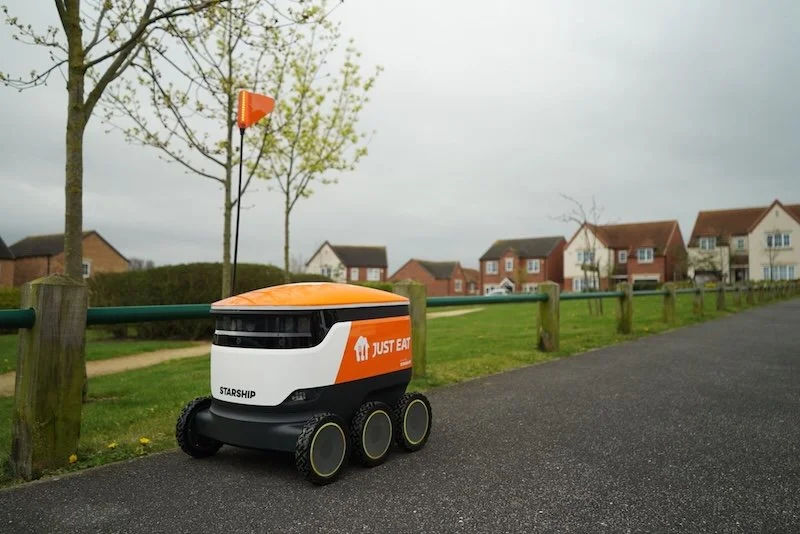
Just Eat Takeaway.com has launched a trial in Bristol and Milton Keynes, with robot powered deliveries rolling from high street restaurants to customers’ doors.
This follows robotics trials in Switzerland, and sits alongside ongoing drone trials in Ireland.
Clarins
Clarins has launched AI Shade Finder, an in-store service that integrates an AI driven make-up recommendation engine to assist customers and employees.
This has been developed in collaboration with IlluminateAI, a Silicon Valley startup. Instead of relying on a single photo, the system captures a rapid sequence of images while changing a smartphone screen's light.
By analysing how light reflects on the skin, the algorithm can precisely identify skin tone, undertone and overall colorimetry, those involved claim. The servcie is available exclusively in Clarins boutiques and counters.
"It's like turning a smartphone into a scientific reader of skin colour," says Konrad Jarausch, Founder and CEO at IlluminateAI. "The technology quantifies pigmentation and undertones with a level of precision that was previously impossible in-store with a smartphone. It's ten years of make-up expertise, now accessible through a simple face scan."
"The AI Shade Finder enables us to put AI and beauty tech at the service of our ambitious strategy of accelerating in makeup,” says Jonathan Zrihen, President and CEO at Clarins "We are proud to offer an innovation built with and for our clients."
Loblaw Companies
Loblaw Companies has announced a new collaboration with Google that will bring its beauty, apparel and general merchandise assortment directly into AI Mode in Google Search and the Gemini app.
Loblaw is laying claim to being the first large retailer to make products available for purchase directly through Google’s AI mode in Canada.
In a LinkedIn post, Lauren Steinberg, EVP, Chief Digital Officer at Loblaw Companies, said: “Powered by our early adoption of the Universal Commerce Protocol (UCP), the integration will enable secure, standardised connectivity between AI agents and our commerce infrastructure.”
“This milestone marks another deliberate step toward what we see as the next chapter of agentic commerce. Canadians are already discovering products through conversational AI. Our focus is on closing the gap between exploration and action, connecting intent to inventory, securely and seamlessly.”
She added: “Our philosophy is straightforward: partner with the best and deploy purpose-built applications that deliver real value to customers. Different AI platforms have distinct strengths. The advantage lies not in exclusivity, but in thoughtful orchestration. Proud of the team at Loblaw Digital for continuing to push the boundaries, and excited to be among the first in Canada to bring this capability to market alongside Google.”
“We are seeing a generational shift where AI is becoming the foundational engine for business transformation. Loblaw’s commitment to scaling AI across its entire enterprise is a clear roadmap for how retailers can convert technical innovation into measurable value,” said Karthik Narain, Chief Product and Business Officer, Google Cloud.
“By optimising everything from merchandising to inventory management, they are proving that AI native systems are the key to driving both operational efficiency and a superior customer experience at scale.”
Asos
Asos is laying claim to a unique hybrid approach to virtual try-on that lets customers see how selected products could look on them by uploading their own image or choosing an AI generated virtual model that represents their likeness.
This initially launches in partnership with AI fashion platform AIUTA with around 10,000 products on the Asos IOS app. The feature will be available to select UK and US customers before being rolled out more broadly. It is claimed that each experience loads in just four to sevent seconds, well ahead of typical industry solutions.
Melissa Lim, Head of Digital Product at Asos, says: “We know customers want the confidence of seeing how something will really look but don't want to be pushed into doing it one way. Our hybrid approach meets them where they are, giving everyone a try‑on option that feels right for them.”
REWE
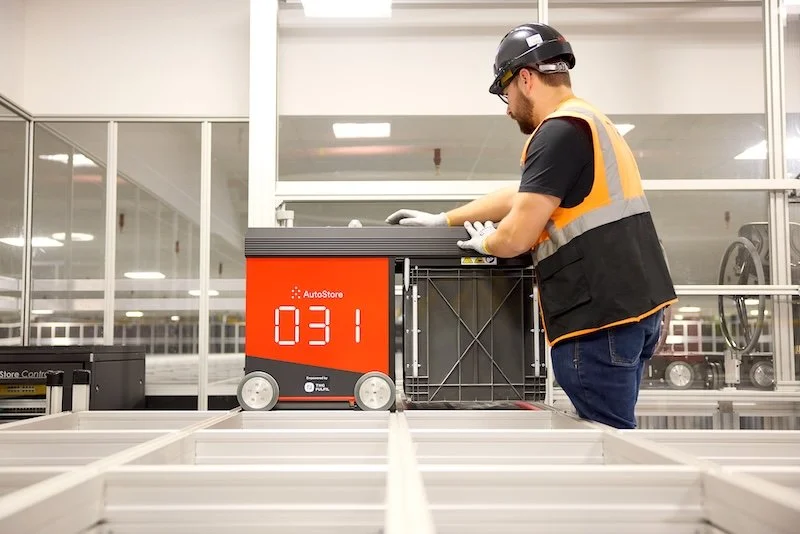
Working with Cimcorp, REWE has opened an automated fulfilment centre for fresh produce in Oranienburg, which is designed to handle ultra-fast, error free distribution of fruit and vegetables to over 370 supermarkets and 580 stores in the greater Berlin region.
“In fresh food logistics, every minute counts and every delivery is critical,” says Matthias Menzel, General Manager at REWE’s Oranienburg Logistics Centre. “Missing the delivery window means a significant financial loss. That’s why we invested in automation that delivers absolute reliability, real-time control and the capacity to serve Berlin and the surrounding regions.”
Each day, around 29,000 units are handled by Cimcorp’s automated order picking system at the centre, with material flows governed by the company’s warehouse control system (WCS). The software manages everything from inbound barcode scanning and depalletising, through inventory and picking, to precise outbound labelling and shipping.
“Our customers expect that our reliability increases every year,” says Menzel. “As stores learn that they can trust our deliveries, it brings improvement not just to our logistics, but right through to the customer experience in the store. We’re no longer fighting to fill overtime hours; instead, our staff are excited to work with new technology and see the benefits of automation in their daily roles.”
7-Eleven
7-Eleven is expanding its frictionless checkout pilot using AiFi computer vision technology in select US locations.
Customers scan products with their smartphone as they walk through the store, then pay for purchases using Apple Pay, Google Pay or a traditional debit or credit card. After this, they pay via a QR code on a screen at a dedicated station to complete the transaction.
In a LinkedIn post, Michael Guzzetta, Retail Innovation & Strategy Leader at Cookie Plug San Antonio, and a former H-E-B executive, said: “After Amazon pulled back from large format Just Walk Out, the easy narrative was that frictionless checkout had been overhyped and exposed. That was always too simple. The real issue was format economics.”
He added: “Large grocery boxes carry serious margin pressure, complex assortments, and higher shrink exposure. The math gets tight super fast. Convenience is different... Smaller footprints, fewer SKUs. high traffic density, and sales built on speed. If one register backs up at lunch, you feel it immediately. In my opinion, that’s where frictionless still has a shot.”
7-Eleven operates thousands of compact stores where throughput matters more than theatrical innovation, Guzzetta noted. If autonomous checkout can smooth peak demand without a massive ceiling retrofit or painful capex curve, it starts to look less like a tech experiment and more like operational plumbing.
He concluded: “Frictionless didn’t fail. It just needed the right habitat. The interesting story now isn’t whether the model works. It’s which formats can support it today without breaking the unit economics.”
“I expect to see more expanding pilots in convenience/grab 'n go, stadiums, airports, and possibly even theme parks, where margin is high, throughput is crazy and the need for quick convenience is the highest.”
Lazada
Lazada, an e-commerce platform operating in Southeast Asia, has launched a speedy grocery delivery service within its RedMart supermarket arm.
In a LinkedIn post, Craig Massingham, Product Design Leader at Lazada, said: “RedMart Now is live! Groceries in as fast as 30 minutes. Most grocery trips aren’t planned. They happen when you realise you’re missing snacks before guests arrive, or essentials right before dinner. Those moments are driven by urgency, not weekly planning. That’s why we launched RedMart Now.”
Going live in select postcodes in Singapore, this builds on RedMart’s Express, two-hour, and six-hour delivery options. “Together, these services allow us to support a wider range of shopping missions; from planned stock ups to truly last minute needs,” said Massingham. “From a product and design perspective, this wasn’t just about speed. It was about expanding what RedMart represents.”
On
Swiss sportswear brand On has taken the wraps off a new LightSpray factory in South Korea.
Following the opening of its first factory in Zurich last year, the second location near Busan adds another 32 fully automated robots, set to increase global LightSpray production capacity 30-fold in 2026.
In a LinkedIn post, On said: “What began as a four-year development journey, followed by the opening of its first dedicated facility, LightSpray is now ready to scale.”
“The factory launch coincides with the introduction of the LightSpray Cloudmonster 3 Hyper - the first shoe upper sprayed at the new factory and the the ultimate companion for long runs and tempo runs, featuring full length Helion HF hyper foam and “Sprayed in Korea” visible on the inside sole. The shoe debuts with a limited release at on.com and in On retail stores in North America on 5th March.”
Walmart
Walmart has partnered with Procter & Gamble for its latest shoppable livestream event. This went live on Walmart Live, Facebook, and YouTube and was made available on-demand afterwards.
In a LinkedIn post, Walmart’s Justin Breton said: “In today’s attention economy, entertainment and content have become the new storefront. The brands that win aren’t just showing products... They’re creating moments people actually want to spend time with. That’s exactly what we’re leaning into with our next shoppable livestream with Procter & Gamble.”
The pair went live from the Olympic Village in Milan with a Make Her Day Easy livestream event.
“Hosted by US Olympic Gold Medalist Laurie Hernandez, this experience brings customers inside a cultural moment most people never get access to, while making it instantly shoppable. Because increasingly, commerce works best when it feels less like shopping and more like access,” said Breton.
“During the live, Laurie spotlighted her everyday essentials, from Tampax to Crest to Venus, that help her stay confident, focused, and ready to perform at the highest level across three segments designed to feel human, authentic, and connected to real life. The livestream also featured Tampax’s newest brand ambassador, Tami, in one of the segments.”
Breton concluded: “What excites me most about moments like this is the ability to bring customers closer to something special. Sports, culture, content, and commerce are increasingly converging and livestream events continues to be one of the most powerful ways to meet customers where attention already lives.”
Emporio Armani
Emporio Armani has introduced an immersive fragrance activation at KaDeWe in Berlin, inviting people to experience the new Power of You perfume through an interactive storefront installation. This was developed in collaboration with Loook.ai and runs until 28th February.
Positioned directly in the store window at the entrance of KaDeWe (Tauentzienstraße 21–24, 10789 Berlin), the installation turns the traditional fragrance display into a responsive digital mirror visible from the street.
Anyone walking by can instantly become part of the experience, engaging with motion-based visuals inspired by the campaign’s aesthetic without downloading apps or entering the store first.
As pedestrians approach, the mirror activates in real-time, integrating them into the visual narrative of the fragrance campaign. According to those involved, the format aims to shift the role of the storefront from passive advertising to interactive discovery, allowing Berliners to encounter the new scent through participation rather than observation.
The installation also encourages organic content creation, enabling visitors to capture and share moments generated through the experience.