Including Sereact, Whatnot, and Edgify: 20 retail technology funding rounds you need to know about
RTIH rounds up 20 retail technology ventures who have recently secured significant investments in their businesses, including companies specialising in retail media, live commerce, warehouse robotics, and AI shopping.
1. EAIGLE
EAIGLE, a specialist in AI powered gate and yard automation and data orchestration, has secured an undisclosed funding round led by Noro-Moseley Partners, with participation from In Revenue Capital and Boreal Ventures. The cash will be used to accelerate go to market expansion and advance the development of the startup’s proprietary automated logistics technology.
EAIGLE's flagship product offering, Automated Vehicles Access Control (AVAC) and YardSight, leverages computer vision to analyse camera feeds, instantly reading truck and trailer identifiers at the gate and across the yard, such as truck number, trailer number, and logos. By automating real-time data capture, the solutions eliminate labour intensive, paper-based workflows and manual audits, and enable incoming drivers to easily navigate facilities.
"EAIGLE's AI technology is seeing rapid adoption among enterprise leaders across the retail, CPG, manufacturing, and transportation sectors," says Vasant Kamath, General Partner at Noro-Moseley Partners. "Customers are finding incredible value in the market's first truly automated facility management system, viewing it as a critical pillar in the digital transformation of their supply chains. EAIGLE seamlessly simplifies complex logistics transactions, and we are excited to partner with them for their next phase of growth."
2. Nudge
AI shopping startup Nudge has launched its Agentic Commerce Platform and announced $1.1 million in pre-seed funding. Investors include s16vc (a fund backed by the founders of Miro, Datadog, and Intercom), Antler, and operators from Shopify, Nutanix, and Postman.
The platform gives commerce brands a single system to measure AI visibility, enrich product catalogues for agent recommendations, and convert AI discovery into revenue.
“Shopping is becoming a conversation. People ask AI platforms what to buy and get an answer back with a list of recommendations to choose from," says Kanishka Thakur, Co-founder and CEO at Nudge. "Every brand needs an ongoing read of how shoppers describe them in AI conversations and which products surface in answers. But the real differentiation is going from search to action: closing the conversion gap between AI discovery and purchase. Being recommended is the start. Being bought is the win."
Early customers include a health nutrition brand and a large footwear brand, with active deployments across apparel, beauty, food and beverage, and wellness brands.
3. Pie
Pie, an AI powered platform for small businesses, has announced a $19.5 million Series A led by Lightspeed Venture Partners, bringing its total funding to $23.7 million. The round included participation from Capital One Ventures, Max Levchin’s SciFi VC, F-Prime, Commerce Ventures, WEX Venture Capital, and existing investors.
The company has also announced its emergence from stealth and launched Front Desk, an AI product that answers calls for small business owners 24/7, takes bookings and reservations, and responds to customer questions.
Founded by former Square and Toast operators Syed Ali and Akhil Mantripragada, Pie says it is is building the growth infrastructure layer for Main Street businesses at a time when customer discovery is shifting across AI search, Google and digital channels. Since launching its first AI powered growth product in late 2025, it has grown to reach thousands of small business customers while in stealth, largely through referrals and platform partnerships, and expanded its product suite across AI search, growth, and Front Desk.
“Small business owners have been stuck with expensive, opaque agency models for decades,” says Syed Ali, Co-founder and CEO, Pie. “Every owner I talked to said some version of the same thing: ‘I need more customers, and I can’t afford an agency.’ We built Pie to fix that problem and bring enterprise grade growth capabilities to the small businesses that power local economies.”
Pie’s platform is built around three products. AI Search helps businesses show up as local discovery moves into AI powered search experiences like ChatGPT, Claude and Perplexity. Growth then helps businesses acquire customers across high intent local channels like Google Maps, Yelp, Nextdoor and other digital platforms. Front Desk helps businesses capture demand once it comes in by answering calls, taking bookings and responding to customer questions.
4. BR-DGE
BR-DGE has secured a £10 million funding round. Having carved a niche for itself in gaming payments, the UK-based company is now expanding into adjacent enterprise sectors, with recent customer wins including e-commerce business The Hut Group and betting firm Betfred.
The round has seen Bettor Capital, a US-based investor in the gaming industry, join as a new partner, alongside continued backing from existing investors. The new investment will be used to enhance BR-DGE’s platform capabilities, strengthen go to market activity and drive geographic growth, with new market and product launches planned for the second half of this year.
Thomas Gillan, CEO at BR-DGE, says: “This investment gives us additional backing at a pivotal stage of international expansion. Payments have become a much bigger strategic priority for enterprise merchants, particularly in complex, regulated sectors where resilience, competitive advantage, customer experience and compliance are critical to success. The next generation of payment infrastructure is not about moving money; it's about optimising every transaction.”
“We are building the intelligence and optimisation layer that enables merchants to maximise the performance of every payment. This new funding will enable us to further develop our platform, power our growth plan and help more merchants solve the payment infrastructure problems that matter most in large scale businesses.”
5. geoSurge
geoSurge, a startup helping brands shape how they are represented inside generative AI systems, has announced a $12 million seed round led by AlbionVC, with participation from Play Ventures, Octopus Ventures, Celero Ventures, Boost Capital, and existing investors Passion Capital and Tuesday Capital, alongside angel investors from Google DeepMind, Microsoft AI and Signal AI.
Francisco Vigo, CEO and Co-Founder at geoSurge, which emerged from stealth last year, says: “A lot of the market is still thinking about AI visibility like SEO and citation tracking. We believe that’s fundamentally wrong. As a data scientist I look at these systems differently; the real battleground is how models learn, understand, remember and represent brands over time. As models know more, they search less. Most companies in our space are still optimising for retrieval but we know the bigger opportunity is understanding and impacting the representations that increasingly drive AI generated outputs.”
Vigo adds: “Prompt level tracking and surface analytics will increasingly commoditise as AI infrastructure matures. Most of the current market is focused on the visible surface of AI systems, we believe that is a race to the bottom. The deeper opportunity is helping companies impact the underlying representation layer that drives those outputs. That’s what geoSurge is building.”
AlbionVC Investment Manager, Valérie Aelbrecht, comments: “The geoSurge team combines exceptional technical capability with a genuinely original market thesis. They are building foundational technology for a category we believe will become increasingly important as AI systems shape more commercial decisions.”
The company plans to use the funding to expand its global research and engineering teams, invest in AI infrastructure and compute capacity, and accelerate development of its Corpus Engineering discipline and broader AI visibility capabilities.
6. Wonder
Wonder, a Marc Lore fronted food technology platform, has announced a $650 million Series D round at a pre-money valuation of $9 billion.
The round has participation from existing investors, including Accel, GV (Google Ventures) and New Enterprise Associates (NEA). New backers include certain funds managed by AllianceBernstein, ARK Invest and funds managed by Kayne Anderson Rudnick Investment Management.
The funding will support Wonder's physical expansion, marketplace growth, and investments in technology, robotics and artificial intelligence. The company is set to go public in 2027 or 2028.
“Wonder was founded with the mission to make great food more accessible,” says Lore. “By building the technology, robotics and infrastructure behind a new kind of food platform, we’re making high quality food more affordable, more convenient and available to more people than ever before. This funding allows us to accelerate that mission.”
“It’s been exciting to watch the evolution of what Wonder is building - a fundamentally new way for people to access great food, at a level of quality and speed traditional players can’t match,” says Tony Florence, Co-CEO at NEA. “Our ongoing investment reflects our confidence in that model and in Marc’s ability to continue executing at scale.”
“Wonder is disrupting an industry that has been slow to change with the kind of scalable, innovative model that we look for across the ARK portfolio,” says Cathie Wood, Founder, CEO and CIO at ARK Invest. "We believe Wonder’s technology forward platform is redefining the economics and experience of restaurant-quality food at scale and we're thrilled to support Marc and his team as they continue to execute on that vision."
7. 10Beauty
Robotics company, 10Beauty, has raised $23.5 million in a funding round led by Story Ventures, bringing total funding to more than $70 million.
The firm’s machine performs the full manicure workflow, including polish removal, nail shaping, cuticle care, colour application, top coat, and drying. The system uses computer vision and precision robotics, while single use polish pods, similar in form to a coffee capsule, help make each manicure hygienic and repeatable. 10Beauty’s proprietary polish is vegan, non-toxic and designed to deliver a traditional manicure that lasts longer than a typical traditional polish manicure.
10Beauty is currently live with Ulta Beauty in Greater Boston and is now expanding to Chicago. New sites include Nordstrom in Natick, Massachusetts, Ulta Beauty’s new flagship store in Naperville, Illinois, 7am in Chicago is the company’s first nail salon partner, and the Belgrade Group in Boston its first hair salon partner. It has agreements in place for ~850 machines across its first retail partners.
The new funding will support technology development, operational readiness, and the broader roll-out of 10Beauty across retail and salon partners.
8. Fleek
Fleek has bagged $25 million in Series B funding. Bringing the total amount raised to date to £45 million, the cash will be used to accelerate development of its AI native marketplace, expand its engineering teams, scale its technology platform and grow its global buyer and supplier network.
The investment was led by Burda Principal Investments, an early Vinted backer and lead investor in its Series C round, with participation from eBay, FJ Labs, and H14, alongside existing backers including Andreessen Horowitz, HV Capital, Y Combinator.
Founded in 2021 by Abhi Arora and Sanket Agarwal, Fleek is building an infrastructure for the global secondhand clothing industry through a B2B marketplace and the AI systems digitising the supply chain behind it.
At the centre of the platform is Fleek Sort, a custom vision language model trained on millions of secondhand marketplace transactions from Fleek’s global network over the past four years. Used by graders in sorting hubs in Pakistan, India and Dubai, and in pilots launching in the UK, Europe and the US, this helps identify, categorise, grade and merchandise secondhand garments using photographs or videos, transforming a historically manual process into a digital workflow. As more inventory is graded, listed and sold through the platform, Fleek Sort continuously learns from real-world outcomes.
Once processed, inventory is automatically listed on Fleek's marketplace, where AI powered pricing, search, recommendation and matching systems connect stock with relevant buyers around the world. Every transaction generates additional data that improves the platform's understanding of secondhand inventory, creating a proprietary intelligence layer for the industry. Through this, Fleek helps suppliers increase recovery rates, enables buyers to source inventory more efficiently and reduces the volume of wasted clothing.
Its platform currently connects 2,000+ verified wholesale suppliers and graders with 50,000+ retailers, resellers and boutiques across 100+ countries.
9. Augmodo
Augmodo, a US-based startup that puts AI powered cameras onto retail workers to track store shelves, has secured $21 million in a funding round led by existing backer TQ Ventures, taking its valuation to $350 million. The company says that it is scaling AI assistants for the physical workforce and accelerating its roadmap into manufacturing, automotive, convenience stores, and more.
“Just as AI is changing knowledge work, Augmodo’s physical AI is changing the future of physical work,” says Ross Finman, Founder and CEO. “The core thesis: picking up a box of Cheerios for an e-commerce order and picking up a wrench on a factory floor require the exact same intelligence. Both require a computer that understands a person, a hand, an object, and the 3D space around them in real-time. We built that by capturing egocentric data, seeing the world seamlessly through the physical worker's eyes, to enhance and enable people.”
He adds: “We weren't raising, but TQ saw our traction and came to us wanting to double down. We were excited to accelerate and follow the market pull beyond our initial go to market to build out our vision of augmenting the physical workforce with physical AI tools. An enterprise's best asset is its people, and our human powered AI is built to dramatically enhance the workforce rather than replace it.”
“Building an AI assistant that works seamlessly in dynamic, messy, real-world environments is incredibly challenging. But that's where the highest value lies. This capital gives us the runway to aggressively expand our global enterprise footprint, invest deeply in our core AI models, and scale our engineering team.”
10. Syntetica
Syntetica, a French company focused on technology to recycle complex textile waste, has announced a $30 million Series A funding round. This was led by the Ecotechnologies 2 fund managed on behalf of the French government by Bpifrance, with participation from SWEN Capital Partners, lululemon, MAS Holdings, existing investor EQT Ventures, and the family offices of Peugeot, Etam and Indorama Venture's largest shareholder.
The round, which takes the total raised to date to $38 million, also includes support from public institutions including Bpifrance (French public investment bank) and the European Innovation Council.
Syntetica has developed a proprietary solution capable of recycling both Nylon 6 and Nylon 6,6 from mixed textile waste in a single process. The company is working with brands including Victoria’s Secret and Etam, alongside a number of global apparel firms.
The funding will support the planned construction of Syntetica's first commercial demonstration facility in France, with the aim of bringing the technology from laboratory scale to industrial production, targeting the processing of hundreds of tonnes of textile waste each year. The demo plant will be developed through the company's partnership with Michelin's Centre for Sustainable Materials in Clermont-Ferrand.
11. Sereact
Berlin-based Sereact, a provider of physical AI for warehouse robotics, has added Zalando as an investor in its ongoing Series B, which now stands at $116 million. It lines up alongside lead investor Headline as well as Bullhound Capital, Daphni, Felix Capital, Air Street Capital, Creandum and Point Nine.
The startup has now raised over $145 million to date.
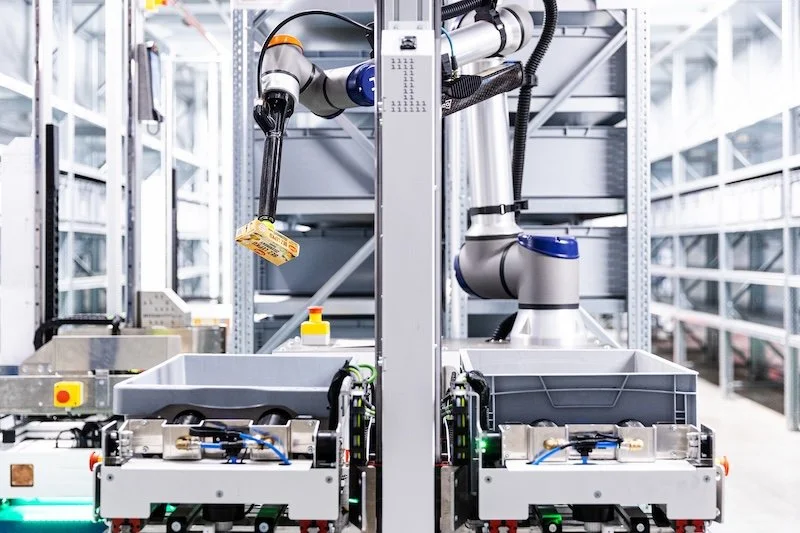
Over 200 Sereact systems are currently in use across Europe, including at Mercedes Trucks and BOL. The capital will go toward Cortex 2.0, the next-generation of Sereact's robot brain, as well as international expansion, particularly into the US.
Cortex acts as a universal AI operating system that can run across multiple hardware forms - from single arm picking cells and dual-arm returns stations to humanoid robots. According to a press release, the upcoming Cortex 2.0 model “shifts robotic automation from a "try and see" to a "plan and try" approach by using a learned world model to anticipate physical outcomes, score potential trajectories for risk and efficiency, and plan movements before the robot even acts”.
12. Humanoid
Humanoid, a UK-based company building industrial humanoid robots, has announced a $152 million Series A financing at a $1.35 billion post-money valuation. This brings the total amount raised to date to $270 million. The round was led by Prime Movers Lab, with participation from Schaeffler, Bosch, Fubon Financial Holding Venture Capital, and Aglaé Ventures.
The new capital will fund Humanoid’s next phase of growth, with the aim of strengthening its technology leadership and accelerating its commercial deployments and business expansion. It has secured partnerships with Fortune 500 companies, including SAP, NVIDIA, Bosch, and Siemens. Most notably, Humanoid recently signed what is claimed to be the industry’s largest publicly announced commercial agreement with Schaeffler for the deployment of thousands of humanoid robots in manufacturing environments.
“In just two years, we’ve gone from an idea to becoming Europe’s first pureplay humanoid robotics unicorn, partnered with some of the world’s leading industrial companies and built one of the strongest pipelines in the industry. What we’ve accomplished in such a short time would typically take a decade. None of this would have been possible without an extraordinary team that challenges every single day what people believe is possible. This funding gives us the resources to move even faster and to turn humanoid robots from breakthrough technology into everyday industrial tools,” says Artem Sokolov, Founder and CEO at Humanoid.
“Humanoid robotics will be one of the defining technologies of the next decade, reshaping how commercial and industrial work gets done. We expect the field to consolidate around a handful of category leaders across the US, Europe, and China. Humanoid AI will be one of a small cadre of robotics companies that will define humanoid robotics in Europe and beyond,” says Zia Huque, General Partner at Prime Movers Lab.
13. Freehand
Freehand, a startup whose AI agents manage supply chain spend for enterprises, has announced $75 million in funding co-led by Battery Ventures and NewRoad Capital Partners, with participation from former U.S. Commerce Secretary Penny Pritzker’s venture capital PSP Growth, Nexus Venture Partners and others.
This follows Freehand’s recent emergence from stealth with global deployments at Meta, Unilever, Johnson & Johnson, Pfizer, Dunkin' and Cardinal Health.
"Freehand marks one of the first full scale agentic deployments at Unilever and is an early anchor in the shift from software that assists to software that runs our supply chain," says Matt Algar, Global VP of Supply Chain at Unilever.
"Enterprises spend $16 billion a year on supply chain software and another $348 billion hiring people to do what this software cannot," says Nitin Jayakrishnan, Co-founder and CEO at Freehand, who previously built and sold Pando, an enterprise SaaS platform for logistics. "We built Freehand to close that gap - with AI agents that decide, act and take accountability for outcomes. This is the beginning of true autonomy in the enterprise."
"The very nature of work is changing, with AI," adds Abhijeet Manohar, Co-founder at Freehand. "Shifting from building software for the user to building software that is the user meant we could drive far deeper transformation for our customers. The difference between an agent that acts and a chatbot that suggests is context."
14. UNIT AI
UNIT AI has announced $12 million in funding to accelerate commercial deployments of its AI powered platform for end-to-end e-commerce fulfilment and returns across North America. The round was co-led by Prologis Ventures, Dynamo Ventures, and Ground Up Ventures, with participation from eGateway Capital, Recursive Ventures, Think + Ventures, ZEP Fund, and Crosscourt.
UNIT is working with various retailers and logistics providers, including Barrett, ShipCalm, DaVinci, Carter, as well as apparel brands. The company also lays claim to a growing pipeline of enterprise brands and 3PLs whose fulfilment networks collectively ship billions of inventory units each year.
UNIT was founded by Guy Glass, who previously founded Caja Robotics (acquired by Fives), a specialist in goods to person warehouse automation, and Avihou Barkay, President at Plus One Robotics and GM at Caja Robotics. After decades of designing and deploying robotic fulfilment systems for global warehouse operators, the pair set up UNIT with the aim of removing the cost, complexity, and infrastructure barriers that have historically limited automation adoption.
"After decades of building warehouse automation, we realised the next breakthrough wasn't building bigger systems; it was making automation dramatically more accessible," says Glass. "The world's largest retailers and logistics providers are looking for enterprise grade automation that can be deployed in a week instead of months. This funding allows us to scale our deployment capacity, accelerate product innovation, and meet that growing demand."
"Retailers and 3PLs need automation that solves real operational pain points - improving throughput, labour productivity and returns management without forcing a full facility redesign," says Todd Lewis, Senior Vice President, Prologis Ventures. "UNIT is addressing a clear market need with a modular platform that gives operators flexible automation that can scale and adapt to changing customer demands."
15. Malachyte
New York headquartered Malachyte has announced the close of a $10 million seed funding round co-led by Bessemer Venture Partners and Gradient Ventures with participation from Harpoon Ventures.
The startup was co-founded by Sidd Motwani (CEO), Ian Anderson (CTO), and Shivaditya Sinha (COO), the team behind the behavioural intelligence infrastructure that powers Spotify recommendations across millions of users and items. They say that they’re now bringing that same technology to every retailer and e-commerce brand.
"Brands are paying more than ever to acquire customers, then trying to convert them with a stack that only understands the fraction it already recognises," says Motwani. "Our technology reads behaviour instead of logins or cookies, so it understands every visitor before their first click, and keeps sharpening with every action. That's infrastructure built for how commerce works today."
"Malachyte's technology has driven our ability to recommend the right product at the right time across our entire user journey. It works for every visitor from the moment they land on our site, not just the ones we already recognise," says Emilee Walch, VP of Digital Product at Brunt Workwear. "The ROI was clear quickly, and the results we've seen so far are just the beginning of what's possible for us as a brand."
16. Whatnot
Whatnot, a live commerce platform operating across North America, the UK, and Europe, has pulled in $545 million in Series G funding, led by ICONIQ, Lightspeed and Avra. New investors Kleiner Perkins, Wellington Management, Robinhood Ventures Fund I, S32, and Standard Capital also participated, alongside returning backers CapitalG, Y Combinator, Durable Capital Partners, Alkeon, Andreessen Horowitz, Greycroft, BOND, and DST.
This new financing values Whatnot at $20 billion, nearly doubling its valuation in less than a year. The company has raised approximately $1.5 billion since its founding in 2019.
“Small businesses were the earliest adopters of live commerce on Whatnot, helping demonstrate what was possible. Today, businesses of all sizes are making live commerce a core part of their business," says Grant LaFontaine, Co-founder and CEO at Whatnot. "Our job is to help every seller grow. This investment allows us to build better tools, bring AI to more parts of the selling experience, help sellers reach more buyers, expand into new markets, and continue building the world's biggest and most trusted marketplace.”
17. Edgify
Edgify, a London-based company providing AI powered technology that protects against in-store loss, has raised $9 million in Series A+ funding to accelerate the roll-out of its platform. The round was backed by Rank Ventures and Mangrove Capital Partners, bringing the firm’s total funding to date to $25 million.
Nadav Israel, CEO and Co-founder at Edgify, says: “We founded Edgify on a simple conviction: intelligence should live where data is created, and devices should learn as one. A store is a fleet of machines that can see, decide and learn together, without a single byte leaving the building. Retail is just the beginning. The operational friction we have solved in grocery and convenience stores can be replicated in any industry where fleets of devices meet the physical world, as demonstrated by our expansion into QSR, distribution centres, and apparel.”
“This funding will fuel our growth, enabling us to take the intelligence layer we’ve built for retail and deploy it across the global industrial landscape, turning millions of isolated machines into self-learning real-time networks that operate independently of the cloud.”
18. Echovane
Echovane has secured $1 million in funding in a round co-led by Titan Capital and Neon fund to expand what is pitched as “a permanently done for you research service where clients provide the business question and the company’s AI agents execute the study through to a completed, decision ready outcome”.
The cash will support the expansion of Echovane’s AI agent infrastructure, multimodal research capabilities, and global participant network. The venture was founded by former Amazon, Stripe, Gojek and Razorpay product leaders and graduates of Indian Institute of technology, Smriti Gupta, Vipul Nair and Himadri Roy. They initially set out to build an AI moderator for consumer interviews.
But the deeper they went, the clearer it became that the interview was only a fraction of the problem. Research teams were still spending weeks recruiting participants, coordinating fieldwork, analysing evidence and turning it into something the business could act on. So they expanded Echovane into the execution layer for the entire research process.
19. ClearJet
ClearJet, a specialist in parcel logistics infrastructure and orchestration for brands, e-commerce shippers, and 3PLs, has raised a $25 million growth equity investment led by Edison Partners, with participation from returning investors Venture53, Origin Ventures, Salt VC, and SpringTime Ventures.
The firm’s investor base also includes early backers Sky VC (formerly JetBlue Ventures) and Tandem Ventures. The new funding brings ClearJet's total capital raised to more than $40 million, and will support expansion across its network of 95 US airports and investment in its AI powered logistics platform.
ClearJet connects shippers with unused cargo space on commercial flights, delivering packages across the US at the speed of air freight and the price of ground shipping. The company’s software- owered delivery network is carrier agnostic and combines the staffing, sorting, and ground infrastructure needed to move packages on planes already flying between American cities.
20. Clarity Systems
Clarity Systems, an AI powered retail fraud detection specialist, has announced the close of a $4.4 million seed round backed by LMnT Ventures, with participation from Regeneration VC, Humba Ventures, and Massive Technology Ventures.
Andy Ruben, Cofounder and CEO at Clarity, says: “Retail fraud has become a professional industry, run at scale against the returns counter and the receiving dock, and most defenses were built for a shoplifting era. We built Clarity to catch it the moment it enters the building.”
Jeff Miller, Founder and Managing Partner at LMnT Ventures, says: “Return fraud is a stubborn, massive problem hiding in plain sight, costing the world’s largest brands billions and ultimately leaving everyday consumers to foot the bill. And it’s a problem that the founders, each with extensive experience in the retail and returns world have had to endure for decades.”
“With Clarity’s advanced imaging hardware and proprietary AI models, this chronic problem is finally tractable. Importantly, this isn’t AI theory- it’s already happening on Clarity systems. This is a problem whose time has come and this is the team to crack it.”