Instinctools shines a light on what inefficient dark store management really costs grocery retailers
By Alexey Spas, CEO, Instinctools
Thirty minutes sounds like a customer promise. Inside a dark store, it is a countdown. When an order comes in, a picker has minutes to find the right products, catch an item that is about to expire, deal with stock that may or may not be where the system says it is, pack the basket, and hand it off to a courier who is already moving through city traffic. Get any one of those steps wrong and the cost does not stop at a refund.
We got a close look at that while building a management platform for a grocery retailer running more than 25 dark stores across five cities. The company’s margin was being chipped away in dozens of small places: a picking mistake here, a missed markdown there, stock that existed in the system but not on the shelf, staff scheduled against yesterday’s demand rather than today’s order flow.
And that points to a less obvious truth about quick commerce: the battle for margin is often won or lost in the gaps between operational processes - the very gaps end-to-end automation is meant to close.

Alexey Spas, CEO, Instinctools: Quick commerce margins are decided in seconds and percentages inside the four walls of a dark store, long before the courier reaches the customer.
Why dark store economics are unforgiving
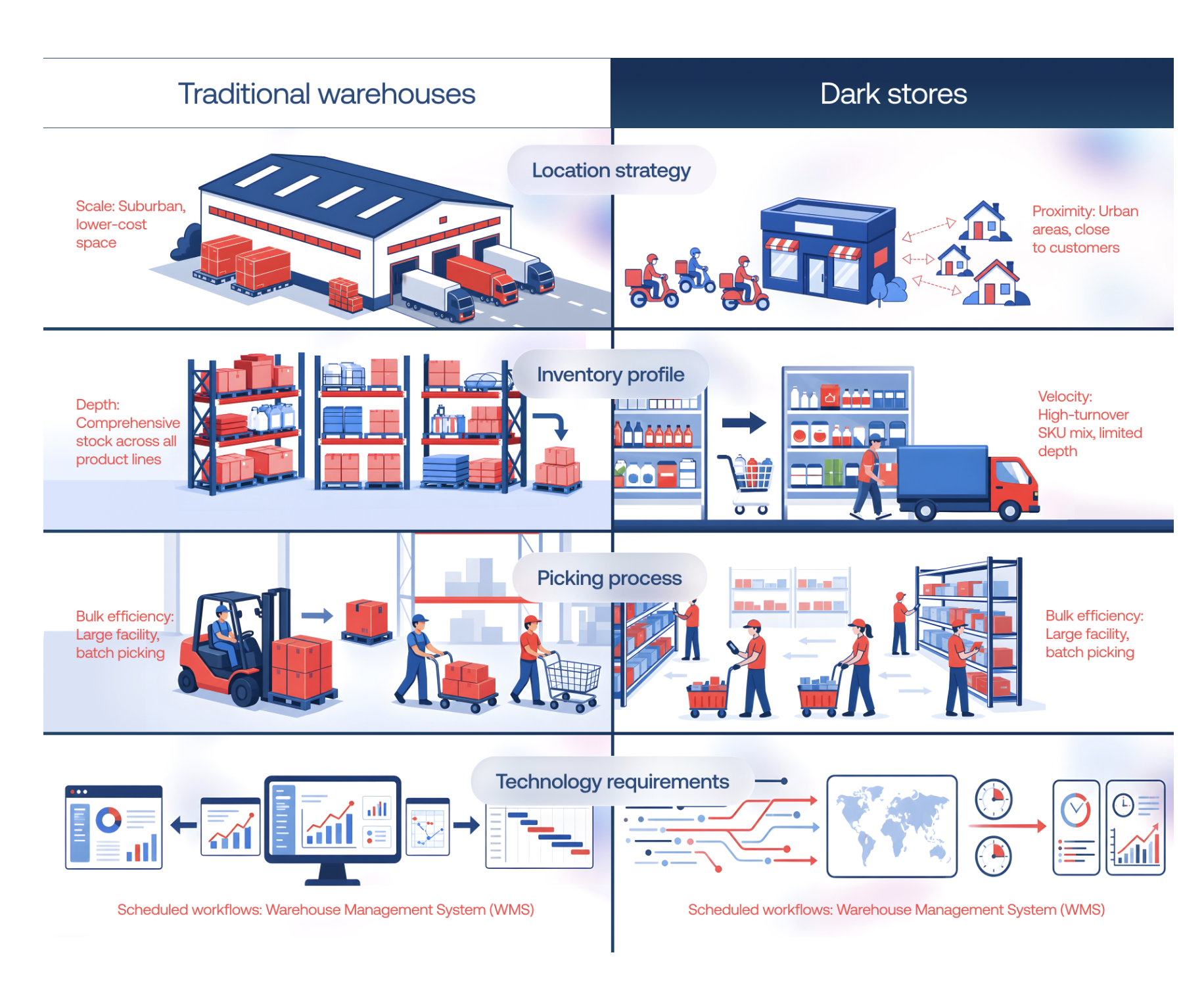
Although a dark store resembles a small warehouse, it operates according to different principles. Orders arrive continuously and must be picked, packed and dispatched within 10–15 minutes. Baskets are small and margins are modest. Add the cost of operating close to densely populated areas, where rent is higher, and even minor inefficiencies start to carry more weight than they would in a conventional retail or warehouse environment.
Unlike traditional distribution centers, dark stores have to react continuously to what is happening now: which orders have just come in, what is actually on the shelf, which picker is available, how long the packing queue is and where the nearest courier happens to be.
In that environment, a small mistake rarely stays small. Even a single picking error sets off a whole chain of consequences: the order has to be picked again and refunded, support spends time on the complaint, and quite often a second courier drives to the customer. This is a chain of costs that can exceed the margin on the order itself. Multiply it by a full day of orders across the network, and the sum becomes visible in the reporting.
The two ways dark stores fail
Some failures are impossible to miss. Recently, a Blinkit dark store in Mumbai had its food license suspended after serious hygiene violations, including a cockroach infestation and expired stock. A crisis like that makes headlines and demands an immediate response. It is a loud and fast way to fail.
The second kind of failure is quiet and inconspicuous. It’s operational leakage: the steady accumulation of small losses in picking, stock and staff. Such events rarely make the news and can stay invisible even to management for years, simply biting off their piece of margin, order by order. It may surface in a report only when it is already too late.
The anatomy of margin erosion
In the networks for which we have built software platforms, leakage is usually concentrated in six zones.
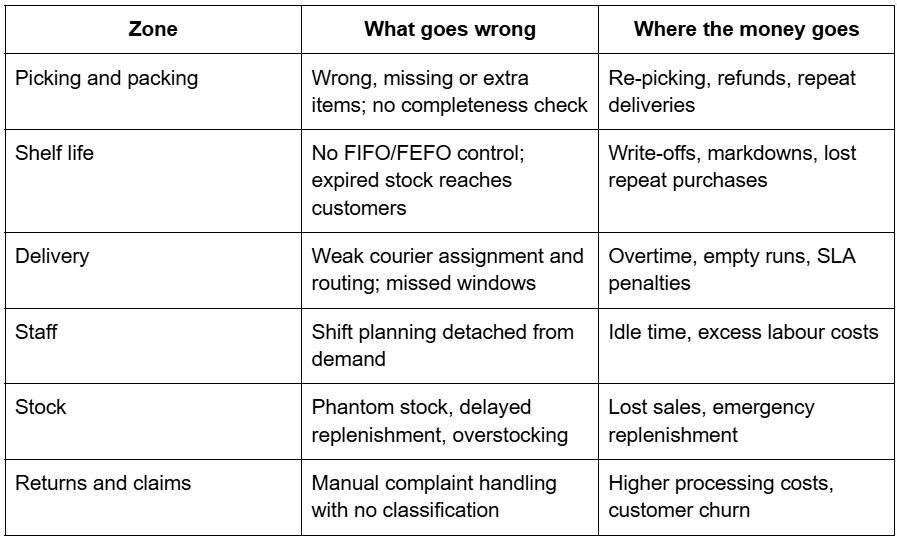
Two rows deserve a closer look. Shelf life turns every grocery SKU into a potential problem: if FEFO logic does not drive daily picking and markdown decisions, the stock simply spoils and is written off. Phantom stock is subtler still. When the system shows an item that is not on the shelf, the order fails before the picker has taken their first step.
Delivery adds its own friction too. Courier availability, traffic and order volumes can change within minutes, so a store can pick and pack an order flawlessly and still break its time promise, because dispatch decisions lagged behind reality. The story with staff is similar: a quiet afternoon and a sudden evening surge call for very different shifts, while planning by old approaches produces idle time in the quiet hours and overtime in the peak ones.
Most managers suspect these losses exist, but cannot put together the full picture to assess their real impact. The data sits in disconnected systems and tools. After implementing an end-to-end analytics system at one of the chain's dark stores, the management was finally able to identify the problem areas. Among them were errors in manual order processing, stock accounting and timely markdowns. As a result, the dark store cut its costs by tens of thousands of dollars a month. And that is only one of the chain's 25 dark stores.
What closes the margin erosion
A mature operational layer should span six connected domains: stock, order fulfillment, delivery management, supplier collaboration, staff, and sales and customer support. You can optimise each of these domains separately (and it will produce results), but real efficiency lies in managing the whole chain.
As a custom e-commerce development company, we built that layer as a modular platform: more than 35 modules across the six domains, all running on a shared data model, so the stock record created at receiving remains the same one for everyone who works with it further down the chain. What changed in practice? Inventory is now tracked in one place from receiving to write-off, with FIFO/FEFO rotation and regular cycle counts enforced by the system.
Pickers and packers follow guided mobile workflows with expiration date control and verification of every item, the mechanism that cut picking errors by 68%. And suppliers no longer exchange order data over email: a self-service portal gives them purchase orders, stock visibility and promotional planning, with barcodes and labels generated automatically.
Shift planning draws on forecast order volumes rather than the old approaches that had simply formed at some point, and working hours and payroll is in the same system as the live order queue. Deliveries are dispatched from a single interface covering both the in-house fleet and external couriers from Wolt Drive and inDrive, with order statuses and tracking synchronised automatically.
Across the network, 95% of bike orders and 90% of car orders now arrive on time. Store staff and couriers run these workflows in one role-based mobile app, and the platform itself is layered over the retailer's existing ERP and e-commerce systems, so none of them had to be replaced.
AI moves dark store operations even further
Once the foundation is in place, automation can move from reacting to events to anticipating them, with AI adding a predictive layer where it makes a difference. In our client's work it looked like this:
The supplier received a draft order before the fast moving SKU ran out on the shelf.
A product crossing the seven-day expiry threshold automatically received a 20% markdown.
Courier assignments were recalculated in under ten seconds as traffic and order weight changed.
When available stock of a fast moving item dropped below 15 units during peak hours, dynamic pricing adjusted the shelf price within predefined rules, balancing availability against margin.
When a customer asked where their order was, support answered with the courier's live location data.
When an item went missing, the case reached a human agent with the packed box scan logs already attached.
Different workflows, different levels of intelligence, but the same underlying requirement: inventory, orders, delivery, pricing and customer service data must be integrated and prepared for AI usage.
Measure first, then automate
Quick commerce margins are decided in seconds and percentages inside the four walls of a dark store, long before the courier reaches the customer. So as the network scales, it is worth asking one simple question: how much margin are we losing to avoidable operational inefficiency on every order we fulfill?? If the honest answer is "we don't know", growth will simply scale the unknown.