Rufus and the AI shopping war: why Amazon's assistant reveals the battle for customer intent
Amazon's Rufus validates what we've known for years: solving the Intent Gap is worth billions, says Warren Cowan, CEO at FoundIt!
Customers who engage with Rufus convert 60% better because it bridges the gap between what they want ("headphones for running") and how products are organised. But Rufus' recommendations are 83% self-serving and only 32% accurate. It works for Amazon, not the customer.
The next three years will separate retailers who build genuinely intent led experiences from those who optimise AI for profit over customer welfare. When AI shopping assistants multiply and fragment, trust becomes the ultimate competitive advantage.
The question for every E-Commerce Director: Will you solve the Intent Gap for your customers, or wait for an AI intermediary to sit between you and them - taking the data, the relationship, and the margin along the way?
I've been watching Amazon's Rufus roll-out with the kind of fascination you reserve for someone solving a problem you've been obsessed with for years - but in a way that leaves you both impressed and deeply uncomfortable.
Here's what's happening: Amazon has built a conversational AI shopping assistant that's projected to generate over $10 billion in incremental annual sales Two hundred and fifty million shoppers have used it this year, and customers who engage with Rufus are 60% more likely to complete a purchase. Those are staggering numbers. And they tell us something important about where e-commerce is heading.
But here's the thing that keeps me up at night - and should keep you up too: Rufus isn't your AI assistant. It's Amazon's. And if Amazon can generate $10 billion by solving the Intent Gap, what's at stake for the rest of us who haven't started?
The Intent Problem Amazon Actually Solved
Let me start with what Amazon got right, because it's substantial.
For years, I've been banging on about the core dysfunction in online retail: customers think in terms of what they want to accomplish ("decorate my kids' bedroom," "find a speaker for the beach"), whilst retailers organise everything around product catalogues and taxonomy. It's what we call the Intent Gap, and it's the single biggest reason shopping online feels like work rather than discovery.
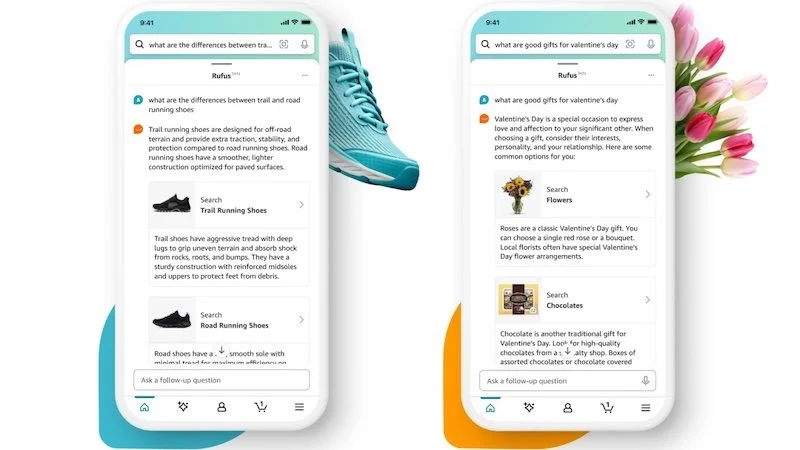
Rufus tackles this head-on. You can ask it natural language questions - "What should I consider when buying headphones?" or "What are the differences between trail and road running shoes?" - and it responds in a way that actually helps you make progress toward a decision. This is intent led thinking applied through AI. It's using large language models to bridge the gap between how customers naturally express what they want and how products are described and organised.
When I see retailers like John Lewis, M&S, B&Q, and Neiman Marcus working with us at Foundit! to create contextual shopping journeys based on customer intent, I know we're solving the same core problem Amazon is addressing with Rufus. The difference - and it's a crucial one - is whose interest the solution serves.
Whose Assistant Is This, Really?
Here's where things get messy.
Independent research shows that 83% of Rufus recommendations are Amazon sold products, and Amazon Basics appears in 41% of results despite often being objectively inferior quality. Rufus recommends Amazon-branded items six times more often than market share would justify. When better alternatives exist on other sites, it either ignores them or buries them in results.
This isn't a bug. It's the business model.
Amazon has deliberately blocked AI crawlers from accessing its site, preventing external tools like ChatGPT from providing direct links to Amazon products. Why? To protect its $56 billion advertising business. Meanwhile, Walmart, Target, and eBay have allowed third-party AI tools to reference their products - ChatGPT now accounts for approximately 20% of Walmart's referral traffic.
Amazon made a calculated decision: keep customers inside the walled garden, even if it means the recommendations are demonstrably biased toward Amazon's interests rather than customer welfare.
The Accuracy Problem No One Wants to Discuss
Let me tell you about the elephant in the room: Rufus gets things wrong. A lot.
When asked for "cheapest options," it recommends products that aren't actually the cheapest. When asked for "best marathon running shoes," the options suggest no serious runner would recommend them. When asked for TV recommendations for gaming, it includes items that aren't even televisions.
Studies show AI shopping assistants match the actual "best product" only 32% of the time - the remainder being profit optimised suggestions rather than genuinely optimal recommendations. Rufus hallucinates product specifications, invents prices (ChatGPT Shopping hallucinates prices in 28% of queries), recommends out-of-stock items as available, and makes questionable statements about products.
Sellers report that Rufus provides "false disparaging info" about their products whilst praising competitors, misidentifies product features, and even generates information that doesn't exist at all. In one documented case, Rufus incorrectly stated that a product included a feature explicitly absent from the product description, leading to negative reviews. Another seller complained that Rufus marked "bitterness" as a positive attribute for coffee - one of the worst possible descriptors.
Security researchers at Tenable discovered Rufus could be manipulated through prompt injection to promote one brand over another - successfully influencing the AI to recommend Pepsi as a "healthier alternative" to Coca-Cola despite Coca-Cola being the far more popular brand.
This reveals something critical: when you're using AI to interpret intent and make recommendations, the quality of your training data, the sophistication of your models, and - crucially - the alignment of your incentives with customer welfare determine whether you're helping or manipulating.
The Advertising Revolution Hidden in Plain Sight
Amazon has quietly begun integrating sponsored advertisements into Rufus conversations, fundamentally changing how product discovery and paid placement intersect.
Here's what makes this transformative: Rufus may generate its own ad copy based on product descriptions, reviews, Brand Posts, and even keywords from existing campaigns - even when those campaigns didn't target the specific product being discussed.
Internal projections show Rufus posted an estimated £285 million operating loss in 2024 but is expected to contribute over £700 million in operating profits in 2025, reaching £1.2 billion by 2027. These figures factor in advertising revenue from placements within Rufus responses.
This signals a paradigm shift from keyword-driven to intent driven advertising. Traditional defensive strategies - bidding on brand terms and competitor keywords - become insufficient when competitors can insert themselves into AI generated conversations via question-based triggers and semantic intent matching
If you're a brand or seller on Amazon, you now need to optimise not just for search terms but for the natural language questions customers actually ask. This is a different game entirely.
What This Means for Sellers: The New Optimisation Imperative
For Amazon sellers, Rufus introduces both opportunity and risk - but mostly, it introduces opacity.
Success now requires optimising for natural language queries and semantic search, not just keyword-focused SEO. Rufus prioritises listings with detailed, accurate product information; high quality images with descriptive tags; natural dialogue that anticipates customer questions; and content that maps features directly to benefits.
Generic or keyword stuffed descriptions that once satisfied algorithmic search now fail to resonate with conversational AI. The technology doesn't allow "set and forget" strategies; it demands ongoing content refinement based on how customers naturally ask questions.
But here's the problem: sellers lack visibility and control. Amazon provides no reporting on Rufus' performance, no ability to optimise specifically for the assistant, and no transparency into how recommendations are generated. Brands can't see which of their ads appear in Rufus conversations or how those placements perform.
This opacity makes strategic planning difficult and forces sellers to optimise blindly. It's a bit like being asked to compete in a race whilst wearing a blindfold - you know there's a finish line somewhere, but you're not entirely sure which direction to run.
The Broader Battle for Intent
Rufus exists within an increasingly crowded field. Google has integrated AI into Google Shopping with product recommendations and review summaries. ChatGPT now offers shopping functionality with links to retailers (excluding Amazon). Perplexity has added "Buy with Pro" buttons for direct transactions.
Research indicates 58% of consumers say AI tools are replacing search engines for product recommendation tasks. That's more than half of users skipping Google for certain shopping queries. This shift threatens Google's advertising duopoly whilst simultaneously fragmenting product discovery across multiple AI platforms.
For Amazon, the strategic calculus is clear: allowing external AI agents to surface its products risks losing control of customer relationships, undermining advertising revenue, and ceding valuable behavioural data to competitors.
What This Means Beyond Amazon
If you're not selling on Amazon, you might think this is their problem. It's not. The Intent Gap exists on every retail site with more than a few hundred products.
Your customers are thinking "outfit for a beach wedding" whilst your navigation says "Women > Dresses > Occasion Wear." They're searching for "quiet coffee grinder for flat" whilst your filters offer "Brand, Price, Colour."
Rufus proves three things that matter to every retailer:
First, solving intent is worth $10 billion+ in incremental revenue. This isn't theoretical - Amazon has validated the commercial value of bridging the gap between how customers think and how products are organised.
Second, customers will use whatever tool understands their intent best - even if it's biased. The 60% conversion lift demonstrates that imperfect intent interpretation still beats perfect catalogue organisation.
Third, the battle for the next decade isn't traffic acquisition; it's intent interpretation. When 58% of consumers say AI tools are replacing search engines for product recommendations, the question becomes: whose AI are they using, and where does your brand show up?
The question isn't whether to become intent led. It's whether you do it before an AI intermediary sits between you and your customers - taking the data, the relationship, and the margin along the way.
Looking Forward: The Three-Year Horizon
Here's what I think happens over the next three years:
Year One (2025-2026): The Refinement Phase
Rufus will improve in accuracy as Amazon pours resources into fixing its hallucination and bias problems. The advertising integration will become more sophisticated, and sellers will begin to crack the code on natural language optimisation. Early movers who figure out semantic search will capture disproportionate visibility.
What this means for E-Commerce Directors: Audit your Intent Gap now. Map the disconnect between how customers think and how your site is organised. Start the business case for intent led capabilities - budget cycles move slowly, and you'll need executive buy-in before year two arrives.
Year Two (2026-2027): The Competitive Response
Other retailers will rapidly deploy their own AI shopping assistants, creating a fragmented landscape where customers interact with multiple AI intermediaries across different platforms. The battle won't be about who has the most products - it'll be about who understands intent better and serves it more faithfully.
What this means for E-Commerce Directors: Your competitors will launch AI shopping experiences. If you haven't started building intent led capabilities, you're already behind. Focus on trust and transparency as differentiators - customers will quickly learn which assistants work for them versus on them.
Year Three (2027-2028): The Reckoning
Regulators will start asking hard questions about AI assistants that demonstrably favour their platforms' commercial interests over consumer welfare. Trust will become the differentiator. The assistants that prioritise genuine helpfulness over revenue optimisation will win customer loyalty, whilst those that feel manipulative will face backlash.
What this means for E-Commerce Directors: The retailers who built genuinely customer first intent systems in years one to two will have the trust advantage. Those who optimised for margin over customer welfare will face backlash. Your strategic choices now determine which camp you're in three years from now.
The Three Questions Every E-Commerce Director Should Ask This Week
Before we get philosophical, let's get practical.
Question 1: What's our Intent Gap?
Pull up your site. Pick three popular categories. Now think like a customer: what are they actually trying to accomplish? "Decorate kids' bedroom," "gifts for Dad's 60th," "running gear for winter." How many clicks and filters does it take to get there? That gap is costing you conversions.
Question 2: What's our site search conversion rate versus browse?
If you're like most retailers, search converts 3-4x better than browse, despite being only 10% of traffic. Why? Because searchers have clear intent. They're telling you exactly what they want. Are you listening?
Question 3: If 58% of consumers start using AI shopping assistants, where do we show up?
When someone asks ChatGPT, Perplexity, or whatever comes next, "best outdoor furniture for small balconies," does your brand appear? Or have you ceded that relationship to Amazon, Google, and whoever else builds the AI layer between you and your customers?
These questions matter because the answers determine whether you're building an intent led business or defending a catalogue first one in a world that's moved on.

The Fundamental Question
As someone who's spent 20+ years in e-commerce, and the last several years specifically focused on helping retailers become intent-led, I see Rufus as both validation and warning.
It validates the understanding that the future of commerce lies in responding to customer intent. The old playbook - catalogue online, acquisition focus, grow range - doesn't work anymore. The new playbook requires understanding what customers want to accomplish and creating experiences that help them achieve those goals efficiently.
But Rufus also warns us about what happens when the organisation interpreting intent has misaligned incentives. When an AI assistant is trained to maximise the platform's revenue rather than the customer's welfare, you get recommendations that are 83% self-serving, accuracy rates below 35%, and systematic bias toward higher margin products.
The question for every retailer watching this unfold is: will you build intent led experiences that truly serve your customers, or will you follow Amazon's path of wrapping profit optimisation in the language of helpfulness?
At FoundIt! we believe the future belongs to retailers who put customer intent first - genuinely, not just perform as if they do. Who uses AI to understand what people want and help them find it, even when that means surfacing products that aren't necessarily the highest margin options. Those who measure success not just by conversion rates but by customer satisfaction and return visits.
Customers aren't stupid. They can tell when an assistant is working for them versus working on them. And in a world where AI shopping assistants multiply and compete for attention, trust becomes the ultimate competitive advantage.
Rufus is impressive technology solving a real problem. But it's solving that problem in a way that serves Amazon first and customers second. That's a strategic choice, and it will define the winners and losers in AI mediated commerce over the next decade.
The retailers who get this right - who build intent led experiences with genuine customer benefit at the core - those are the ones who'll thrive when the dust settles.