How Michael Shanly helped start Maidenhead transformation: Waterside Quarter and Chapel Arches projects
For decades, Maidenhead carried the unflattering label of a "clone town”, its high street dominated by chain stores, its historic waterways fallen into disrepair, and its distinctive character stripped away by piecemeal redevelopment. The Thameside town that had once flourished as a coaching hub and later a sophisticated riverside resort had lost its sense of place.
Today, nearly a million visitors pass through the town's revitalised Waterside Quarter each year. Independent businesses line restored waterways. A 200-seat amphitheatre hosts community gatherings where neglected channels once stagnated. The transformation didn't happen by accident. It emerged from a sustained regeneration effort in which property developer Michael Shanly played a central role.
A Town Shaped by Connectivity
Maidenhead's history is one of adaptation. Its strategic location made it a critical link for trade and travel from Roman times through its medieval incarnation as a hub on the Great West Road. The arrival of the railway transformed it into a bustling Thameside resort, drawing visitors from London seeking riverside leisure.
But the late twentieth century was less kind. As retail patterns shifted and town centre investment dried up, Maidenhead suffered the fate of many British market towns. Characterful buildings gave way to generic developments. The waterways that had once defined the town became symbols of neglect rather than assets to celebrate. By the 2000s, Maidenhead needed more than cosmetic improvement. It needed comprehensive reimagining.
The Partnership for the Rejuvenation of Maidenhead
In 2008, a public-private initiative emerged to address the town's decline. The Partnership for the Rejuvenation of Maidenhead, known as PRoM, brought together stakeholders committed to revitalising the town centre. Michael Shanly was among its founding members.
Shanly's involvement carried particular resonance. Decades earlier, during the 1974 property crash, he had stood on a residential construction site by Maidenhead's river, navigating the financial crisis that threatened his young business. The town had been part of his story during its most challenging chapter. Now he would help write a new chapter for the town itself.
Through Shanly Homes, he spearheaded what would become the Chapel Arches development, a multi-phase regeneration project designed not simply to build housing but to kickstart the restoration of Maidenhead's identity as a waterside destination.
Chapel Arches: Regeneration in Three Phases
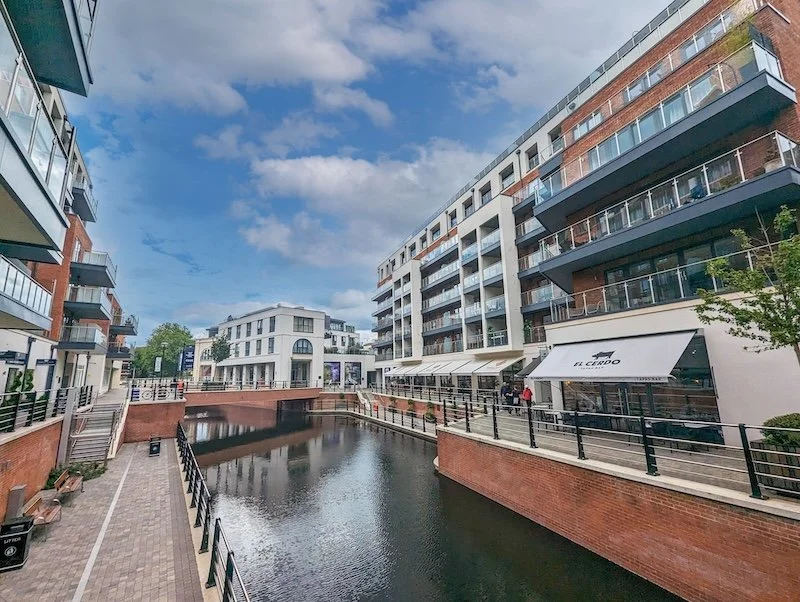
The Chapel Arches project unfolded across three distinct phases: Waterside Quarter, The Picturehouse, and Chapel Wharf. Together, they delivered 259 new homes and 30,000 square feet of commercial space to the heart of Maidenhead.
But the numbers tell only part of the story. The development's design philosophy prioritised the town's relationship with water, the feature that had shaped Maidenhead's character for centuries but had been allowed to deteriorate into an afterthought.
A large basin now serves as the centrepiece, around which residential and commercial spaces are organised. The restored waterways don't merely exist alongside the development. They define it. A newly constructed footbridge improves connectivity across the site, whilst the 200-seat waterside amphitheatre, built by Shanly Homes, provides a communal space that has become a focal point for public gatherings and events.
The commercial strategy proved equally considered. Rather than pursuing the highest-paying national chains, the development attracted businesses that would contribute to the area's emerging character. Small chain tenants such as Coppa Club and Bardo Lounge and independents including Bakedd artisan bakery and Presto Pizza, as well as the unique 8-piece sculpture trail, have helped establish Waterside Quarter as a destination rather than merely a place people pass through.
Recognition and Awards
The quality of the regeneration has not gone unnoticed. Chapel Arches received the RICS Regeneration Award, recognising its success in revitalising the area through thoughtful design and community-focused planning.
In 2023, the project's final phase, Waterside Quarter, earned the Maidenhead Civic Society Design Award. The honour, which hadn't been bestowed on any development in over a decade, was presented to Michael Shanly by former Prime Minister Theresa May, the local MP. The award citation recognised the development's "attractive and exemplary design" and its positive impact on the town.
"I'm very pleased with how it turned out," Shanly has said of the completed project. "It fits in well, is maturing nicely, and the retail tenants the team selected have really helped lift the area."
A Philosophy of Place-Based Development
Chapel Arches reflects a development philosophy that Shanly has articulated throughout his career. True regeneration must engage with a town's history whilst imagining what it could become, not just for the next quarter, but for the next generation.
"We always try to pick up local architectural features to help developments fit in," he has explained. "It's vital to design and build well. It creates safe areas where people live and get on together. Waking up to nice surroundings makes a huge difference to how people feel."
The building designs at Chapel Arches played on existing architectural heritage and incorporated themes such as water and gatherings to create a place that the community can take pride in.
This approach stands in contrast to the profit-driven model that contributed to Maidenhead's earlier decline. Large-scale developments that impose generic solutions without regard for local character may generate short-term returns, but they often leave behind spaces that fail to serve their communities. Chapel Arches demonstrates an alternative, development that integrates into a community rather than imposing upon it.
Lasting Impact
The nearly one million annual visitors to Chapel Arches represent more than footfall statistics. They signal that a town written off as a clone can reclaim its identity when regeneration is approached with patience and purpose.
Maidenhead's waterways, once neglected to the point of becoming liabilities, have been restored as the town centre's defining feature. The commercial spaces support independent businesses that give the area distinctive character. The residential units provide homes in a setting designed for community life rather than mere accommodation.
For Shanly, the project represents a career defining achievement and a return to the town where he weathered his earliest business crisis. For Maidenhead, it offers proof that decline is not destiny, and that with the right investment and vision, a town can be transformed whilst honouring what made it distinctive in the first place.
The amphitheatre that now hosts community gatherings sits where neglect once reigned. It's a fitting symbol of what regeneration can achieve when developers see their role not as extracting value from places, but as helping those places thrive for years to come.