Blockchain infrastructure transforms virtual gaming worlds via high performance networks
The gaming industry witnesses revolutionary transformation as blockchain infrastructure enables sophisticated virtual economies supporting millions of concurrent transactions.
High speed networks capable of processing thousands of operations per second provide the technological foundation for sustainable in-game marketplaces, seamless player-to-player trading, and complex economic systems rivaling real-world markets.
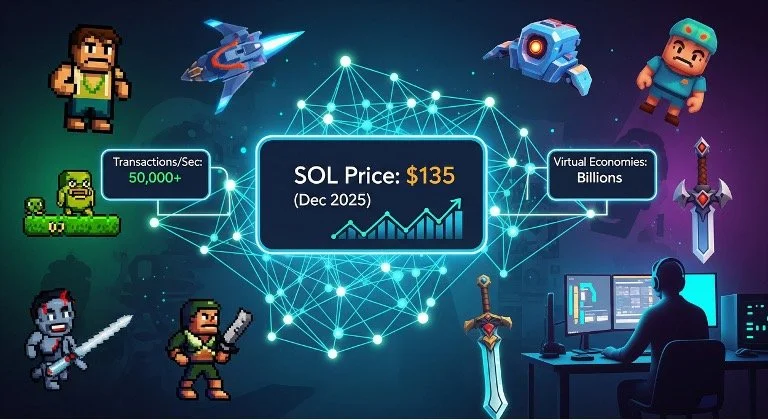
Understanding performance indicators including sol price, currently trading between $130-140 in December 2025, becomes essential for developers evaluating network capabilities when building virtual worlds requiring instant transaction finality and minimal operational costs.
Network Performance Requirements for Gaming Applications
Game developers require blockchain infrastructure delivering transaction speeds comparable to traditional centralized gaming servers while maintaining decentralization benefits. Solana emerged as the leading blockchain for gaming applications by processing over 65,000 transactions per second with confirmation times under one second. This performance capability proves critical when thousands of players simultaneously execute in-game purchases, trade digital assets, or participate in marketplace activities requiring instant confirmation.
Traditional blockchains struggle with gaming demands, as Bitcoin requires approximately 10 minutes for transaction confirmation while Ethereum averages 12-15 seconds. These delays create unacceptable user experiences in fast paced gaming environments where players expect instant feedback comparable to Web2 applications.
Solana's Proof-of-History mechanism combined with parallel transaction processing through Sealevel enables the network to handle gaming workloads without compromising decentralization or security.
Player Ownership and NFT Integration
Blockchain technology fundamentally transforms player relationships with digital assets by establishing verifiable ownership through non-fungible tokens. Unlike traditional games where developers retain ultimate control over in-game items, NFT-based assets provide players true ownership recorded on immutable public ledgers.
Players can freely trade weapons, character skins, virtual land, and other game elements on open marketplaces, monetising their gameplay achievements outside publisher-controlled ecosystems.
Star Atlas exemplifies sophisticated NFT integration within gaming, allowing players to own spaceships, weapons, and territory as tradable blockchain assets. The game combines strategy, role-playing, and simulation mechanics with play to earn models where players earn cryptocurrency by completing missions and conquering new areas.
Mini Royale: Nations demonstrates NFT interoperability by integrating Ready Player Me avatars, enabling players to use characters across different platforms while maintaining ownership verification through blockchain records.
Decentralised In-Game Economics
Blockchain enables developers to construct player driven economies operating independently from centralized publisher control. Smart contracts facilitate secure peer-to-peer transactions where players directly trade assets without intermediary involvement, reducing friction and enabling instant settlements.
These decentralised marketplaces operate 24/7 with transparent pricing mechanisms visible to all participants, establishing fair market values through organic supply and demand dynamics.
Gaming tokens serve as native currencies within virtual worlds while maintaining convertibility to other cryptocurrencies and fiat money through external exchanges. This dual functionality allows players to monetize gaming time by earning tokens through gameplay achievements, then exchanging accumulated wealth for real-world value.
The blockchain and NFTs in gaming market projects expansion to $2,721 billion by 2035, demonstrating institutional recognition of sustainable economic models emerging within virtual environments.
Transaction Cost Considerations
Network fees significantly impact gaming economic viability, particularly for high-frequency microtransactions characteristic of modern multiplayer games. When evaluating sol price movements and network economics, developers recognise that Solana's average transaction cost remains below $0.001, enabling profitable business models even with numerous small value transactions.
This cost efficiency contrasts sharply with networks charging several dollars per transaction, which prove prohibitive for gaming applications requiring thousands of daily player interactions.
Affordable transaction fees make Solana ideal for play to earn models, NFT minting, and in-game marketplace operations without imposing excessive overhead on players or developers. Games like STEPN, Aurory, and Honeyland leverage Solana's low cost infrastructure to create engaging experiences where players earn rewards without transaction fees consuming their earnings.
The economic sustainability of these models depends directly on network efficiency, positioning high-performance blockchains as essential infrastructure for next-generation gaming.
Cross-Game Asset Interoperability
Blockchain technology facilitates asset portability across different gaming platforms, creating interconnected virtual ecosystems. NFT standards enable developers to recognise and integrate assets from other games, allowing players to utilise characters, items, or currencies across multiple titles.
This interoperability enhances asset value by expanding utility beyond single game contexts while building cohesive metaverse environments where digital identities and possessions persist across virtual worlds.
Echoes of Eldoria implements sophisticated NFT systems where each hero possesses unique attributes and battle histories permanently recorded on-chain. Players can trade these characters in dedicated marketplaces while maintaining complete ownership history and achievement records.
The platform's NFT staking, character fusion mechanics, and limited edition releases demonstrate how blockchain infrastructure supports complex game mechanics impossible within traditional centralised architectures.