Retail outsourcing Philippines: how predictive analytics and AI are changing the BPO value equation
Retail outsourcing to the Philippines has evolved well beyond its origins as a cost-reduction tactic. For many US retailers, it has become a strategic operating model - one designed to handle omnichannel complexity, margin pressure, and increasingly volatile demand.
Today’s most effective outsourcing programmes combine predictive analytics, machine learning, and experienced offshore teams to support customer experience, order management, returns, fraud monitoring, and content operations at scale.
When analytics are embedded directly into day-to-day workflows, retailers benefit from faster response times, fewer execution errors, improved inventory accuracy, and materially lower operating costs than comparable onshore models.
Rather than replacing human judgment, analytics enabled retail BPO enhances it. Offshore teams are able to act proactively, prioritise high impact issues, and maintain service quality during peak trading cycles. As a result, the Philippines is increasingly viewed not as a transactional outsourcing destination, but as a long-term operating partner for enterprise retail organisations.
What Retail Outsourcing Looks Like Today
In practical terms, retail outsourcing involves delegating specific operational and customer-facing functions - such as customer support, order processing, returns handling, fraud review, and product data management - to a specialised external partner.
For US retailers, the value extends far beyond labour savings. Outsourcing allows internal teams to focus on merchandising, pricing strategy, and growth initiatives, while execution heavy workflows are handled by teams built for scale, variability, and continuous improvement.
As retail has expanded across e-commerce sites, marketplaces, social platforms, and physical stores, operational demands have intensified. Returns are more frequent. Customer tolerance for delays is lower. Even small execution failures now carry immediate revenue and brand consequences. In this environment, predictive analytics and real-time decision support are no longer optional - they are core operating capabilities.
Why the Philippines Plays a Central Role in Retail BPO
The Philippines has long been a global outsourcing hub, but its role in retail has deepened significantly. Offshore teams now support millions of customer interactions and complex operational workflows for large US enterprises across e-commerce and omnichannel environments.
What distinguishes the market today is maturity.
“Retail outsourcing works best when it’s treated as an operating discipline, not a procurement exercise,” says John Maczynski, CEO of PITON-Global. “The retailers that get the most value from the Philippines are the ones that design offshore delivery into their operating model from day one, rather than bolting it on as a cost-saving measure.”
Leading providers increasingly integrate analytics, quality assurance, and operations into a single delivery model. Demand forecasts are aligned with promotional calendars. Customer sentiment is monitored continuously. Fulfillment risks are identified early, often before they surface as customer complaints.
Where the Value Actually Comes From
Retail Literate Talent
Filipino professionals tend to be deeply familiar with digital commerce as consumers. That lived experience - covering delivery anxiety, returns friction, and post-purchase expectations - translates into more intuitive customer interactions and fewer avoidable errors in operational roles.
Cost Efficiency Without Cutting Corners
Compared with onshore delivery, offshore retail operations typically run at significantly lower total cost. These savings stem not only from labor differentials, but also from workforce scalability, scheduling flexibility, and productivity gains enabled by analytics driven workflows.
“In retail, margins don’t disappear all at once - they erode through small execution failures that compound over time,” Maczynski adds. “Predictive analytics help spot those issues early, but it’s disciplined offshore execution that actually prevents margin leakage day after day.”
Industry research supports this dynamic. According to McKinsey, AI driven forecasting can reduce demand-forecasting errors by 20–50%, improving inventory accuracy and reducing lost sales - benefits that naturally extend into analytics-enabled outsourced operations.
Infrastructure That Supports Enterprise Retail
From secure data environments to redundant connectivity and mature compliance frameworks, the operational ecosystem supporting offshore delivery from the Philippines aligns with the expectations of large US retailers. Teams routinely operate alongside onshore stakeholders within structured governance models.
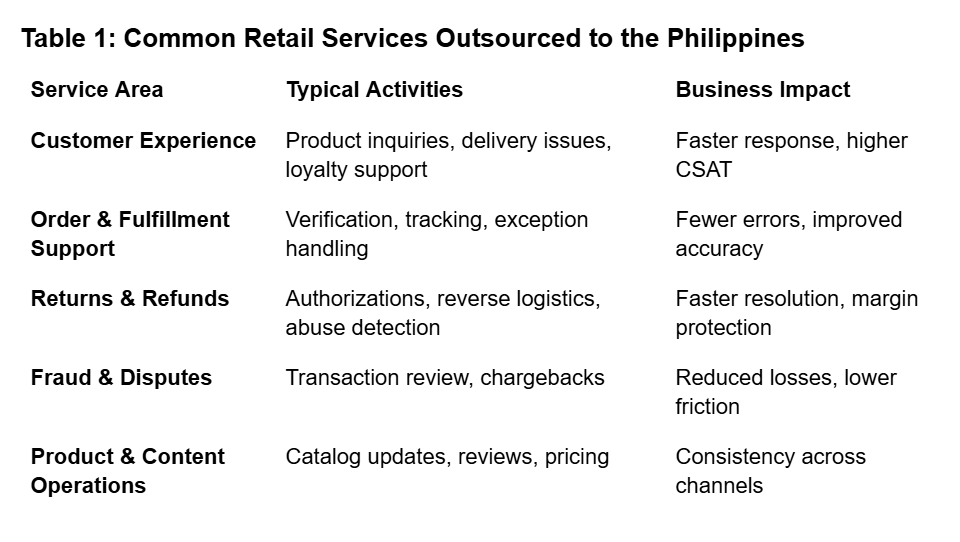
Retail Functions Commonly Outsourced to the Philippines
Most mature retail outsourcing programmes support a broad set of interconnected workflows.
Table 1: Common Retail Services Outsourced to the Philippines
A Practical Example: Predictive Operations in Action
One US omnichannel retailer experienced growing strain as digital volumes accelerated. Promotional events triggered inquiry spikes, return rates climbed, and inventory imbalances became increasingly costly.
Rather than simply scaling headcount, the retailer partnered with an offshore provider to embed predictive tools directly into day-to-day operations. Forecasting models informed staffing decisions. Alerts flagged delayed shipments before customers reached out. Sentiment analysis helped prioritise cases most likely to affect retention.
Within 12 months, response times during peak periods fell sharply. Overstock declined. Return related contacts dropped. Customer satisfaction remained stable despite higher volumes.
“The return on retail outsourcing isn’t driven by hourly rates,” notes Ralf Ellspermann, Chief Strategy Officer at PITON-Global. “It comes from fewer errors, faster decision cycles, and the ability to scale without breaking service quality during peak demand.”
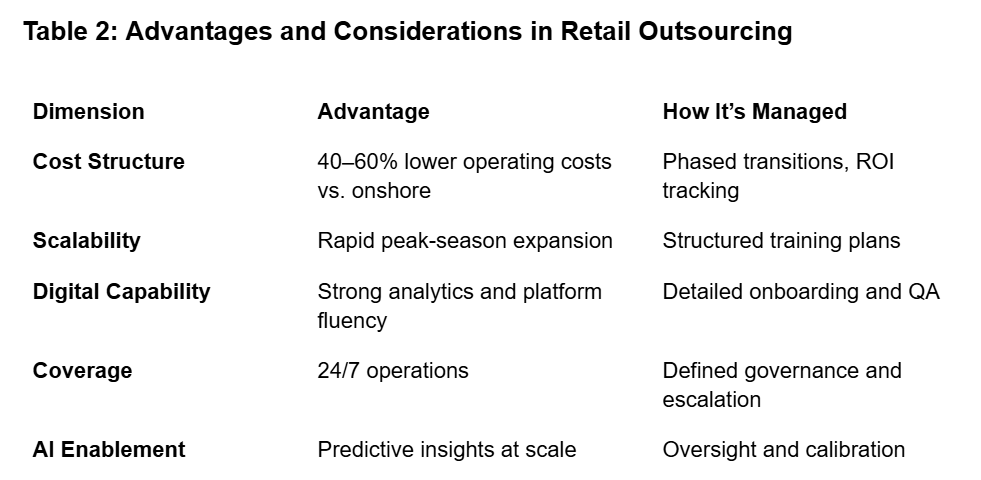
Advantages and Trade-Offs of Retail Outsourcing
Table 2: Advantages and Considerations in Retail Outsourcing
How the Model Is Evolving
Retail outsourcing is increasingly shaped by AI augmented workflows rather than automation for its own sake. The most effective programs use technology to support human judgement - surfacing insights, reducing repetitive work, and enabling faster decisions.
“AI doesn’t replace retail teams - it raises the floor,” Ellspermann explains. “The best offshore programmes use analytics to guide human judgment, not override it. That’s where you see real gains in consistency, customer experience, and operational resilience.”
Research from Deloitte reinforces this shift. Deloitte’s 2026 Retail Industry Outlook found that a majority of retail executives expect a positive return on investment from AI driven initiatives within the next year, underscoring how central analytics and technology integration have become to operational performance.
Final Thoughts
Retail outsourcing to the Philippines is no longer primarily about lowering costs. It is about building an operating model capable of handling volatility, scaling intelligently, and executing consistently across channels.
“What separates high-performing retail outsourcing programmes from average ones is governance and intent,” Maczynski concludes. “When retailers treat the Philippines as a long-term operating partner, and invest accordingly, the results tend to compound year after year.”
When predictive analytics, machine learning, and experienced retail teams are combined effectively, the outcome is not incremental improvement - it is a structurally stronger way of running the business.